存货成本
重要
此文档适用于Odoo 19或更高版本。 了解版本间的改变。
存货计价方法
Odoo支持三种存货计价方法,在会计设置中配置,可选择产品类别。
- Standard Cost: fixed unit cost, updated manually
作业
单位成本
在手数量
差异值
存货成本
$10
0
$0
接收8个 @$10
$10
8
+8×$10
$80
接收4个 @$16
$10
12
+4×$10
$120
发货 10
$10
2
-10×$10$20
接收2个 @$9
$10
4
+2×$10
$40
- Average Cost: weighted average of all units
作业
单位成本
在手数量
差异值
存货成本
$0
0
$0
接收8个 @$10
$10
8
+8×$10
$80
接收4个 @$16
$12
12
+4×$16
$144
发货 10
$12
2
-10×$12$24
接收2个 @$6
$9
4
+2×$6
$36
- FIFO: first in, first out
作业
单位成本
在手数量
差异值
存货成本
$0
0
$0
接收8个 @$10
$10
8
+8×$10
$80
接收4个 @$16
$12
12
+4×$16
$144
发货 10
$16
2
-8×$10-2×$16$32
接收2个 @$6
$11
4
+2×$6
$44
注解
下架策略还支持 LIFO(后进先出) 和 FEFO(先到期先出) ,但它们只影响优先拣选哪种产品,而不影响计价方法。例如,您可以按 LIFO 方式拣货,同时采用平均成本计价,因为 IFRS(国际财务报告准则) 不允许使用 LIFO 计价。
库存与会计
库存应用程序 会在您 接收和发货商品 时实时跟踪库存价值。通过报告菜单,您可以按公司、位置、产品等维度分析库存数量和价值。
会计应用 会更新账户,当您 收到发票或账单 时。虽然收据和发票不同,但是对于会计来说,对每个库存移动都进行日记账是不实际的。因此,他们会生成结账条目来记录发票和收據/发货之间的差异。这个结账过程通常一年一次,对于中小企业来说,或者每月一次。
会计 |
仓储物流 |
|
|---|---|---|
采购订单 |
/ |
/ |
收货 |
/ |
✓ |
供应商账单 |
✓ |
/ |
销售订单 |
/ |
/ |
客户结算单 |
✓ |
/ |
交货 |
/ |
✓ |
期末分录 |
✓ |
/ |
会计方法
关于如何维护您的账户,有两种会计实务,定义于 的 Inventory Valuation 部分:
定期法: 将供应商账单按费用性质过账为费用,并在结账分录中通过减少费用(库存变动)来更新库存估值。这是欧洲的最佳实践。
永续法: 将供应商账单作为资产(库存估值)过账,在货物售出时报告费用(销货成本)。这是遵循盎格鲁-撒克逊会计的国家(如美国和印度)的最佳实践。
产品类别上的 Stock Account
库存账户上的 Stock Variation
产品/类别上的 Expense/Cost of Goods Sold
库存损耗(Inventory Loss)区位上的 Inventory Adjustment (可选,推荐用于盎格鲁-撒克逊会计)
库存账户上的 Expense (仅用于永续欧陆会计)
更多内容
存货成本:有关配置存货估值所涉会计方面的更详细说明。
库存移动与库存操作的估值:有关库存移动和调整对存货估值影响的更多信息。
欧盟定期法 |
欧盟永续法 |
美国定期法 |
美国永续法 |
|
|---|---|---|---|---|
调整 |
Stock |
Stock |
||
LOSS |
Shrinkage |
|||
账单 |
Expense |
Stock |
COGS |
Stock |
Payable |
Payable |
Payable |
Payable |
|
发票 |
Expense |
COGS |
||
Stock |
Stock |
|||
Income |
Income |
Income |
Income |
|
Receivable |
Receivable |
Receivable |
Receivable |
|
关闭 |
Stock |
Stock |
Stock |
Stock |
[1] |
Variation |
Expense |
Variation |
Variation |
[2] |
LOSS |
Shrinkage |
||
[3] |
Variation |
|||
Expense |
库存估值 - 会计估值
库存估值损失,仅当在损耗区位上设置了账户时适用
期末会计估值 - 期初估值
会计分录
Choose a standard:
Continental (Expenses = Purchase Expenses)
Anglo-Saxon (Expenses = Cost of Goods Sold)
Choose an accounting method:
Periodic: focuses on expenses by nature
Perpetual: focuses on inventory value
Activate operations to see the impact:
Initial Inventory (Goods for Resale $50)
Supplier Goods Reception (PO $50, Bill $50)
Supplier Bill (PO $50, Bill $50)
Supplier Goods Reception (PO $48, Bill $50)
Supplier Bill (PO $48, Bill $50)
Customer Shipping (SO $100, Invoice $100, Good Value $50)
Customer Invoice (SO $100, Invoice $100, Good Value $50)
Manufacturing Order (Finished Product at $52, Component at $50)
Inventory Loss (Scrap $30)
关闭
Bill To Receive
Invoices To Be Issued
Billed Not Received
Invoiced Not Delivered
Inventory Valuation
Debit |
Credit |
Balance |
|
|---|---|---|---|
1 Equity and Liabilities |
|||
2 Fixed Assets |
|||
3 Stock (Current Assets) |
|||
300000 Inventory Raw Materials |
|||
320000 Work in Progress |
|||
330000 Inventory Finished Goods |
|||
340000 Inventory Goods Purchase for Resale |
|||
4 Receivables and Payables |
|||
400000 Customers |
|||
411000 VAT Recoverable |
|||
414000 Income Receivable |
|||
440000 Suppliers |
|||
444000 Invoices to Be Received |
|||
451000 VAT Payable |
|||
490000 Deferred Charges |
|||
493000 Deferred Income |
|||
5 Financial Accounts and Cash |
|||
6 Expenses |
|||
600000 Raw Materials |
|||
600200 Cost of Finished Goods |
|||
604000 Goods for Resale |
|||
609000 Decrease (Increase) in Stocks of Raw Materials |
|||
609400 Decrease (Increase) in Stocks of Goods Purchased for Resale |
|||
7 Revenues |
|||
700000 Sales |
|||
712000 Increase (Decrease) in Stocks of Work in Progress |
|||
713000 Increase (Decrease) in Stocks of Finished Goods |
|||
General Balance for Inventory Initial Value |
Debit |
Credit |
Balance |
|
|---|---|---|---|
1 Assets |
|||
101401 Bank |
|||
110100 Inventory |
|||
110101 Raw Materials Inventory |
|||
110102 Manufactured Products Inventory |
|||
110400 Cost of Production |
|||
110600 Inventory Variations |
|||
121000 Accounts Receivable |
|||
121200 Uninvoiced Receivable |
|||
128000 Prepaid Expenses |
|||
131000 Tax Paid |
|||
2 Liabilities |
|||
211000 Accounts Payable |
|||
211100 Bills to Receive/Goods Received Not Invoiced |
|||
212000 Deferred Revenue |
|||
251000 Tax Received |
|||
3 Equity |
|||
303000 Common Stock |
|||
4 Revenue |
|||
400000 Product Sales |
|||
5 Expenses |
|||
500000 Cost of Goods Sold |
|||
530000 Price Difference |
|||
609100 Inventory Loss Expense |
|||
609000 Miscellaneous Expenses |
|||
General Balance for Inventory Initial Value |
会计凭证配置
Choose a standard:
Continental (Expenses = Purchase Expenses)
Anglo-Saxon (Expenses = Cost of Goods Sold)
Choose an accounting method:
Periodic: focuses on expenses by nature
Perpetual: focuses on inventory value
Activate operations to see the impact:
Initial Inventory (Goods for Resale $50)
Supplier Goods Reception (PO $50, Bill $50)
Supplier Bill (PO $50, Bill $50)
Supplier Goods Reception (PO $48, Bill $50)
Supplier Bill (PO $48, Bill $50)
Customer Shipping (SO $100, Invoice $100, Good Value $50)
Customer Invoice (SO $100, Invoice $100, Good Value $50)
Manufacturing Order (Finished Product at $52, Component at $50)
Inventory Loss (Scrap $30)
关闭
Bill To Receive
Invoices To Be Issued
Billed Not Received
Invoiced Not Delivered
Inventory Valuation
Account |
Debit |
Credit |
|---|---|---|
340000 Inventory Goods Purchase for Resale |
50 |
|
General Balance for Inventory Initial Value |
50 |
配置
Stock Account: defined on the product category
Account |
Debit |
Credit |
|---|---|---|
110100 Inventory |
50 |
|
General Balance for Inventory Initial Value |
50 |
配置
Stock Account: defined on the product category
Explanation
In a periodic inventory valuation, goods’ receipts are not directly posted in the accounting.
The inventory value is updated when entries are generated from Inventory Valuation report at closing.
Explanation
In a perpetual inventory valuation, goods receipts are not directly posted in the accounting.
The inventory value is updated:
when the invoice/bill is posted
when entries are generated from Inventory Valuation report at closing
Account |
Debit |
Credit |
|---|---|---|
604000 Goods for Resale |
50 |
|
440000 Suppliers |
54.5 |
|
411000 VAT Recoverable |
4.5 |
配置
Account Payable: defined on the supplier contact
Tax Account: defined on the account from the Purchase Taxes set on the product
Expense Account: defined on the product/product category
Account |
Debit |
Credit |
|---|---|---|
340000 Inventory Goods Purchase for Resale |
50 |
|
440000 Suppliers |
54.5 |
|
411000 VAT Recoverable |
4.5 |
配置
Stock Account: defined on the product category
Account Payable Account: defined on the supplier contact
Tax Account: defined on the account from the Purchase Taxes set on the product
Account |
Debit |
Credit |
|---|---|---|
500000 Cost of Goods Sold |
50 |
|
211000 Accounts Payable |
54.5 |
|
131000 Tax Paid |
4.5 |
配置
Account Payable: defined on the supplier contact
Tax Account: defined on the account from the Purchase Taxes set on the product
Expense Account: defined on the product/product category
Account |
Debit |
Credit |
|---|---|---|
110100 Inventory |
50 |
|
211000 Accounts Payable |
54.5 |
|
131000 Tax Paid |
4.5 |
配置
Account Payable: defined on the supplier contact
Tax Account: defined on the account from the Purchase Taxes set on the product
Expense Account: defined on the product/product category
Explanation
In a periodic inventory valuation, goods shipments are not directly posted in the accounting.
The inventory value is updated when entries are generated from Inventory Valuation report at closing.
Explanation
In a perpetual inventory valuation, goods shipments are not directly posted in the accounting.
The inventory value is updated:
when the invoice/bill is posted
when entries are generated from Inventory Valuation report at closing
Account |
Debit |
Credit |
|---|---|---|
400000 Customers |
109 |
|
451000 VAT Payable |
9 |
|
700000 Sales |
100 |
配置
Account Receivable Account: defined on the customer contact
Tax Account: defined on the account from the Sales Taxes set on the product
Income Account: defined on the product/product category
Account |
Debit |
Credit |
|---|---|---|
340000 Inventory Goods Purchase for Resale |
50 |
|
604000 Goods for Resale |
50 |
|
400000 Customers |
109 |
|
451000 VAT Payable |
9 |
|
700000 Sales |
100 |
配置
Stock Account: defined on the product category
Expense/COGS Account: defined on the product/product category
Account Receivable Account: defined on the customer contact
Tax Account: defined on the account from the Sales Taxes set on the product
Income Account: defined on the product/product category
Account |
Debit |
Credit |
|---|---|---|
121000 Accounts Receivable |
109 |
|
251000 Tax Received |
9 |
|
400000 Product Sales |
100 |
配置
Account Receivable Account: defined on the customer contact
Tax Account: defined on the account from the Sales Taxes set on the product
Income Account: defined on the product/product category
Account |
Debit |
Credit |
|---|---|---|
110100 Inventory |
50 |
|
500000 Cost of Goods Sold |
50 |
|
121000 Accounts Receivable |
109 |
|
251000 Tax Received |
9 |
|
400000 Product Sales |
100 |
配置
Stock Account: defined on the product category
Expense/COGS Account: defined on the product/product category
Account Receivable Account: defined on the customer contact
Tax Account: defined on the account from the Sales Taxes set on the product
Income Account: defined on the product/product category
Explanation
In a periodic inventory valuation manufacturing orders are not directly posted in the accounting.
The inventory value is updated when entries are generated from Inventory Valuation report at closing.
Explanation
No ‘Cost of Production’ account is set on the production location, therefore variations in inventories of manufactured goods and components will be recorded at closing.
Account |
Debit |
Credit |
|---|---|---|
110102 Manufactured Products Inventory |
52 |
|
110400 Cost of Production |
52 |
|
110101 Raw Materials Inventory |
50 |
|
110400 Cost of Production |
50 |
配置
Stock Account for manufactured product: defined on the product category
Stock Account for component: defined on the product category
Cost of Production Account: defined on the production location
Explanation
In a periodic inventory valuation, inventory adjustments are not directly posted in the accounting.
The inventory value is updated when entries are generated from Inventory Valuation report at closing.
Explanation
No ‘Inventory Loss’ account is set on the inventory loss location, therefore variations in inventories coming from inventory adjustments will be recorded at closing.
Account |
Debit |
Credit |
|---|---|---|
110100 Inventory |
30 |
|
609100 Inventory Loss Expense |
30 |
配置
Stock Account: defined on the product category
Inventory Adjustment Account: defined on the inventory loss location
Account |
Debit |
Credit |
|---|---|---|
444000 Invoices to Be Received |
50 |
|
604000 Goods for Resale |
50 |
|
444000 Invoices to Be Received |
48 |
|
604000 Goods for Resale |
48 |
Explanation
These accrual entries are adjusting journal entries made at the end of an accounting period to ensure that expenses are recognized in the period in which they are incurred, regardless of when cash is paid.
Related operations:
Supplier Goods Reception (PO $50, Bill $50) is done but no bill is received yet
Supplier Goods Reception (PO $48, Bill $50) is done but no bill is received yet
配置
Expense Account: defined on the product/product category
GRNI Account: defined when generating accrual entries from ‘Bill To Receive’
Account |
Debit |
Credit |
|---|---|---|
444000 Invoices to Be Received |
50 |
|
604000 Goods for Resale |
50 |
|
444000 Invoices to Be Received |
48 |
|
604000 Goods for Resale |
48 |
Explanation
These accrual entries are adjusting journal entries made at the end of an accounting period to ensure that expenses are recognized in the period in which they are incurred, regardless of when cash is paid.
They are reverted after the period we are closing.
Related operations:
Supplier Goods Reception (PO $50, Bill $50) is done but no bill is received yet
Supplier Goods Reception (PO $48, Bill $50) is done but no bill is received yet
配置
Expense Account: defined on the product/product category
GRNI Account: defined when generating accrual entries from ‘Bill To Receive’
Account |
Debit |
Credit |
|---|---|---|
211100 Bills to Receive/Goods Received Not Invoiced |
50 |
|
500000 Cost of Goods Sold |
50 |
|
211100 Bills to Receive/Goods Received Not Invoiced |
48 |
|
500000 Cost of Goods Sold |
48 |
Explanation
These accrual entries are adjusting journal entries made at the end of an accounting period to ensure that expenses are recognized in the period in which they are incurred, regardless of when cash is paid.
Related operations:
Supplier Goods Reception (PO $50, Bill $50) is done but no bill is received yet
Supplier Goods Reception (PO $48, Bill $50) is done but no bill is received yet
配置
Expense Account: defined on the product/product category
GRNI Account: defined when generating accrual entries from ‘Bill To Receive’
Account |
Debit |
Credit |
|---|---|---|
211100 Bills to Receive/Goods Received Not Invoiced |
50 |
|
110600 Inventory Variations |
50 |
|
211100 Bills to Receive/Goods Received Not Invoiced |
48 |
|
110600 Inventory Variations |
48 |
Explanation
Accrual entries are adjusting journal entries made at the end of an accounting period to ensure that revenues/expenses are recognized in the period in which they are earned/incurred, regardless of when cash is received / paid.
They are reverted after the period we are closing.
From a stock point of view, it also enables us to specify a part of the origin of stock variations (between Accounting Stock and Inventory Stock) recorded from the Inventory Valuation report.
Related operations:
Supplier Goods Reception (PO $50, Bill $50) is done but no bill is received yet
Supplier Goods Reception (PO $48, Bill $50) is done but no bill is received yet
配置
Inventory Variation Account: defined on the used Stock Account for the product category
GRNI Account: defined when generating accrual entries from ‘Bill To Receive’
Account |
Debit |
Credit |
|---|---|---|
414000 Income Receivable |
100 |
|
700000 Sales |
100 |
Explanation
These accrual entries are adjusting journal entries made at the end of an accounting period to ensure that revenues are recognized in the period in which they are earned, regardless of when cash is received.
Related operation:
Customer Shipping (SO $100, Invoice $100, Good Value $50) is done but no invoice is sent yet
配置
Revenue Account: defined on the product/product category
Uninvoiced Receivable Account: defined when generating accrual entries from ‘Invoices To Be Issued’
Account |
Debit |
Credit |
|---|---|---|
414000 Income Receivable |
100 |
|
700000 Sales |
100 |
Explanation
These accrual entries are adjusting journal entries made at the end of an accounting period to ensure that revenues are recognized in the period in which they are earned, regardless of when cash is received.
They are reverted after the period we are closing.
Related operation:
Customer Shipping (SO $100, Invoice $100, Good Value $50) is done but no invoice is sent yet
配置
Revenue Account: defined on the product/product category
Uninvoiced Receivable Account: defined when generating accrual entries from ‘Invoices To Be Issued’
Account |
Debit |
Credit |
|---|---|---|
121200 Uninvoiced Receivable |
100 |
|
400000 Product Sales |
100 |
Explanation
These accrual entries are adjusting journal entries made at the end of an accounting period to ensure that revenues are recognized in the period in which they are earned, regardless of when cash is received.
Related operation:
Customer Shipping (SO $100, Invoice $100, Good Value $50) is done but no invoice is sent yet
配置
Revenue Account: defined on the product/product category
Uninvoiced Receivable Account: defined when generating accrual entries from ‘Invoices To Be Issued’
Account |
Debit |
Credit |
|---|---|---|
121200 Uninvoiced Receivable |
100 |
|
400000 Product Sales |
100 |
|
110600 Inventory Variations |
50 |
|
500000 Cost of Goods Sold |
50 |
Explanation
These accrual entries are adjusting journal entries made at the end of an accounting period to ensure that revenues/expenses are recognized in the period in which they are earned/incurred, regardless of when cash is received/paid.
From a stock point of view, it also enables us to specify a part of the origin of stock variations (between Accounting Stock and Inventory Stock) recorded from the Inventory Valuation report.
They are reverted after the period we are closing.
Related operation:
Customer Shipping (SO $100, Invoice $100, Good Value $50) is done but no invoice is sent yet
配置
Inventory Variation Account: defined on the used Stock Account for the product category
Uninvoiced Receivable Account: defined when generating accrual entries from ‘Invoices To Be Issued’
Revenue Account: defined on the product/product category
Expense/COGS Account: defined on the product/product category
Account |
Debit |
Credit |
|---|---|---|
490000 Deferred Charges |
50 |
|
604000 Goods for Resale |
50 |
|
490000 Deferred Charges |
50 |
|
604000 Goods for Resale |
50 |
Explanation
Billed Not Received are journal entries made during closing when a supplier bill is received before goods or services are received, so the amount is recorded as an asset until the expense is recognized.
Related operations:
Supplier Goods Reception (PO $50, Bill $50) is not done but the bill is received
Supplier Goods Reception (PO $48, Bill $50) is not done but the bill is received
配置
Expense Account: defined on the product/product category
Prepaid Expense Account: defined when generating entries from ‘Billed Not Received’
Account |
Debit |
Credit |
|---|---|---|
128000 Prepaid Expenses |
50 |
|
500000 Cost of Goods Sold |
50 |
|
128000 Prepaid Expenses |
50 |
|
500000 Cost of Goods Sold |
50 |
Explanation
Billed Not Received are journal entries made during closing when a supplier bill is received before goods or services are received, so the amount is recorded as an asset until the expense is recognized.
Related operations:
Supplier Goods Reception (PO $50, Bill $50) is not done but the bill is received
Supplier Goods Reception (PO $48, Bill $50) is not done but the bill is received
配置
Expense Account: defined on the product/product category
Prepaid Expense Account: defined when generating entries from ‘Billed Not Received’
Account |
Debit |
Credit |
|---|---|---|
128000 Prepaid Expenses |
50 |
|
110600 Inventory Variations |
50 |
|
128000 Prepaid Expenses |
50 |
|
110600 Inventory Variations |
50 |
Explanation
Billed Not Received are journal entries made during closing when a supplier bill is received before goods or services are received, so the amount is recorded as an asset until the expense is recognized.
From a stock point of view, it also enables us to specify a part of the origin of stock variations (between Accounting Stock and Inventory Stock) recorded from the Inventory Valuation report.
Related operations:
Supplier Goods Reception (PO $50, Bill $50) is not done but the bill is received
Supplier Goods Reception (PO $48, Bill $50) is not done but the bill is received
配置
Inventory Variation Account: defined on the used Stock Account for the product category
Prepaid Expense Account: defined when generating entries from ‘Billed Not Received’
Account |
Debit |
Credit |
|---|---|---|
493000 Deferred Income |
100 |
|
700000 Sales |
100 |
Explanation
Invoiced Not Delivered are journal entries made during closing when an invoice has been issued but goods or services are not delivered yet, so the amount has to be recorded as a liability until the revenue is earned.
They are reverted after the period we are closing.
Related operation:
Customer Shipping (SO $100, Invoice $100, Good Value $50) is not done but the invoice is sent
配置
Revenue Account: defined on the product/product category
Deferred Revenue Account: defined when generating accrual entries from ‘Invoiced Not Delivered’
Account |
Debit |
Credit |
|---|---|---|
212000 Deferred Revenue |
100 |
|
400000 Product Sales |
100 |
|
110600 Inventory Variations |
50 |
|
500000 Cost of Goods Sold |
50 |
Explanation
Invoiced Not Delivered are journal entries made during closing when an invoice has been issued but goods or services are not delivered yet, so the amount has to be recorded as a liability until the revenue is earned.
From a stock point of view, it also enables us to specify a part of the origin of stock variations (between Accounting Stock and Inventory Stock) recorded from the Inventory Valuation report.
They are reverted after the period we are closing.
Related operation:
Customer Shipping (SO $100, Invoice $100, Good Value $50) is not done but the invoice is sent
配置
Inventory Variation Account: defined on the used Stock Account for the product category
Deferred Revenue Account: defined when generating accrual entries from ‘Invoiced Not Delivered’
Revenue Account: defined on the product/product category
Expense/COGS Account : defined on the product/product category
Account |
Debit |
Credit |
|---|---|---|
340000 Inventory Goods Purchase for Resale |
20 |
|
609400 Decrease (Increase) in Stocks of Goods Purchased for Resale |
20 |
|
330000 Inventory Finished Goods |
52 |
|
300000 Inventory Raw Materials |
50 |
|
713000 Increase (Decrease) in Stocks of Finished Goods |
52 |
|
609000 Decrease (Increase) in Stocks of Raw Materials |
50 |
Explanation
At closing, Inventory Valuation must be updated to reflect reality. This will be done by generating entries from the Inventory Valuation report. This will recognize value coming from operations such as the following ones:
Supplier Goods Reception (PO $50, Bill $50)
Supplier Goods Reception (PO $48, Bill $50)
Customer Shipping (SO $100, Invoice $100, Good Value $50)
Inventory Loss (Scrap $30)
Manufacturing Order (Finished Product at $52, Component at $50)
配置
Stock Account: defined on the product category
Inventory Variation Account: defined on the used Stock Account
Account |
Debit |
Credit |
|---|---|---|
340000 Inventory Goods Purchase for Resale |
18 |
|
604000 Goods for Resale |
18 |
|
330000 Inventory Finished Goods |
52 |
|
600200 Cost of Finished Goods |
52 |
|
300000 Inventory Raw Materials |
50 |
|
600000 Raw Materials |
50 |
|
609400 Decrease (Increase) in Stocks of Goods Purchased for Resale |
18 |
|
604000 Goods for Resale |
18 |
|
600000 Raw Materials |
50 |
|
609000 Decrease (Increase) in Stocks of Raw Materials |
50 |
|
600200 Cost of Finished Goods |
52 |
|
713000 Increase (Decrease) in Stocks of Finished Goods |
52 |
Explanation
At closing Accounting Stock and Inventory Stock must have the same value.
A difference could come from cases such as the ones listed below and this will be corrected thanks to the Inventory Valuation report closing entry.
Supplier Goods Reception (PO $50, Bill $50) is done but no bill is received yet
Supplier Goods Reception (PO $48, Bill $50) is done but no bill is received yet
Customer Shipping (SO $100, Invoice $100, Good Value $50) is done but no invoice is sent yet
Inventory Loss (Scrap $30)
Manufacturing Order (Finished Product at $52, Component at $50)
At closing, an adjusting entry is created to ensure that the values are correctly recorded in the variation and expenses accounts according to continental accounting logic. Indeed, even though expenses are recorded according to the COGS logic of Anglo-Saxon accounting during the period, at closing the expenses recorded should represent what was actually purchased during this period.
The variation is known thanks to the calculation (Stock Account y - Stock Account y-1) for each of the following categories:
Purchased good for resale
Component
Finished product
配置
Expense Account: defined on the product/product category
Stock Account: defined on the product category
Inventory Variation Account: defined on the used Stock Account
Expense Account for adjusting entry: defined on the used Stock Account
Account |
Debit |
Credit |
|---|---|---|
110100 Inventory |
50 |
|
500000 Cost of Goods Sold |
50 |
|
110100 Inventory |
30 |
|
609100 Inventory Loss Expense |
30 |
|
110102 Manufactured Products Inventory |
52 |
|
110400 Cost of Production |
52 |
|
110101 Raw Materials Inventory |
50 |
|
110400 Cost of Production |
50 |
Explanation
At closing, Inventory Valuation must be updated to reflect reality. This will be done by generating entries from the Inventory Valuation report. This will recognize value coming from operations such as the following ones:
Supplier Goods Reception (PO $50, Bill $50)
Supplier Goods Reception (PO $48, Bill $50)
Customer Shipping (SO $100, Invoice $100, Good Value $50)
Inventory Loss (Scrap $30)
Manufacturing Order (Finished Product at $52, Component at $50)
配置
Stock Account: defined on the product category
Inventory Variation Account: defined on the used Stock Account
Inventory Adjustment Account: defined on the Inventory Loss location
Cost of Production Account: defined on the Production location
Account |
Debit |
Credit |
|---|---|---|
110100 Inventory |
48 |
|
110600 Inventory Variations |
48 |
Explanation
At closing, Accounting Stock and Inventory Stock must have the same value.
A difference could come from cases such as the ones listed below and this will be corrected thanks to the Inventory Valuation report closing entry.
Related operations:
Supplier Goods Reception (PO $50, Bill $50) is done but no bill is received yet
Supplier Goods Reception (PO $48, Bill $50) is done but no bill is received yet
Customer Shipping (SO $100, Invoice $100, Good Value $50) is done but no invoice is sent yet
配置
Stock Account: defined on the product category
Inventory Variation Account: defined on the used Stock Account
报表
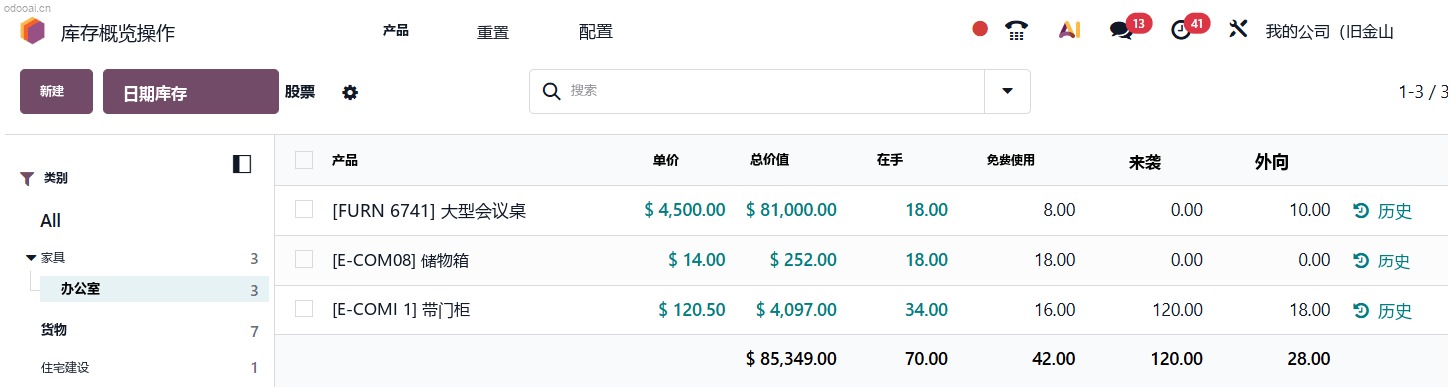
在库存中
打开 ,查看每个产品当前的库存水平和估值,或查阅截至以往日期的历史数据。
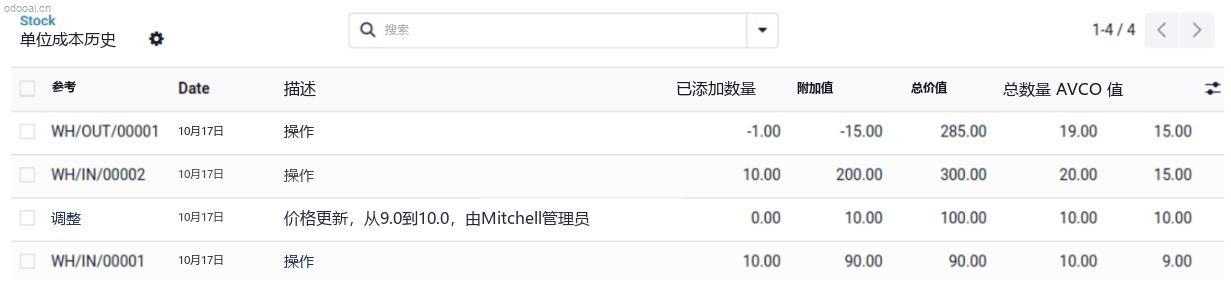
单位成本
要查看产品现有单价的更新及其来源,请点击该产品的 单位成本。在 AVCO 下,这能帮助您了解当前所用值是如何计算出来的。
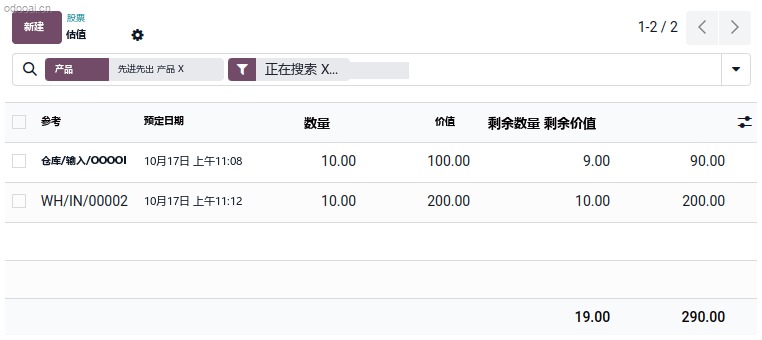
总价值
要查看所有仍有剩余数量的入库数量及其估值所用的值,请点击产品的 总价值。
在 AVCO 或标准成本法下,所用的值始终是当前平均单位成本。
在 FIFO 下,先前每笔入库移动的剩余单元保留各自独立的估值。
在 FIFO 或 AVCO 下,如有必要,可以调整先前入库移动剩余数量的值:选择要调整的入库移动,点击 Actions,然后点击 Adjust Valuation。输入新的 Value,并可选择填写 Description。
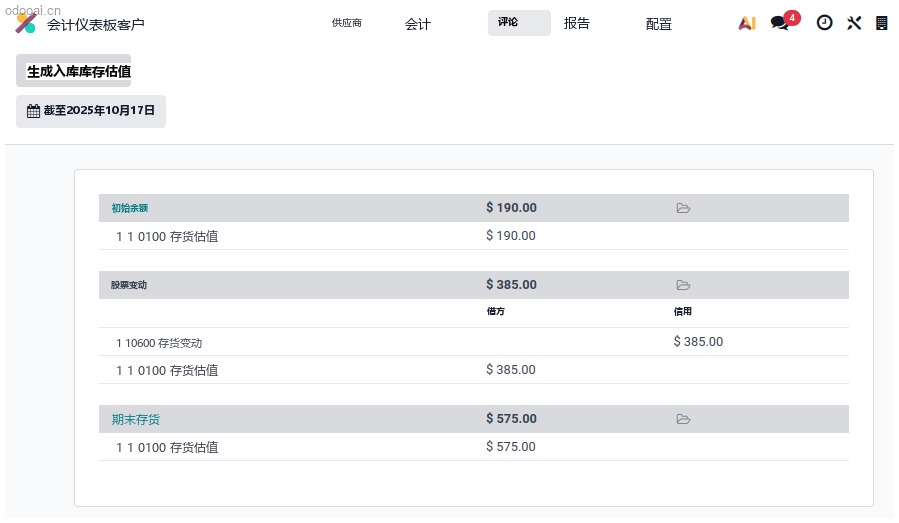
在会计中
要查看会计库存值与借助有剩余数量的入库移动所记录的当前库存值之间的差异,请转到 。
要生成一条新的会计分录以供审核和过账,请点击 Generate Entry。
要查看应录入权责发生制分录的销售订单和采购订单列表,请转到 并选择相关菜单项(Bill To Receive、Invoices To Be Issued、Billed Not Received 和 Invoiced Not Delivered)。选择所需的行,然后点击 Create Accrual Entries。
在盎格鲁-撒克逊永续会计下,这还有助于将已记录的库存变动分配到相应账户,例如待收账单/GRNI 或 COGS,如 会计分录 和 会计凭证配置 章节所示。
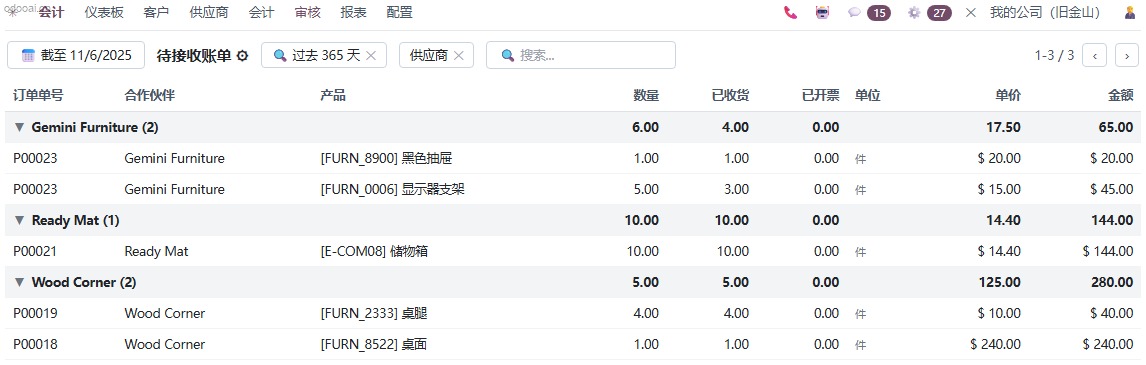
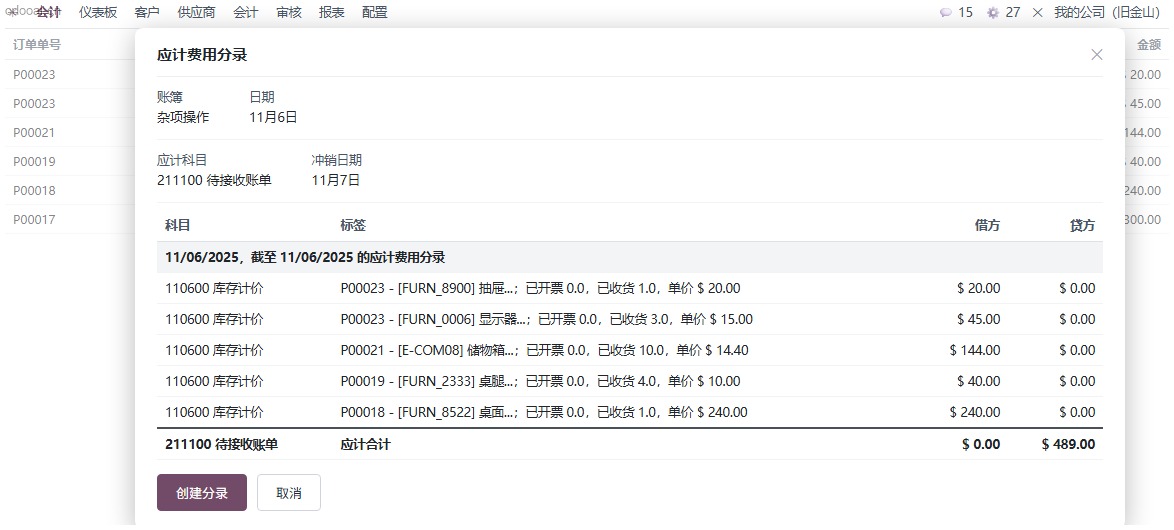
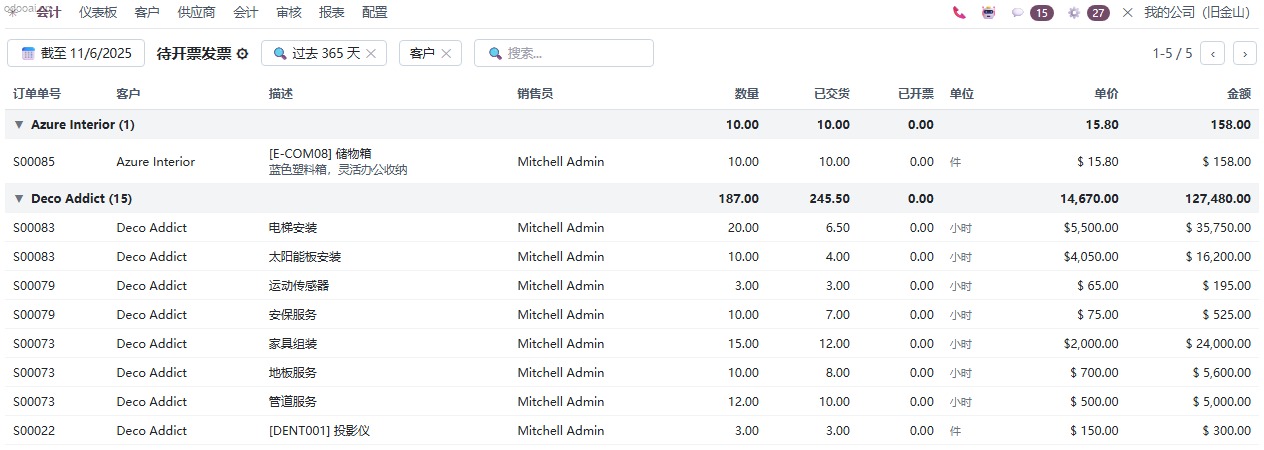
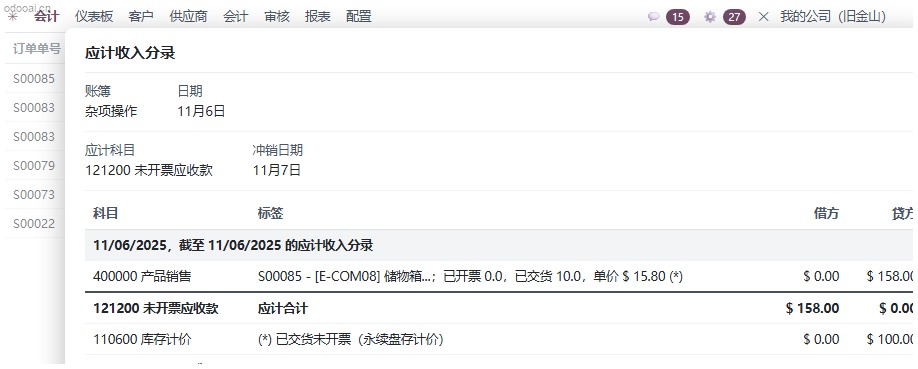
Odoo 19 中的变更
在 Odoo 19 之前,永续会计法通过在每次库存移动时过账实时会计分录来实现。这会在会计中产生大量日记账项目,对性能、总账清晰度和可审计性造成问题。
自 Odoo 19 起,永续法在发票层面影响库存估值账户。随后通过结账分录来管理待收账单、待开发票、递延收入、预付费用,以及库存值与会计值之间的其他差异。
Odoo 18 |
Odoo 19 |
|
|---|---|---|
定期欧陆法 |
手动结账 |
自动结账 |
定期盎格鲁-撒克逊法 |
不支持 |
完全支持 |
永续欧陆法 |
手动结账 |
✓ |
永续盎格鲁-撒克逊法 |
手动结账 |
✓ |
会计估值 |
需要库存应用 |
仅需会计应用 |
永续分录 |
发票 + 每笔移动 |
发票 + 一次结账 |
待开发票 |
✗ |
✓ |
预付费用 |
✗ |
✓ |
待接收账单 |
✗ |
✓ |
递延收入 |
✗ |
✓ |
绩效 |
较慢 |
较快 |
总账 |
更多会计凭证 |
更少会计凭证 |
本站校对说明
本篇《Odoo 20.0 documentation》翻译自 Odoo 20.0 企业版官方文档。库存与制造章节的术语统一为:location 译为「库位」、putaway 译为「上架规则」、work center 译为「工作中心」、bill of materials 译为「物料清单」。文中涉及的路线、补货与工单状态,均按 20.0 版本界面核对;开启多步收发货或多仓配置后,菜单会多出层级,与本页顺序不完全一致属于正常。制造业常见的 BOM 层级与成本归集配置,可在本站生产制造专题中查阅。如与官方英文版表述不一致,以 odoo.com 官方文档为准。
内容源自 Odoo S.A. 官方文档,依 CC BY-SA 4.0 许可翻译与校对,版权归 Odoo S.A.。本站为第三方中文文档站点,非 Odoo 官方网站。遇到与官方表述冲突之处,请以 odoo.com 官方文档 为准;版本选型可参考 社区版与企业版对比。