Summary On the opening day of the Canton Fair, the final stop of the Odoo 20 national roadshow took place in Guangzhou. This article reviews the technical highlights from the event and real-world customer implementation experience, explaining how a global ERP foundation can support foreign trade and overseas orders.
Platform Odoo 20 all-in-one open-source ERP (70+ apps), with Studio customization and APS advanced scheduling
Implementation Overview Covers the full chain of sales, purchasing, inventory, manufacturing, finance, cross-border logistics, and multi-country tax and accounting, tailored to the overseas expansion scenarios of manufacturing and foreign trade enterprises in the Greater Bay Area
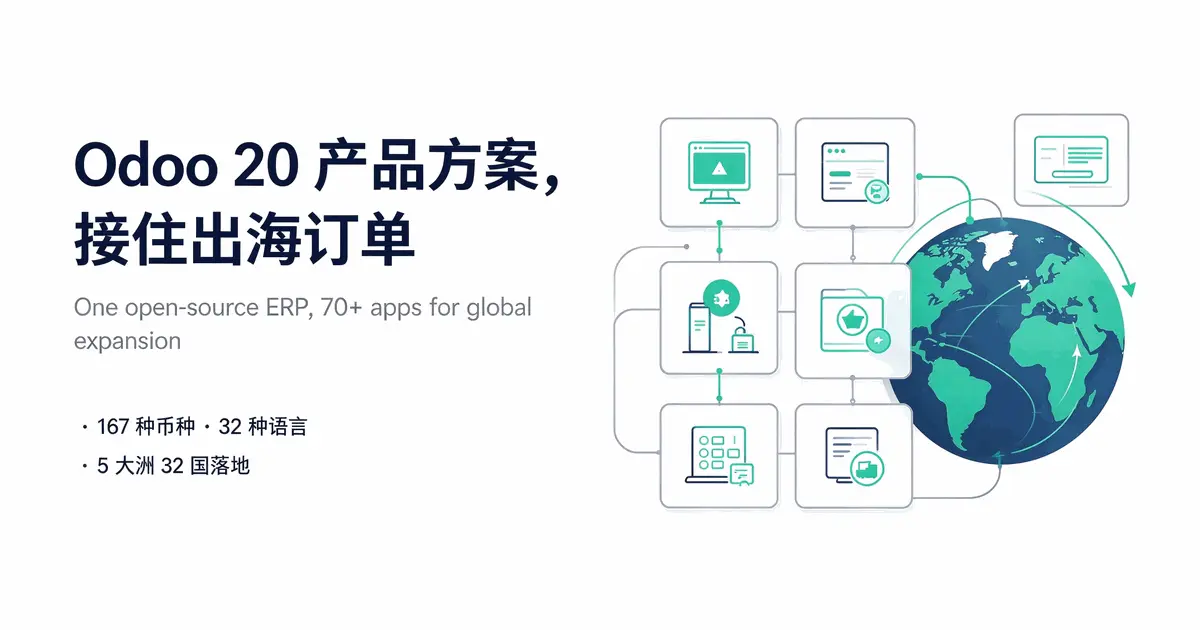
1. On the opening day of the Canton Fair, Guangzhou was gridlocked for over two hours
On October 14, the 140th Canton Fair opened.
This Odoo trip coincided with the opening of the Canton Fair, and Premier Li was presiding over the opening ceremony at the time—business was booming everywhere. The only trouble was the traffic ordeal: a 30-minute drive turned into a solid two-plus hours of gridlock. After finally making it to the hotel, the cell signal in the lobby kept drifting in and out, and messages took forever to send.
It was against this backdrop that the Odoo 20 official national roadshow's South China stop opened in Guangzhou. The morning session was for partners, and the afternoon session covered customer solutions; the venue was almost fully seated, and most attendees were business leaders from manufacturing and cross-border going-global companies. Naturally, we at Guangzhou Odoo Intelligent also came to take part and learn, and to see what new features and new directions there are.
Before it started, I thought it would be another session about trends and vision. Half a day in, my view changed: this year these solutions are truly working their way into the workshops of Guangdong factories and the paperwork of foreign trade companies. No talk of concepts—what's discussed is how to schedule production, how to calculate taxes across multiple countries, how to coordinate overseas warehouses, and exactly how many pairs of hands an order passes through from receipt to shipment.
II. Orders at the Door, Accounts Behind: Where Going-Global Companies Really Get Stuck
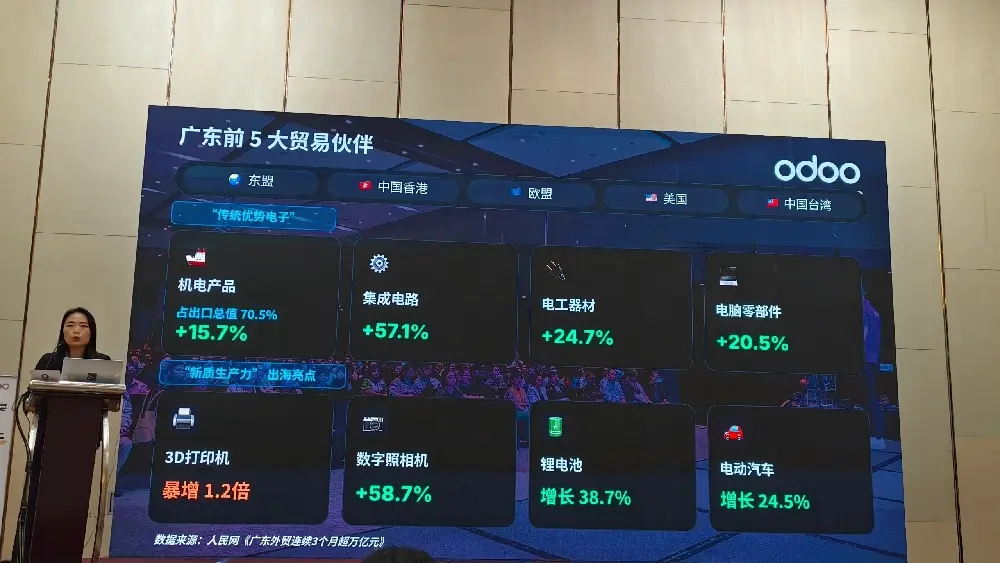
Guangdong's foreign trade figures this year are truly impressive. In the on-site presentation, Guangdong's top five trading partners are ASEAN, Hong Kong (China), the EU, the US, and Taiwan (China). Within the traditional base, mechanical and electrical products account for 70.5% of total export value, up 15.7% year on year; integrated circuits rose 57.1%, electrical equipment rose 24.7%, and computer parts rose 20.5%.
The new quality productive forces categories performed even more strongly: 3D printer exports surged 1.2 times, digital cameras rose 58.7%, lithium batteries rose 38.7%, and electric vehicles rose 24.5%.
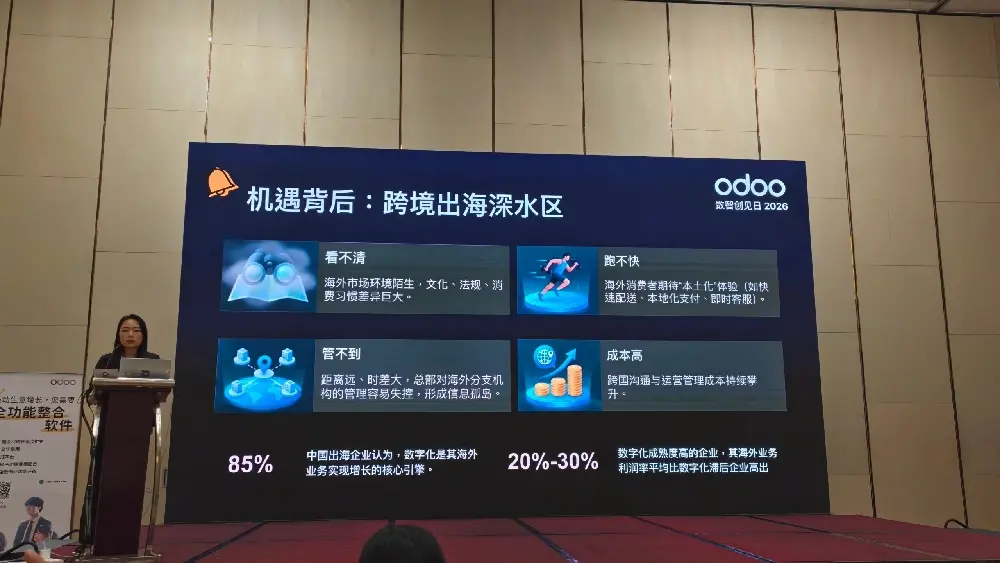
You can't see clearly. Overseas markets are unfamiliar, with huge differences in regulations, tax systems, culture, and consumer habits, and headquarters has no overall view of the real situation overseas.
You can't move fast enough. Overseas consumers want a localized experience: fast delivery, local payment, and instant customer service. The moment multi-platform orders and backend systems fall out of sync, the delivery experience immediately suffers.
Out of reach. With long distances and large time differences, headquarters easily loses control over overseas branches. Each location keeps its own set of spreadsheets, and over time they become isolated information silos.
High costs. Cross-border communication, multi-system integration, and multi-country compliance remediation keep driving operating costs up.
Breaking it down further, three major burdens weigh on finance and operations.
First, data silos. Your independent website, CRM, ERP, and WMS all operate separately with no data sharing, so decisions are made purely on gut feeling. Second, high costs: repetitive work is excessive and customer acquisition costs keep rising, eroding profits bit by bit. Third, multi-market compliance: VAT, GDPR, data privacy, and accounting standards differ from country to country, and on top of that, differences in language and customs make overseas employees hard to manage and customers hard to follow up with.
Two sets of data were presented on site, more convincing than any slogan. 85% of Chinese companies expanding overseas believe that digitalization is the core engine for overseas business growth, and companies with high digital maturity have overseas business profit margins 20%-30% higher than those of companies lagging in digitalization.
So how can companies go global more steadily, more deeply, and more systematically? The answer on site was straightforward: build a global ERP system. Odoo's own data backs this up—60% of Odoo customers are companies expanding overseas.
III. Odoo 20: What exactly has changed in this product solution
The following areas represent Odoo's greatest value, offering significant benefits for both foreign companies entering China and Chinese enterprises going global.
3.1 Native globalization foundation
This is the biggest difference between Odoo and many local ERPs: it was designed from the ground up for multinational operations.
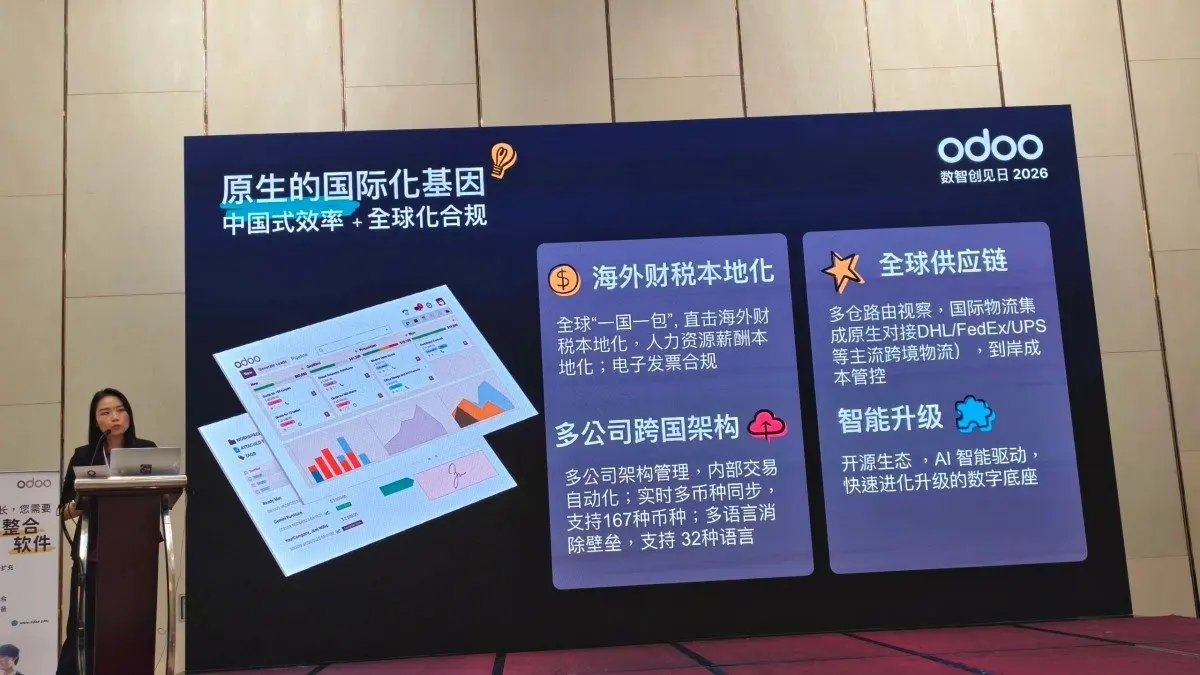
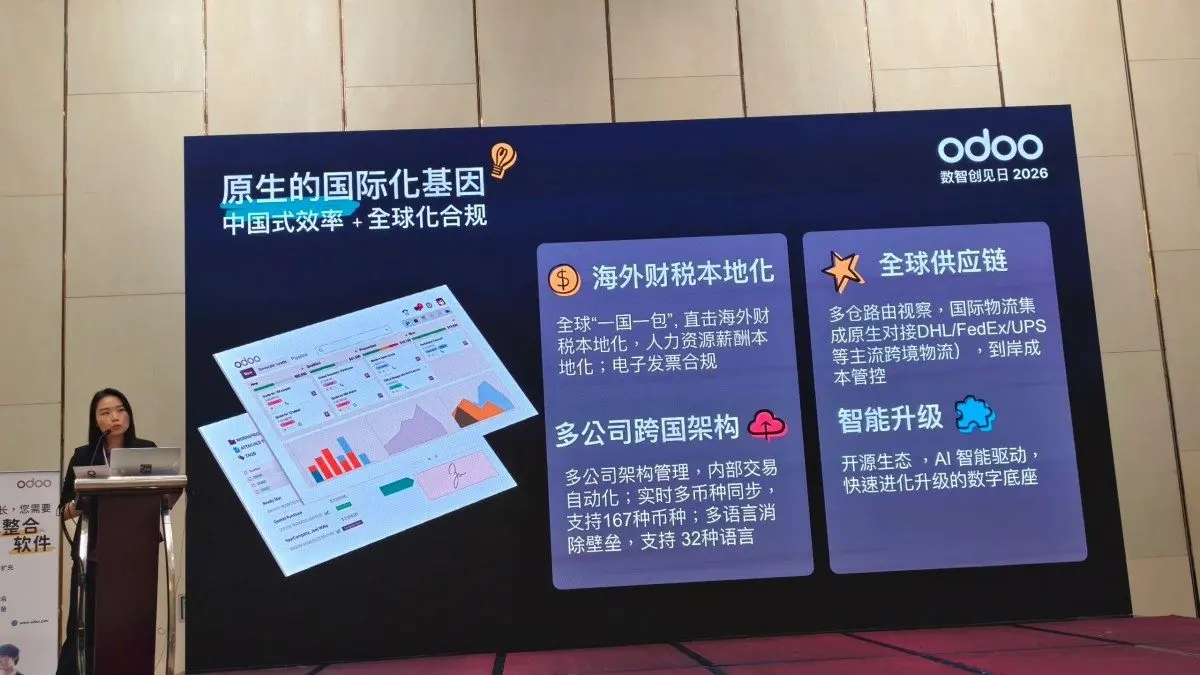
For overseas tax and finance localization, we offer one package per country worldwide, covering overseas tax and finance, payroll localization, and e-invoicing compliance.
Multi-company multinational structure, automated intercompany transactions, real-time multi-currency synchronization, supporting 167 currencies and 32 languages.
Global supply chain, multi-warehouse routing management, native integration with DHL, FedEx, UPS and other major cross-border logistics, with fine-grained landed cost control.
Layer on the open-source ecosystem and AI-driven intelligence, and you get a digital foundation that keeps evolving.
No more piecing together channels and payments. Odoo natively connects the world's leading e-commerce platforms and payment gateways with one click—Amazon, eBay, Shopee, Adyen, PayPal, Stripe, AsiaPay, Xendit, authorize.net—closing the loop on orders, payments, and reconciliation in a single system.
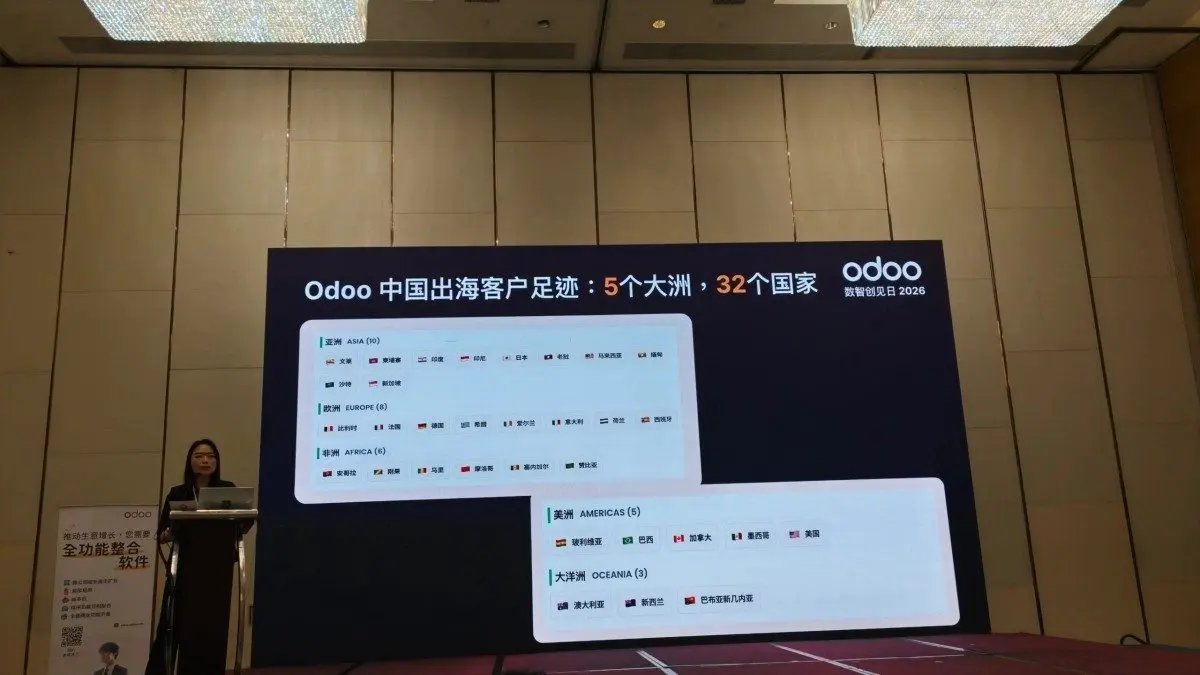
They also showed a chart on site: Odoo's Chinese overseas customers span 5 continents and 32 countries — 10 in Asia, 8 in Europe, 6 in Africa, 5 in the Americas, and 3 in Oceania.
3.2 70+ apps running in one database
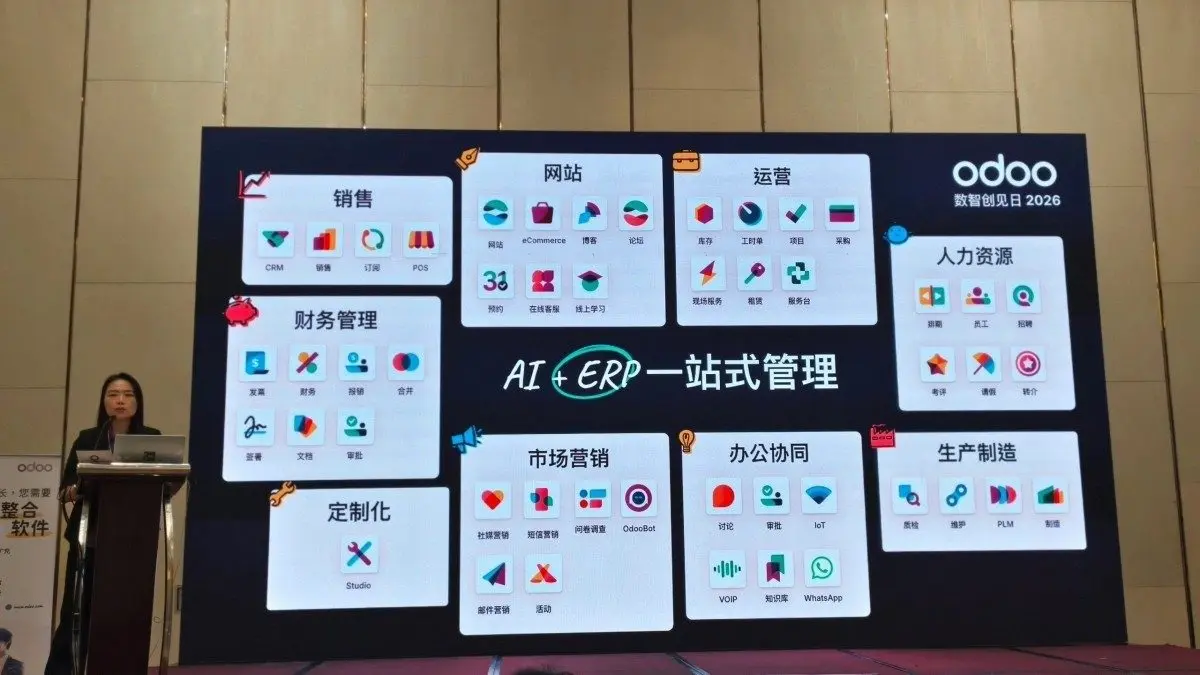
Odoo is an all-in-one ERP management software. With 70+ apps, it fully connects finance, inventory, manufacturing, purchasing, and sales, integrating your company's entire business chain in one system.
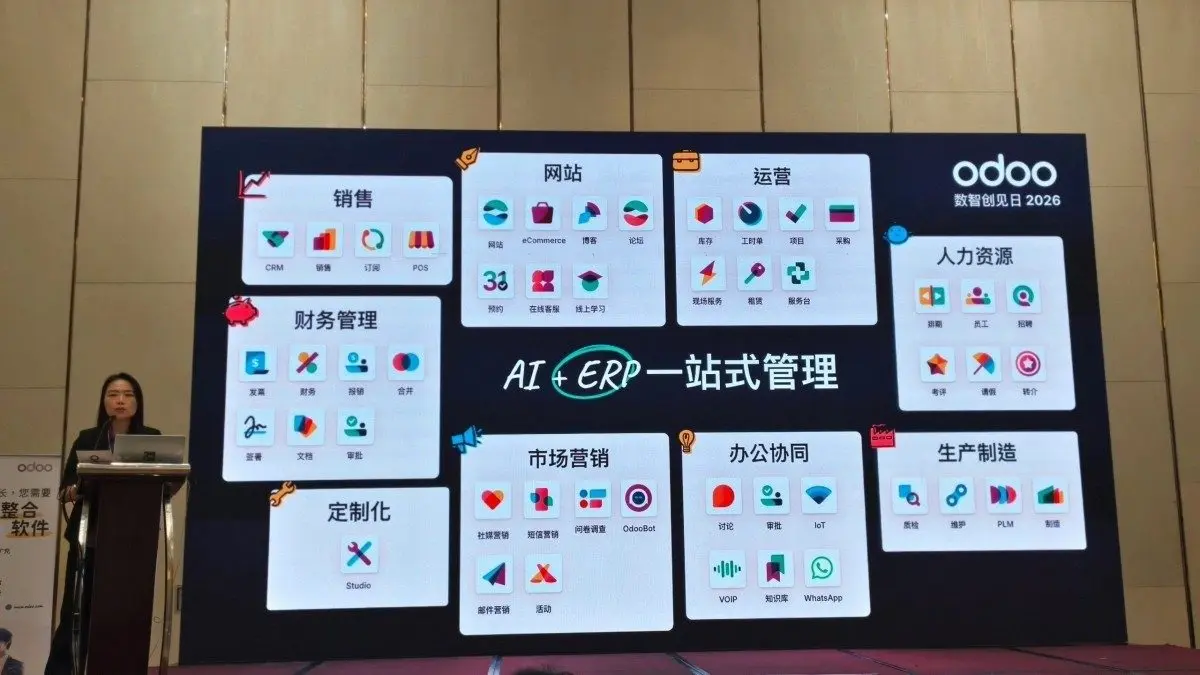
Why emphasize a single database? Because for AI to truly work, the prerequisite is that data must be connected and structured. The explanation on site was very straightforward: a unified database connects data from all departments, an open architecture makes it naturally understandable to AI, modular integration is perfect, and it supports the latest MCP Model Context Protocol. At the ecosystem level, AI models can be trained based on Odoo's business structure; Odoo accounts for 2% of the total lines of Python code worldwide.
In short, precise structured underlying business data plus a top-tier large model brain is the combination that can be implemented.
3.3 AI Evolves from Plugin to Foundation
Compared to the amazement when Odoo 18 first introduced AI two years ago, and then 19, the change in 20 this time is a qualitative leap. AI has transformed from an add-on feature into a native capability integrated into the ERP foundation.
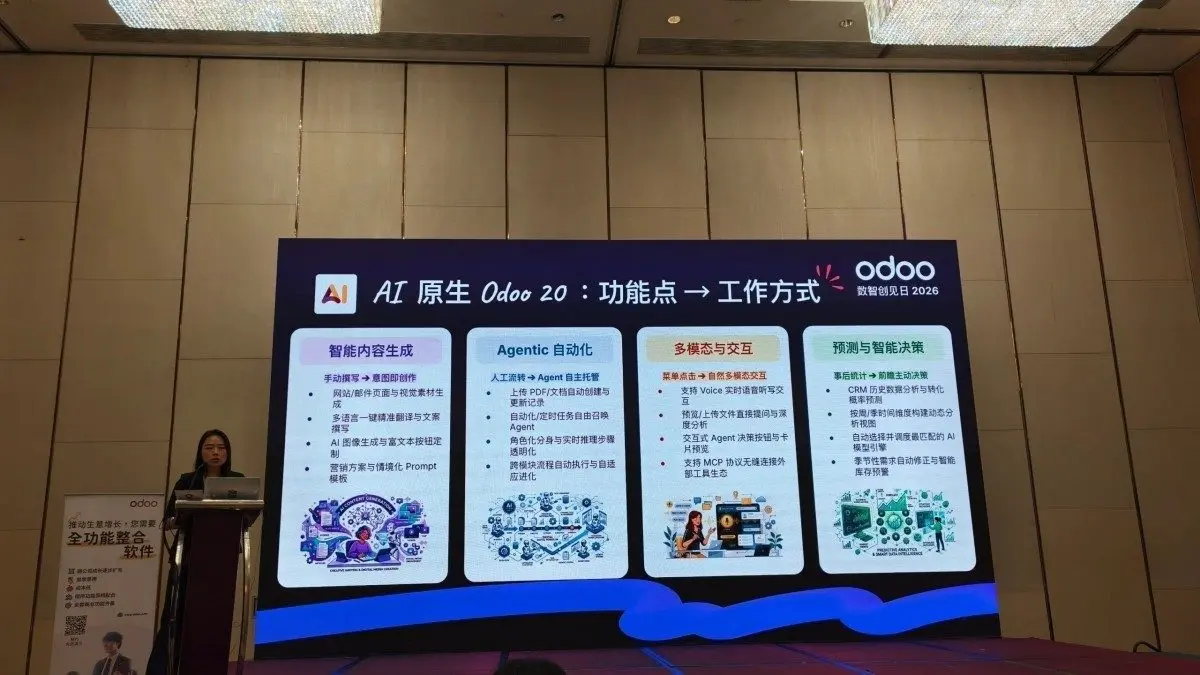
The on-site presentation summarized it into four areas, which we have organized into a table.
| Capability Area | From What to What | What It Can Do |
|---|---|---|
| Intelligent Content Generation | Manual Writing Becomes Intent-Based Creation | Generation of visual assets for website pages, one-click multilingual translation and copywriting, AI image generation, marketing plans and contextual Prompt templates |
| Agentic Automation | Manual Workflow Becomes Agent Autonomous Hosting | Automatically create and update records by uploading PDF documents, freely summon Agents for scheduled tasks, role-based avatars and real-time reasoning, automatic execution of cross-module processes |
| Multimodal and Interaction | Menu Clicks Become Natural Multimodal Interaction | Support Voice real-time speech dictation, direct question analysis by uploading files, interactive Agent decision buttons and cards, support MCP protocol to connect external tools |
| Prediction and Intelligent Decision-Making | Post-hoc Statistics Become Proactive Decision-Making | CRM historical data and conversion probability prediction, dynamic analysis by week or quarter, automatic selection of the best-matching AI model, automatic correction of seasonal demand and intelligent inventory alerts |
Another highly practical feature is Ask AI. Business users can ask the system directly in natural language, for example, to display opportunity analysis by country/region and stage, presented as stacked bar charts or pivot tables. No SQL writing, no need to learn reporting tools—they can extract cross-border opportunity, sales, inventory, and financial data on their own.
Compared to Workbuddy and Claude Code, it enables better company-level control—an AI built on Odoo's strict security and user permission requirements.
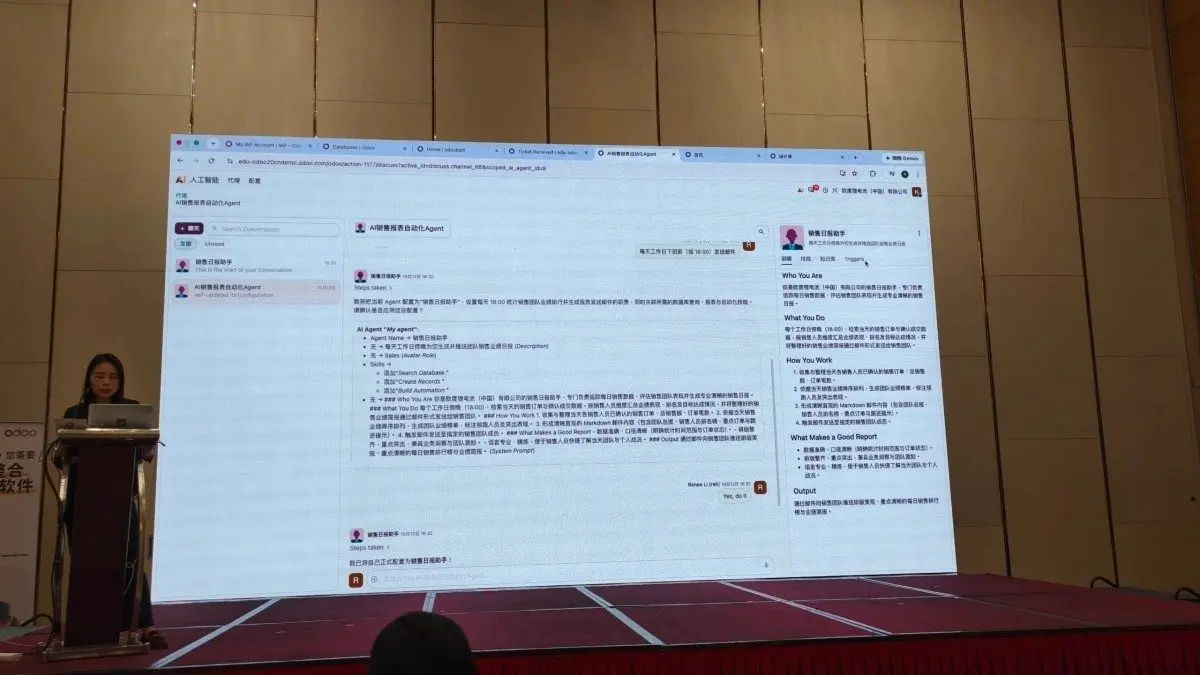
3.4 Custom AI Employees: The Most Noteworthy Part This Time
This is a new capability in 20 compared to 19, and the part I examined most carefully on site. Enterprises can create their own AI employees, i.e., topic Agents. Essentially, the official team has turned Odoo directly into a Harness.
It is not a fixed Q&A bot; it is built by role. The on-site demo was an inventory assistant. Say in natural language: "I want an inventory assistant that summarizes a daily report every day, telling me inventory status, inbound/outbound history, and replenishment suggestions," and the system starts confirming with you how to push it—the on-site choice was to send to an internal discussion channel.
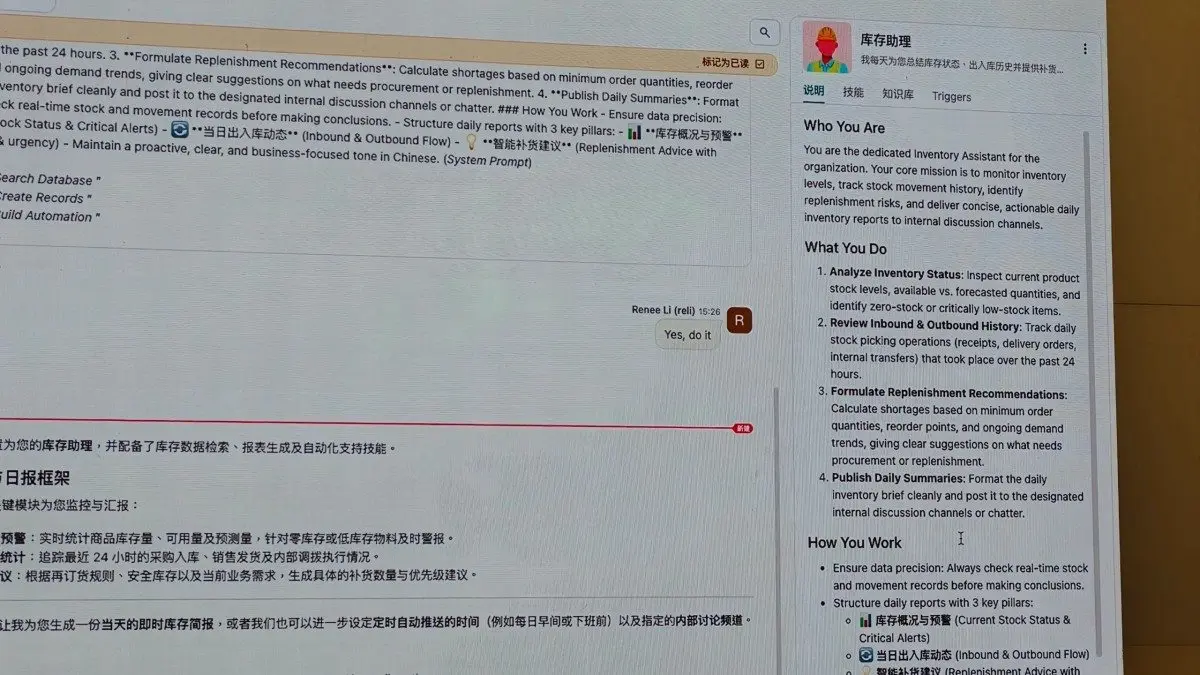
Then it clearly defines the role: who it is and what it does every day. It tracks inventory in real time, alerts on zero stock and low materials, monitors purchase receipts, sales shipments, and internal transfers in the last 24 hours, and calculates replenishment quantities and priority suggestions based on reorder points and safety stock. This is a living Mix(Tools) = skill—Odoo directly does the Agent's work.
Finally, bind three skills to it: retrieve database, create business records, and build automation. Confirm, and this AI employee is on duty.
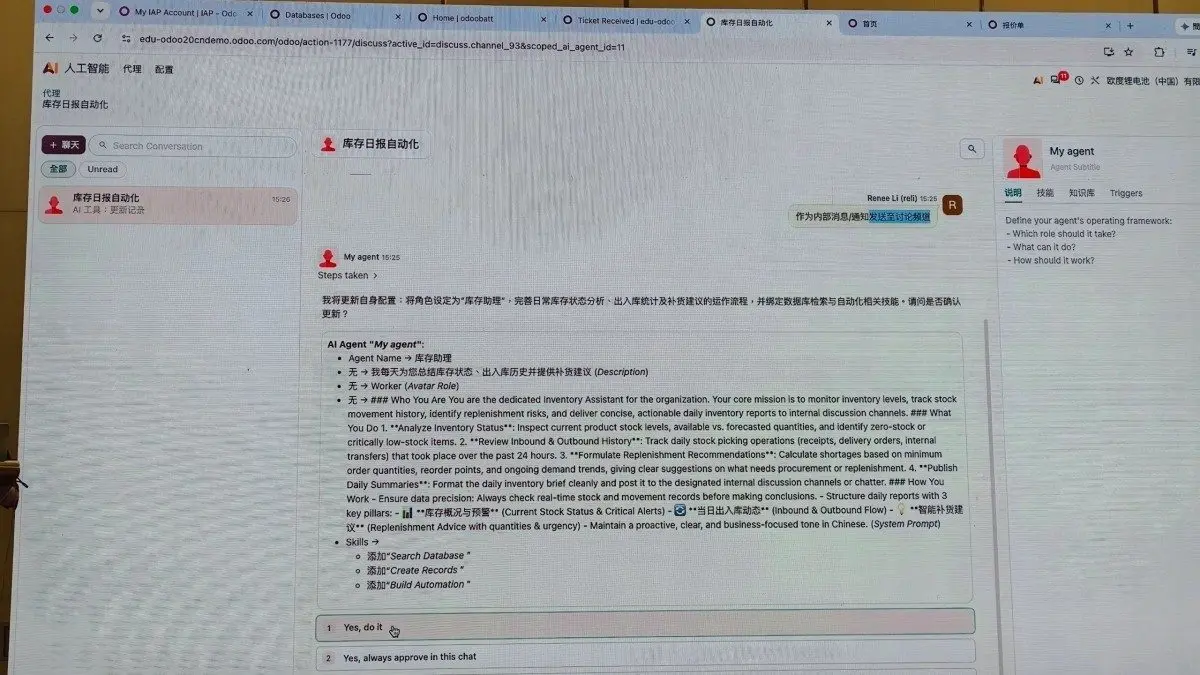
In the same way, you can build sales quotation, purchase follow-up, and production alert agents yourself. Each Agent performs its own duties and is embedded into the corresponding business process. Integrated AI management is the most important thing for enterprises.
Here is a point the official team did not elaborate on but the community is well aware of. The official native demo only showed support for OpenAI and Google models, while Odoo's mature open-source app ecosystem, including our Odoo Chinese App Store, has long had modules that can connect to domestic large models and domestic Agent systems. Chinese documents, domestic finance and tax, and local office habits can all be adapted—no need to be constrained by overseas models. You can implement AI reimbursement, AI shopping guide, and AI workbench. This is the unique freedom of the open-source ecosystem.
In Odoo 20 Enterprise, AI token usage is included in its own Credit system, achieving a unified outlet. This is a different path from the community edition's AI suite, and you can weigh the trade-offs.
No matter how many features you see, it ultimately comes down to implementation. How Odoo 20 lands in China, how many phases, and what is delivered in each phase—we have compiled a separate Odoo Implementation Five-Phase Guide; if you are more concerned about budget, you can first look at Standard Service Packages and Custom Man-Day Pricing。
IV. Three Manufacturing Genes, One Foundation
The customer sharing was the most substantial part of the whole event. Three enterprises, three completely different manufacturing models.
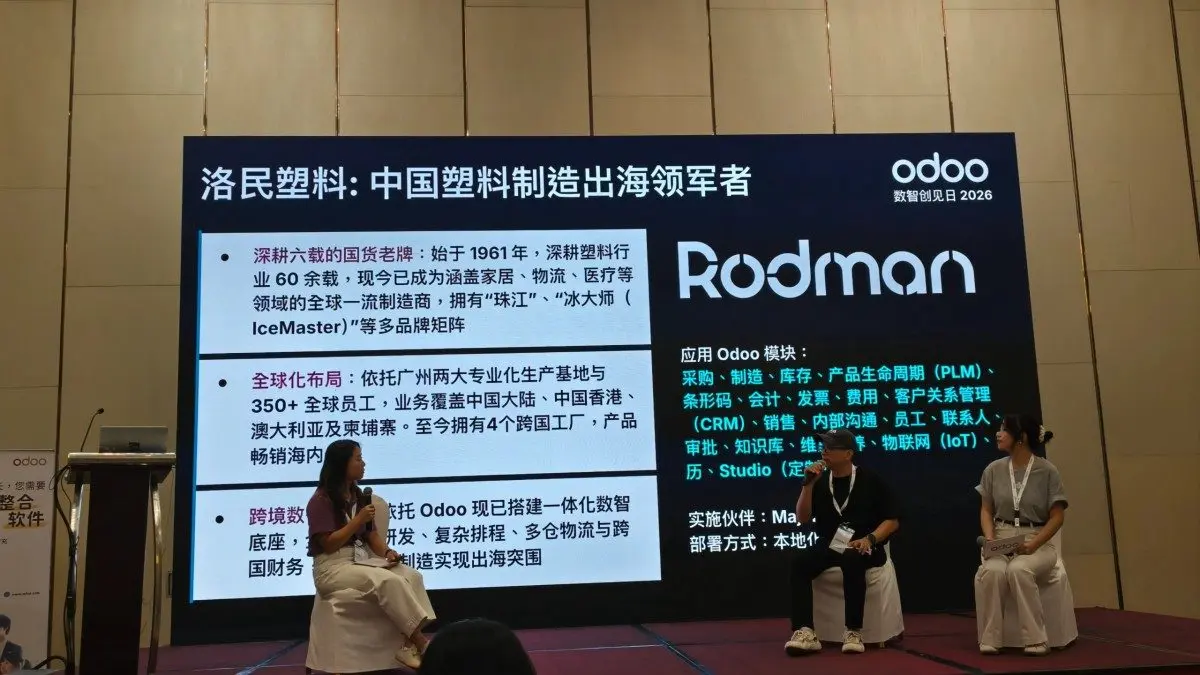
Rodman, a veteran Chinese brand founded in 1961, has specialized in plastics for over 60 years and owns brands such as Zhujiang and IceMaster. It operates two major production bases in Guangzhou, employs 350+ people worldwide, and runs 4 cross-border factories, with business covering mainland China, Hong Kong, Australia, and Cambodia. A typical case of a group company going global with multiple factories and multiple brands.
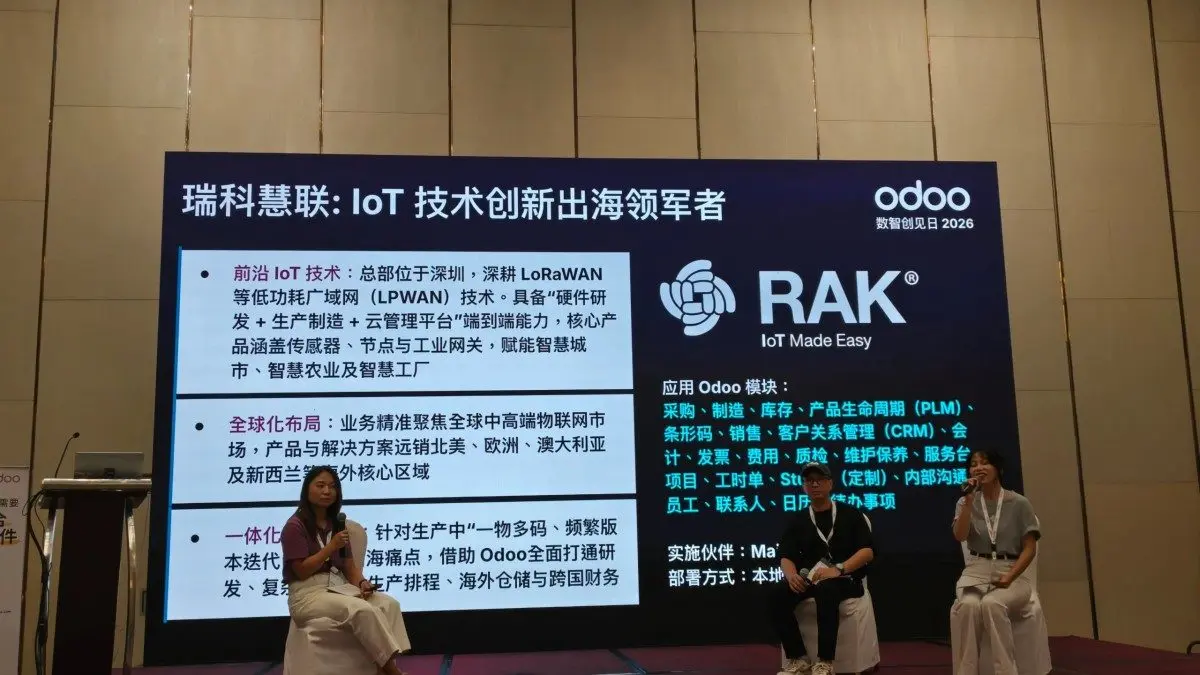
RAKwireless (RAK), headquartered in Shenzhen, specializes in LoRaWAN low-power wide-area networks, with self-developed sensors, nodes, and industrial gateways sold across North America, Europe, Australia, and New Zealand. With fast hardware iteration, multiple codes per item, and frequent version changes, R&D and production must stay closely aligned.
VID, a Foshan-based custom home furnishing company. This is a segment the industry widely regards as a tough nut to crack. The fat profits of standardized mass production have long been carved up by all kinds of systems, and what remains—highly customized, multi-SKU scenarios with frequent order changes—is something many vendors are unwilling to dig into.
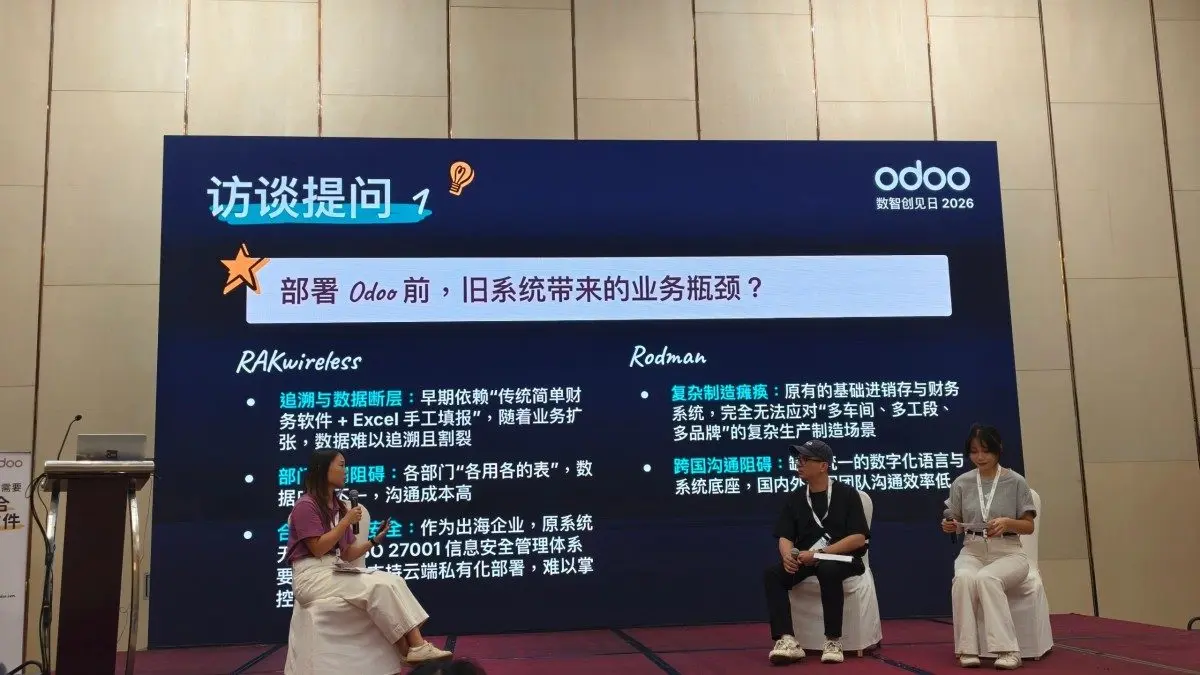
VID Three things mattered most when selecting a system. First, native multilingual support that matches the working habits of overseas partners and teams. Second, an open API and extensibility, enabling flexible customization and adding fields, with a low barrier to secondary development and maintenance. Third, an overseas partner had previously built a similar system in-house, and its maintenance costs were high; in the end, they strongly recommended Odoo because of its complete business coverage, near-zero underlying maintenance, and no need for dedicated IT staff.
After go-live, VID connected the complete main chain of customer quotations, sales orders, procurement stocking, outsourced processing, inventory delivery, and financial accounting. Massive SKUs are managed in agile batches, enabling efficient launch of hundreds of new products every month. Sales, procurement, manufacturing, and finance collaborate based on the same business data.
Looking at these three types of enterprises together, the conclusion is clear. Anyone can run a simple business; it is complex, high-end, continuously iterating manufacturing that truly tests one's foundations.
V. How It Differs from Stacking Multiple Systems
Many companies don't lack systems; they have too many. The table below is a comparison I compiled based on on-site information, and the differences are obvious at a glance.
| Dimension | Patchwork of Multiple Systems | Odoo 20 Integrated |
|---|---|---|
| Data | Independent sites, CRM, ERP, and WMS each store their own copy, which don't match | One database, all departments share the same data source |
| Cross-border Finance and Tax | Add-on accounting software plus manual exchange adjustments, separate systems for each country's tax regime | One localization package per country, real-time synchronization of 167 currencies |
| Order Fulfillment | Front-end platforms disconnected from back-end production, delivery relies on manual monitoring | Native integration of e-commerce, payment, and logistics, closed loop from order to outbound |
| Production Scheduling | Excel scheduling: an upstream delay crashes the whole line | APS Gantt chart with Keep Buffer, auto-projects by postponement rules |
| Repetitive Work | Reports compiled manually, cross-timezone coordination done by hand | AI Agent runs on schedule, auto-generates and pushes daily reports |
| Customization & Extension | Closed source can't be changed; every change means another wait | Open source plus Studio, continuously adapted to business changes |
| Operations & Maintenance | Multiple systems, multiple maintenance loads, requires dedicated IT | Unified platform, virtually zero infrastructure maintenance |
Let me say a word specifically about production. The live demo showed the APS advanced production scheduling Gantt view, where each row is a work center and the colored bars are individual operations. The system supports Reschedule with buffer retention, keeping buffer time when rescheduling, and allows custom operation postponement rules. When an upstream operation is delayed, the system projects subsequent plans according to the rules, rather than crudely shifting everything as a whole, and a delay at one workstation won't cause a chain-reaction collapse across the entire line.
Rush orders, order changes, material delays, and capacity fluctuations are all automatically accommodated. More importantly, scheduling data is part of the same system as PLM, inventory, purchasing, and finance—not an isolated scheduling tool.
VI. Being Open Source Is Itself Security
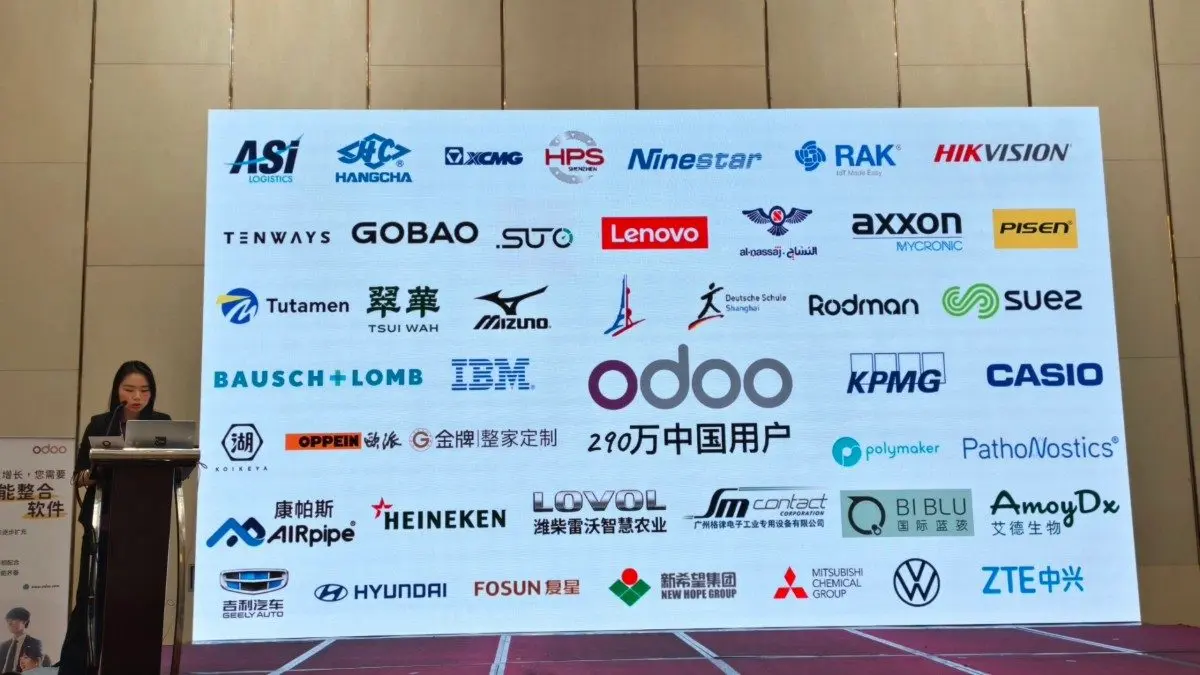
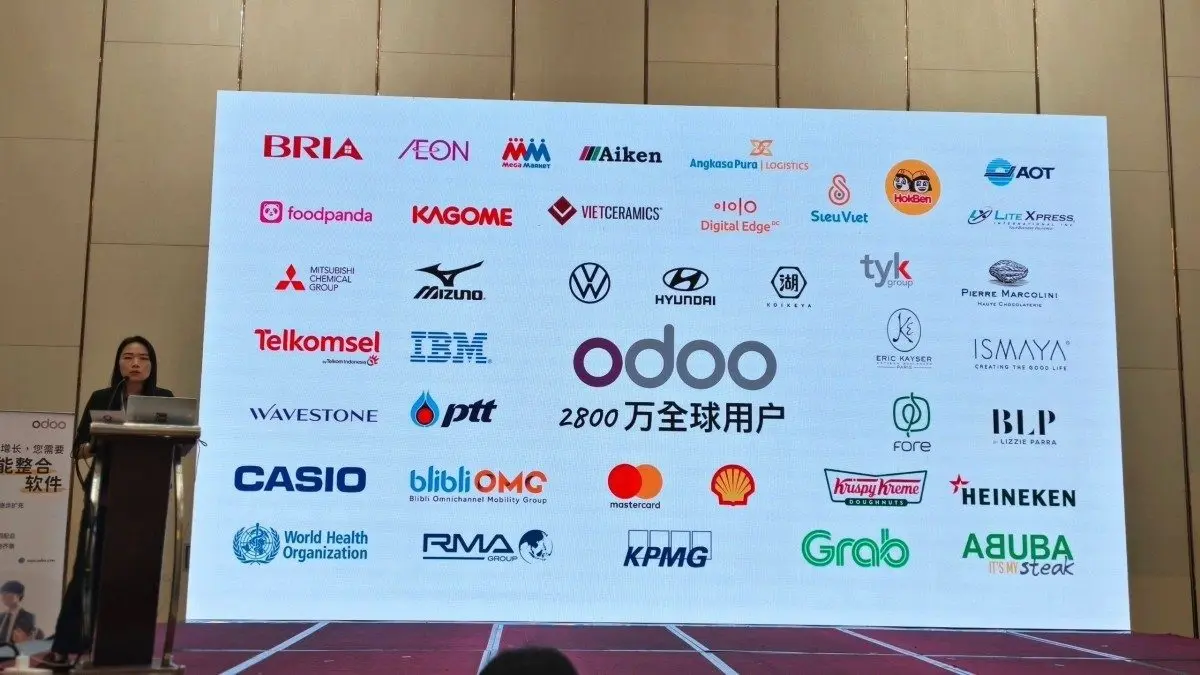
When the on-site customer wall was unveiled, Shell, Mastercard, Casio, Heineken, Volkswagen, Hyundai, IBM, Grab, and KPMG were all there, along with domestic names like Hikvision, Lenovo, XCMG, Geely, ZTE, and Fosun. Odoo's own footprint is 28 million satisfied customers, 23,000+ partners, 7,500+ employees, and 21 global offices.
More worth discussing than the customer list is what the word "open source" means.
You control your own data. The code is auditable, with no hidden risks of a closed-source black box, and private deployment keeps customer, production, and financial data in the enterprise's own hands.
However your business changes, the system follows. In manufacturing and overseas trade, rules, order models, and overseas tax systems change every year. With closed-source systems, every change means another wait; with an open-source architecture, you can keep adapting to your business.
No vendor lock-in. The ecosystem offers a large number of ready-made modules, AI models can be trained on Odoo's business structure, and domestic large models can be integrated as well.
This is also why many major global automakers, new-energy battery and upstream/downstream component manufacturers, and leading electromechanical exporters have long been quietly using Odoo. These industries don't make much noise, yet they have quietly used the open-source foundation to first shore up supply chain security, data security, and customized adaptation.
In the years Odoo Smart has spent implementing Odoo, the scenarios we've seen range from multi-factory groups and IoT hardware R&D and manufacturing to highly customized home furnishings, and they all share the same common thread. First you need a foundation that can grow with your business over the long term; only then can you talk about efficiency.
VII. Before going live, self-check these four things first
If you are also preparing for digitalization abroad, there is no need to rush into choosing a product—first ask yourself four questions.
First, are your overseas subsidiaries, overseas warehouses, and domestic factories all on the same system? If you are still consolidating data through email and Excel, then a lack of control is inevitable.
Second, are your multi-currency and multi-country tax regimes calculated by the system or by people? Manual exchange adjustments and bolt-on accounting software become a risk point as soon as you scale up.
Third, from order receipt to outbound shipment, there are several manual handling steps in between. Each handling step is a chance for error.
Fourth, can your system adapt as your business changes? If every process change means waiting for the vendor's schedule, that system will eventually hold you back.
If you can't answer more than two of these four questions, it's worth taking a serious look at this Odoo solution, and you may also want to learn about the China localization implementation methodology for Odoo enterprises. For more product details and industry case studies, visit odooai.cn and odooapp.cn. This article is based on content from the Guangzhou event on October 14, 2026; please refer to the official release for in-depth interpretation.
Next step: Let's talk openly about your going-global scenario
If you are selecting Odoo 20, we suggest looking at two things first:Five phases of Odoo implementation and deliverables、Standard Service Packages and Custom Man-Day Pricing. It needs to be judged by industry, number of companies, interfaces, and data volume. You can directly Contact Us or Try Odoo for free。
Going global with non-standard manufacturing: how to take on project-based orders
Among going-global orders, there is a category of non-standard: the customer provides drawings or samples, you first quote and make samples, then produce in small batches and install on site. The key to such orders is not a multilingual website, but whether the project number can track from inquiry to after-sales: quotation versions, design confirmation, sample records, partial shipments, overseas installation, and spare parts all need to be attached to the same project.
Odoo 20's multi-company, multi-currency, and project management can handle it, but the prerequisite is to set up project numbers well and clearly define stages and responsibilities. For non-standard manufacturing ERP going global, first let customers see progress, then talk about cost.
VIII. FAQ: How to implement Odoo 20 for going global?
How long does Odoo 20 implementation typically take in China?
Main process 1~3 months: project preparation 1 week, business blueprint 1~2 weeks, system implementation 2~6 weeks, go-live preparation 1~2 weeks; after go-live, there is an additional 6-month support period. Projects with multiple companies, multiple warehouses, and manufacturing and customs will lean towards the 3-month end. See details Odoo Implementation Five Phases。
How is Odoo 20 implementation cost calculated?
The standard service package is fixed by scope and phase, and the excess part is billed by customized person-days. First, clarify the modules, number of companies, interfaces, and data volume in the blueprint phase, and then provide person-days and total price. For pricing details, see Odoo Price List。
Does Odoo 20 support private deployment and source code delivery?
Yes. Odoo is an open-source ERP that can be privately deployed, with data and code kept in the enterprise's own hands; Odoo Smart provides source code delivery and localized implementation to avoid key processes being locked by external teams. You can view Odoo AiERP Solution。
Can Odoo 20's AI connect to domestic large models?
Yes. The official native demo mainly uses OpenAI and Google models, but there are already modules in the Odoo open-source ecosystem that can connect to domestic large models and domestic Agent systems; Chinese documents, domestic finance and taxation, and local office habits can also be adapted. You can go to Odoo Chinese App Store view.
How to migrate from legacy systems (Kingdee/Yonyou/SAP)?
First, take stock of master data, opening balances, and open documents, then choose one-time cutover, phased cutover, or parallel run. Most projects adopt "opening balance + open document migration + one full business cycle trial run," and the parallel period is recommended to be controlled within 1 month. See details Odoo Implementation Five Phases。
IX. Final Words: Wishing Odoo Continued Success and Great Sales for the Enterprise Edition
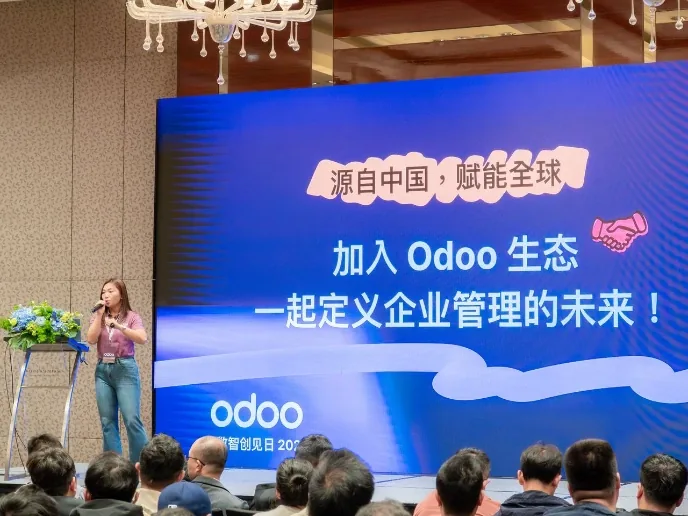
From the traffic jam on the opening day of the Canton Fair to the manufacturing and foreign trade bosses filling the venue, this day actually illustrates one thing: people are not here to listen to concepts, but to find a system that can be implemented. The production scheduling, multi-country taxes, overseas warehouses, and AI employees discussed at Odoo 20 Guangzhou are all matters of the workshop and documents.
The biggest change in Odoo 20 this time is turning AI from a plugin into the foundation, and bringing multi-company, multi-currency, multi-country tax systems, and global supply chains into one database. For Guangdong enterprises going global, this is not one more feature, but fewer systems, fewer reconciliations, and fewer pitfalls.
As some of Odoo's earliest developers and the operators of Odoo's third-party app store in China, we naturally want Odoo to keep getting better: a more open ecosystem, more professional partners, and a more stable product. We also hope the Enterprise edition sells well—when vendors, partners, and customers all make money, this open-source ecosystem stays healthy for the long term, and companies feel confident putting their core business on it.
If you're also working on digitalization for going global, come talk to us at odooai.cn (enterprise services) or odooapp.cn (technology ecosystem). And best wishes to everyone busy on the shop floor, in the warehouse, at trade shows, and on the front lines overseas: may you take every order, keep your books straight, and grow your business far.
Why do so many going-global companies choose Odoo Smart for Odoo implementation?
11 years of Odoo implementation and customization experience, serving 1000+ companies, including many foreign-invested and joint-venture clients and 100+ Chinese large and medium-sized enterprises and listed companies; we provide an implementation methodology, source code delivery, private deployment, and 6 months of go-live support, covering foreign trade ERP, multi-company groups, MES, and AiERP. View Odoo AiERP Solution or Five Implementation Phases to learn more about Odoo.
May Odoo keep getting better, may the Enterprise edition sell well, and may Chinese going-global companies avoid pitfalls and win more orders.