Open source MES · Odoo MES · Manufacturing execution system
Open source MES: connect work orders, reporting, quality, and cost in one line
Built on open-source ERP, Odoo MES covers shop-floor execution scenarios from BOM, production scheduling, and scan-based reporting to batch traceability, in-process quality inspection, and OEE, while sharing a single data set with sales, purchasing, inventory, and finance. It is suitable for manufacturers with high-mix low-volume production, make-to-order (MTO/ATO/ETO), and integrated manufacturing and trading operations.
- Open source code, auditable
- Supports on-premise deployment
- Can share the same database with ERP
- Custom secondary development available on demand
Free trial of open source MES Book a manufacturing industry diagnostic
Updated: 2026-10-25 · This article was written by the Guangzhou OdooAi Odoo implementation team, based on public documentation and project practices of Odoo 20 Manufacturing, Shop Floor, Quality, Maintenance, and Inventory modules.

What is an open-source MES? What features does Odoo MES have?
One-sentence answer: An open source MES is a Manufacturing Execution System (MES) with open source code that can be self-deployed and customized. It breaks down production plans issued by ERP into work orders and operations, collects data on people, machines, materials, methods, and environment on the shop floor, and writes the results back to inventory, quality, and costs.
According to the ISA-95 hierarchy, MES sits at Level 3, manufacturing operations management: it connects upward to Level 4 ERP and downward to Level 2 SCADA/PLC. It answers not "whether to produce" but "which work order, which operation, who is doing it, how much has been done, how much is qualified, and when it can be delivered".
Odoo MES is not a single official module name. Odoo's MES capabilities are implemented by combining Manufacturing (MRP), Shop Floor, Quality, Maintenance, Inventory, and IoT capabilities. Therefore, "Can Odoo be used as an MES" depends on the depth you need to cover: for material picking—production—warehousing only, MRP is sufficient; when you need operation-level reporting, batch traceability, in-process quality inspection, OEE, and piece-rate wages, you truly enter the scope of MES.
See clearly in one table: the boundaries of MES, ERP, WMS, QMS, SCADA
The most common misconception in system selection is treating ERP, MES, and WMS as interchangeable software. They answer questions at different levels.
| System/Layer | Key questions answered | Typical objects | Corresponding Odoo capabilities |
|---|---|---|---|
| ERP (Layer 4) | Which orders to take, which materials to buy, what the costs are, and how receivables stand | Sales orders, purchase orders, financial vouchers | Sales, purchasing, inventory, accounting |
| MES (Layer 3) | Which work order, which operation, who did it, how much was done, how much passed | Work orders, operations, work reports, quality inspection records | Manufacturing, shop floor, quality, maintenance |
| WMS | Where materials are, when they are received and issued, how batches flow | Locations, lots, serial numbers | Inventory, barcodes |
| QMS | Compliance, how defects are closed, supplier quality | Inspection points, defects, CAPA/8D | Quality management |
| APS | Which order to prioritize under limited capacity, where the bottleneck is | Scheduling, work center load | Gantt scheduling, MPS |
| SCADA/PLC (Layer 2) | Current equipment status, parameters, alarms | PLC, sensors, OPC UA | IoT Box, edge gateway |
Note: ISA-95 / IEC 62264 divides enterprise control systems into Levels 0–4, with MES typically corresponding to Level 3. Vendors differ slightly in how they draw the boundary between MES and MOM.
8 core capabilities of Odoo open source MES
1. Work orders and routings
Supports multi-level BOMs, substitute materials, operations, work centers, and standard hours. Work orders can be triggered by sales orders, forecasts, replenishment rules, or manually; routings determine which work center each operation is performed in and how many standard hours it takes.

2. Finite capacity scheduling
Drag and drop Gantt chart to adjust work order times, validate load by work center, support ASAP scheduling, priority, material shortage orders, and split work orders. It solves "fill bottleneck operations first" rather than filling each order with a seemingly reasonable date.

3. Shop floor execution and scan-based work reporting
The Shop Floor interface is designed for large screens and touchscreens, supporting scan-to-start, completed quantity, scrap quantity, continuous production, and flexible consumption. Work reporting data is written back to work orders in real time, reducing after-hours data entry.

4. Quality and QMS
Covers IQC incoming inspection, IPQC in-process inspection, FQC/OQC outgoing inspection, supports AQL sampling (GB/T 2828.1 / ISO 2859-1), first article inspection, patrol inspection, defect rework, CAPA/8D closed loop, and basic SPC. Inspection points can be bound to operations, materials, or receiving steps.
5. Lot and serial number traceability
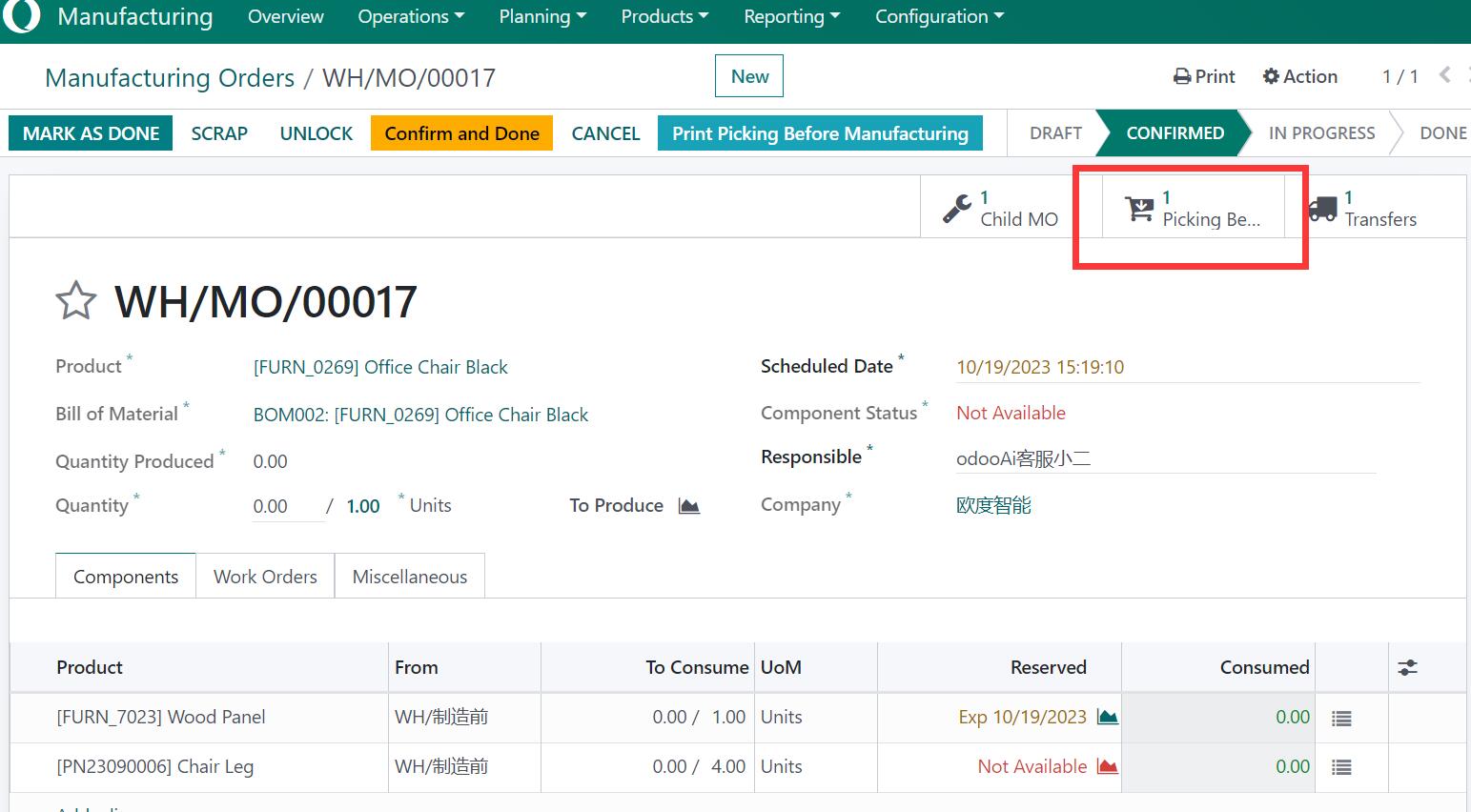
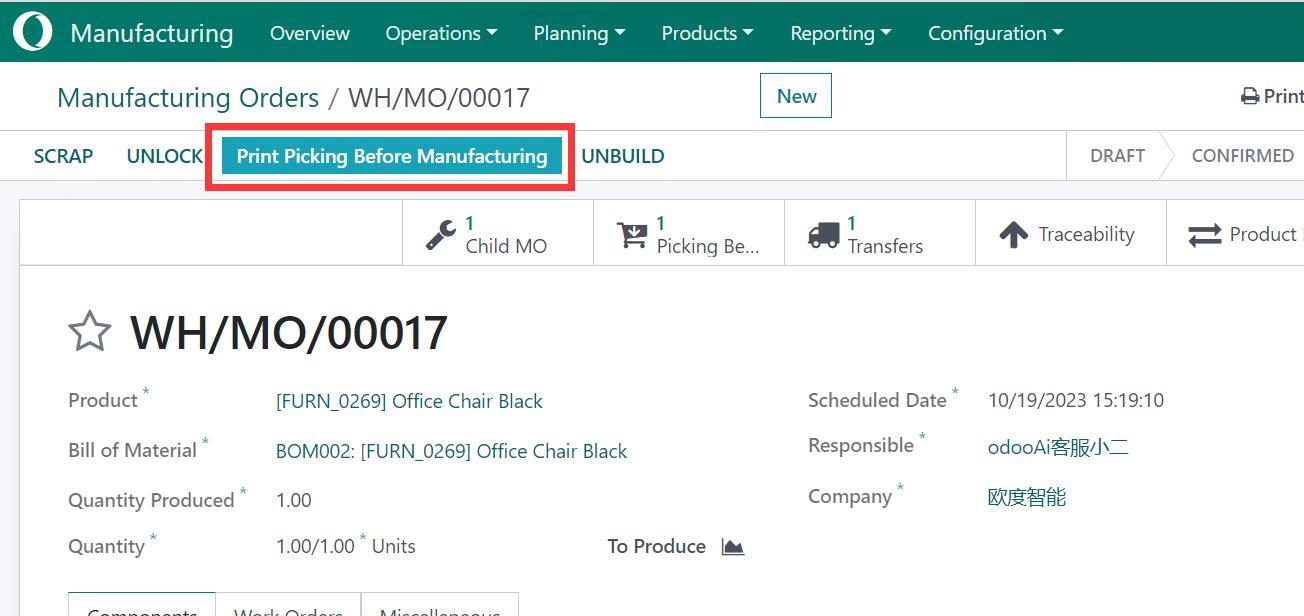
Supports forward and backward traceability of batches and serial numbers, recording supplier batches, production batches, operations, inspection results, and shipped customers. When a customer complains, you can trace back from the finished product serial number to the raw material batch number and operator, reducing traceability time from hours to minutes.
6. Equipment, maintenance, and OEE
Integrated equipment ledger, preventive maintenance, inspections, fault reporting, and spare parts management. Equipment status and downtime reasons feed into OEE analysis, helping distinguish four types of downtime: "no orders," "material shortage," "changeover," and "breakdown." Equipment data can be connected via IoT Box, edge gateway, or OPC UA/Modbus adapters.
7. Production cost
Work order costs support estimated vs. actual comparison, covering materials, labor, manufacturing overhead, and subcontracting, and can analyze standard cost variances. Timesheet and piece-rate data can flow back to payroll accounting, avoiding two sets of books for production and financial data.
8. Data integration and open interfaces
MES shares the same database and master data with CRM, sales, purchasing, inventory, finance, and PLM. It provides XML-RPC/JSON-RPC APIs for integration with WMS, SCADA, barcode, weighing, electronic kanban, and other systems.
How to calculate key metrics: OEE, kitting rate, first-pass yield, on-time delivery rate
The value of MES is not "having a system," but making the following metrics calculable, comparable, and accountable. Definitions must be unified across the plant; otherwise, different departments will reach different conclusions.
| Metric | Calculation basis | Common references | Consequences of distortion |
|---|---|---|---|
| OEE overall equipment effectiveness | Availability × Performance × Quality; Availability = actual operating time / planned operating time, Performance = actual output / theoretical output, Quality = good units / total output | World-class manufacturing often targets ≥85%; discrete manufacturing commonly sees 40%–60%, with wide variation by industry | Looking only at output without downtime hides the real bottleneck |
| Kit completeness rate | Kitted work orders / planned work orders; expanded by BOM, missing any item means not kitted | Most factories target ≥95% for improvement | Low kitting rate means production lines stop waiting for materials no matter how good the schedule looks. |
| First pass yield (FPY) | First-pass yield / input quantity, excluding rework and repair | Set baselines by industry and process | Rework and scrap costs are underestimated |
| On-time delivery rate (OTD) | Orders delivered by promised date / total orders | Most manufacturers target ≥95% | Sales commitments disconnected from capacity, customer churn |
| Inventory accuracy | SKUs matching physical count / total SKUs counted | Target ≥98% for improvement | Inaccurate records distort all MRP calculation results |
| Standard cost variance | Actual cost − standard cost, broken down by material, labor, and manufacturing overhead | Analyze by month, drill down by product/work order | Gross margin judgment distorted, quoting loses basis |
For the definition of OEE and the decomposition of the three rates, refer to ISO 22400-2 and equipment management practices in lean production; different enterprises may have differences in the attribution of planned downtime, changeover time, and trial production time. The definitions should be fixed before going live.
Which factories are suitable for open-source MES? First-phase modules by industry
Open-source MES is not "one template for all factories." Different processes have different bottlenecks, and the modules to launch first should differ accordingly.
| Industry/process | Typical pain points | Recommended to start with | Priority indicators |
|---|---|---|---|
| Electronics assembly / SMT | High-mix low-volume, many substitute materials, high batch traceability requirements | Work orders, scan-based reporting, IQC/first article, serial number traceability | FPY、OEE、WIP |
| Hardware machining | Equipment bottlenecks, tooling and molds, piece-rate wages | Finite capacity scheduling, equipment maintenance, piece-rate pay, first article inspection | OEE, on-time delivery rate |
| Injection molding | Mold-machine matching, cycle time fluctuations, regrind material reuse | Work orders, equipment/molds, batches, OEE | Cycle time, yield rate, downtime duration |
| Equipment manufacturing / non-standard | ETO project-based, long cycle, heavy outsourcing | Projects, BOM, operations, subcontracting and costs | Project gross margin, milestone achievement rate |
| New energy batteries / auto parts | Batch and serial number traceability, process parameters, customer audits | Batch traceability, quality inspection, equipment, SPC | Traceability completeness rate, yield rate |
| Medical devices | Regulatory traceability, batch records, cleanroom management | Serial numbers, batch records, quality inspection, audit trail | Traceability completeness rate, release cycle |
| Custom home furnishings | Order splitting, panel barcodes, kitting and delivery | BOM, barcode, kitting, scheduling | Kit completeness rate, delivery cycle |
| Footwear, apparel and bags | Style-color-size, operation piecework, outsourcing | Multi-spec BOM, operation reporting, piece-rate, subcontracting | Piece-rate accuracy, rework rate |
| Food / process manufacturing | Formula, shelf life, batch recall | Batch, expiry, quality inspection, equipment | Shelf-life accuracy, batch traceability |
Open-source MES vs commercial MES: cost, delivery, and controllability comparison
One-sentence answer: The advantages of open-source MES are controllable source code, same database as ERP, low software cost, and fast iteration; the trade-off is that you need a reliable implementation partner and cannot expect it to "automatically become lean once installed."
| Dimension | Traditional commercial MES | Odoo open-source MES |
|---|---|---|
| Software licensing | Charged by module, point, or user, high upfront investment | Community edition is free; Enterprise edition is subscription-based, choose as needed |
| Implementation cycle | Typically 3–12 months | First closed loop for a single workshop typically takes 2–4 weeks; full scope 6–12 weeks |
| Customization capability | Dependent on vendor scheduling, high secondary development costs | Python/XML source code is controllable, can be developed in-house or outsourced |
| Data sovereignty | Mainly SaaS, data on vendor side | Private deployment available; database owned by the enterprise |
| System integration | Interfaces quoted per project | Open ORM and API, same database as ERP reduces interfaces |
| Vendor lock-in | High migration cost | Code and data are portable, but require internal or partner capabilities |
| Applicability boundaries | Large process industries, deep APS, proprietary equipment protocols | Discrete manufacturing, high-mix low-volume, integrated industry and trade, rapid iteration |
Honest note: open source does not mean zero cost. Master data governance, process mapping, training, servers, and implementation services still require investment; complex process industries may need additional SCADA, APS, or specialized algorithms.
From 0 to 1 go-live: 4 phases and acceptance criteria
We recommend piloting with one workshop and one production line, then replicating after the closed loop runs successfully. Below is our commonly used four-phase path; the timelines are experience-based ranges depending on master data quality and scope.
Phase 0 · Master data governance (1–2 weeks)
Material coding, BOM accuracy, routings, work centers, teams, inspection items. Acceptance: BOM accuracy ≥98%, key material codes one item one code.
Phase 1 · Work order closed loop (2–3 weeks)
Sales/forecast → MRP → work order → material picking → work reporting → warehousing. Acceptance: work reporting timeliness ≥95%, work order status matches physical goods.
Phase 2 · Quality and traceability (2–3 weeks)
IQC/IPQC/FQC, batch and serial number, defect closed loop. Acceptance: any finished product can be traced back to raw material batch and process records within 5 minutes.
Phase 3 · Efficiency and cost (3–4 weeks)
OEE, equipment maintenance, labor hours/piece-rate, work order cost variance, management dashboards. Acceptance: OEE data completeness ≥90% (by shift), costs drillable by work order.
The 7 most common pitfalls in implementation
- Don't implement MES if BOM is inaccurate. If BOM is wrong, work order picking, kitting, and costs will all be wrong. First achieve BOM accuracy above 98%.
- Process routes rely on verbal descriptions from experienced masters. Without standard operations and standard work hours, scheduling and costing have no baseline.
- Work reporting becomes after-hours backfilling. Data delayed by a day makes scheduling meaningless. Use barcode scanning, tablets, and large displays to reduce data entry friction.
- Multiple codes for one item. When the same material has three codes in purchasing, warehouse, and shop floor, traceability will inevitably break.
- Implementing a system without changing processes. MES is a management transformation, not moving Excel to the web.
- Too many interfaces in phase one. First get the work order closed loop running, then gradually connect WMS, SCADA, and finance to avoid the project being dragged down by interfaces.
- Don't roll out plant-wide without a pilot line. Validate in one workshop first, then replicate to other workshops to minimize risk.
Open-source MES selection checklist (printable)
Checking against the 12 questions below is more effective than just looking at a feature list to judge whether an MES suits your factory.
- Does it support multi-level BOMs, substitute materials, and BOM versions?
- Does it support finite capacity scheduling and work center load?
- Does work reporting support scanning, tablets, and offline backfilling?
- Can batches and serial numbers be traced forward and backward?
- Are IQC/IPQC/FQC/OQC and AQL sampling configurable?
- Can the three OEE rates be adjusted to the company's actual situation?
- Does it support operation piecework and labor hour accounting?
- Are multi-plant, multi-language, and multi-currency natively supported?
- Does it share master data with ERP, WMS, and finance?
- Are API and secondary development restricted?
- Can it be deployed on-premises, and does the data belong to the enterprise?
- Does the implementation partner have delivery experience in the same industry and verifiable case studies?
FAQ about open-source MES and Odoo MES
Is open-source MES really free?
Software licenses can be free, but projects are not zero-cost. Odoo Community edition charges no license fee; Enterprise edition charges a subscription. Implementation, master data governance, custom development, servers, training, and operations still require investment. When evaluating costs, calculate "software + implementation + internal manpower + change costs" together.
What is the difference between Odoo MES and Odoo MRP?
MRP manages planning and material requirements, while MES manages shop floor execution and data collection. MRP answers "what to produce, what to buy, and when it is needed"; MES answers "which work order is in progress, which operation has been reached, who did it, and how many are qualified". In Odoo, both are implemented by combining modules such as Manufacturing, Shop Floor, Quality, and Maintenance, sharing a single set of data.
Can Odoo do equipment data collection?
Yes, but real-time control should still be handled by PLC/SCADA. Odoo can collect equipment status, counts, temperature, weight, and other data via IoT Box, edge gateways, and OPC UA/Modbus adapters; millisecond-level interlocking and safety control are not suitable for the MES layer.
How to schedule production in high-mix low-volume factories?
Schedule bottleneck work centers first, then the remaining operations. Use Gantt charts for finite capacity scheduling, combined with priorities, shortage lists, and split work orders; use ASAP scheduling for orders with tight delivery dates, and freeze orders with incomplete materials first to avoid "scheduling what cannot be produced."
Can it coexist with Kingdee, Yonyou, and SAP?
Yes, but first clarify the system of record for master data. A common approach is to retain the existing financial or group ERP and exchange orders, inventory, and cost data via API, intermediate tables, or files; do not let the same work order be modified separately in two systems.
Does it support batch and serial number traceability?
Yes. It can record supplier batches, production batches, operations, inspection results, and shipped customers by batch or serial number, supports forward and backward traceability, and can manage shelf life by FEFO.
How long does it take to implement open-source MES?
The first closed loop for a single factory and single workshop typically takes 2–4 weeks; the full scope including quality, traceability, and costing typically takes 6–12 weeks. Multi-factory, multi-language, or large historical data migrations will take longer. The timeline depends on master data quality, scope boundaries, and internal cooperation.
What servers are needed for on-premise deployment?
A single Linux server with PostgreSQL is enough to start. Configure CPU, memory, and disk based on the number of concurrent users, work reporting terminals, and data retention period; it can also be deployed on a cloud host or the enterprise's own virtualization platform. For production environments, backups, monitoring, and a test database are recommended.
What's the difference between open-source MES and commercial MES?
Advantages are same database as ERP, controllable source code, low software cost, and fast iteration; disadvantages are that ultra-large-scale process industries, proprietary equipment protocols, and deep APS require additional integration. Commercial MES has accumulated industry-specific templates and vendor services, while open-source solutions rely more on the capabilities of implementation partners.
Can I try before deciding?
Yes. Odoo Community edition can be downloaded and deployed for free, and you can also book an online trial and manufacturing industry diagnostic. It is recommended to first run a material issue—work reporting—receipt closed loop using your own BOM and a real work order, then evaluate whether to expand.
Glossary: Understanding abbreviations in MES selection documents
| Terminology | English | One-sentence explanation |
|---|---|---|
| BOM | Bill of Materials | Bill of materials, describing which materials and quantities make up a product. |
| Routing | Routing | The sequence of operations, work centers, and standard hours a product goes through. |
| Work order | Manufacturing Order, MO | The execution unit of a production task, including product, quantity, delivery date, and operations. |
| WIP | Work in Process | Work in progress: materials or semi-finished goods that have entered production but are not yet completed. |
| OEE | Overall Equipment Effectiveness | Overall equipment effectiveness equals the product of availability, performance, and quality rates. |
| OTD | On-Time Delivery | On-time delivery rate, the proportion of orders delivered by the promised date. |
| FPY | First Pass Yield | First pass yield, the proportion of products that pass without rework or repair. |
| AQL | Acceptable Quality Limit | Acceptable quality limit, a core parameter of sampling plans, commonly based on GB/T 2828.1 or ISO 2859-1. |
| SPC | Statistical Process Control | Statistical process control: use control charts to determine whether a process is stable. |
| CAPA / 8D | Corrective and Preventive Action | Corrective and preventive actions; 8D is an eight-step method for solving repetitive quality problems. |
| MTO / ATO / ETO | Make/Assemble/Engineer to Order | Make-to-order, assemble-to-order, and engineer-to-order have different delivery models, so MES priorities differ as well. |
| ISA-95 | IEC 62264 | Enterprise control system integration standard, using layers 0–4 to divide equipment, control, manufacturing operations, and business management. |
Learn more: open-source MES solutions and modules
- MRP manufacturing: from BOM and scheduling to shop floor execution— Learn the specific features and operations of the Odoo Manufacturing module.
- From MRP to MES to QMS: the three stages of manufacturing digitalization—Understand the sequence and boundaries of the three-tier systems.
- Quality inspection and QMS: IQC/IPQC/OQC, AQL, and 8D closed loop—Turn quality data into traceable records.
- Warehouse inventory: multiple warehouses and locations, batch/serial numbers, and FEFO— The material foundation of MES.
- Equipment maintenance: upkeep, repair requests, downtime and OEE—Bring equipment data into efficiency analysis.
- PLM product development: EBOM/MBOM, ECO/ECN, and version management—Sync design changes to production.
Book an open-source MES assessment Try online
This article is a reference for selection and implementation and does not constitute a commitment to any specific project timeline, cost, or benefit. The actual scope must be assessed based on the enterprise's master data, processes, and organizational conditions.