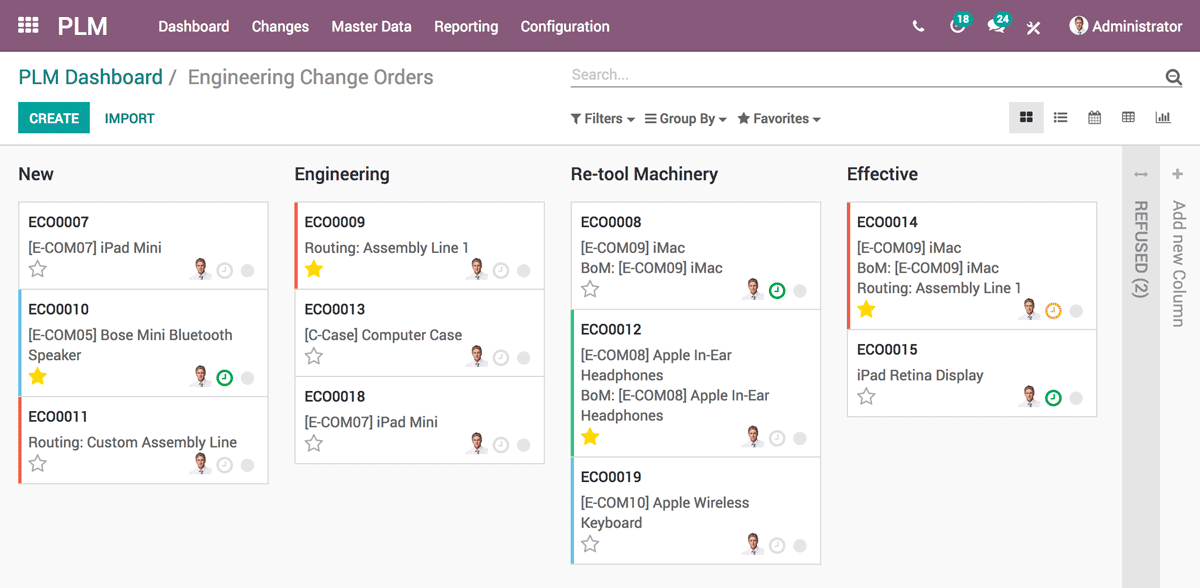
Centralized management of product structures, versions, changes, and documents; change impacts can be assessed; BOMs and process documents are directly released to production; R&D data is integrated with materials and cost accounting.
Related solutions:Open Source ERP + Open Source MES Integration · Free Trial
Manage Engineering Changes
Communicate in real time.
Effectively manage communication involved in engineering changes. The Odoo PLM application leverages the power of enterprise social networking to help you communicate more efficiently across departments. Everyone focuses only on what they need, approvals are simple, and discussions are centralized and real-time.
Integrated Document Management
For drawings, timesheets, and quality documents.
Transmit information to the production department through alerts triggered on work orders or work center control panels.
Attach your files directly to bills of materials, routings, or anywhere else.
Easily manage multiple versions of your documents. Odoo Product Lifecycle is powerful and easy to use.
Intelligent Version Management
Efficiently compare and merge.
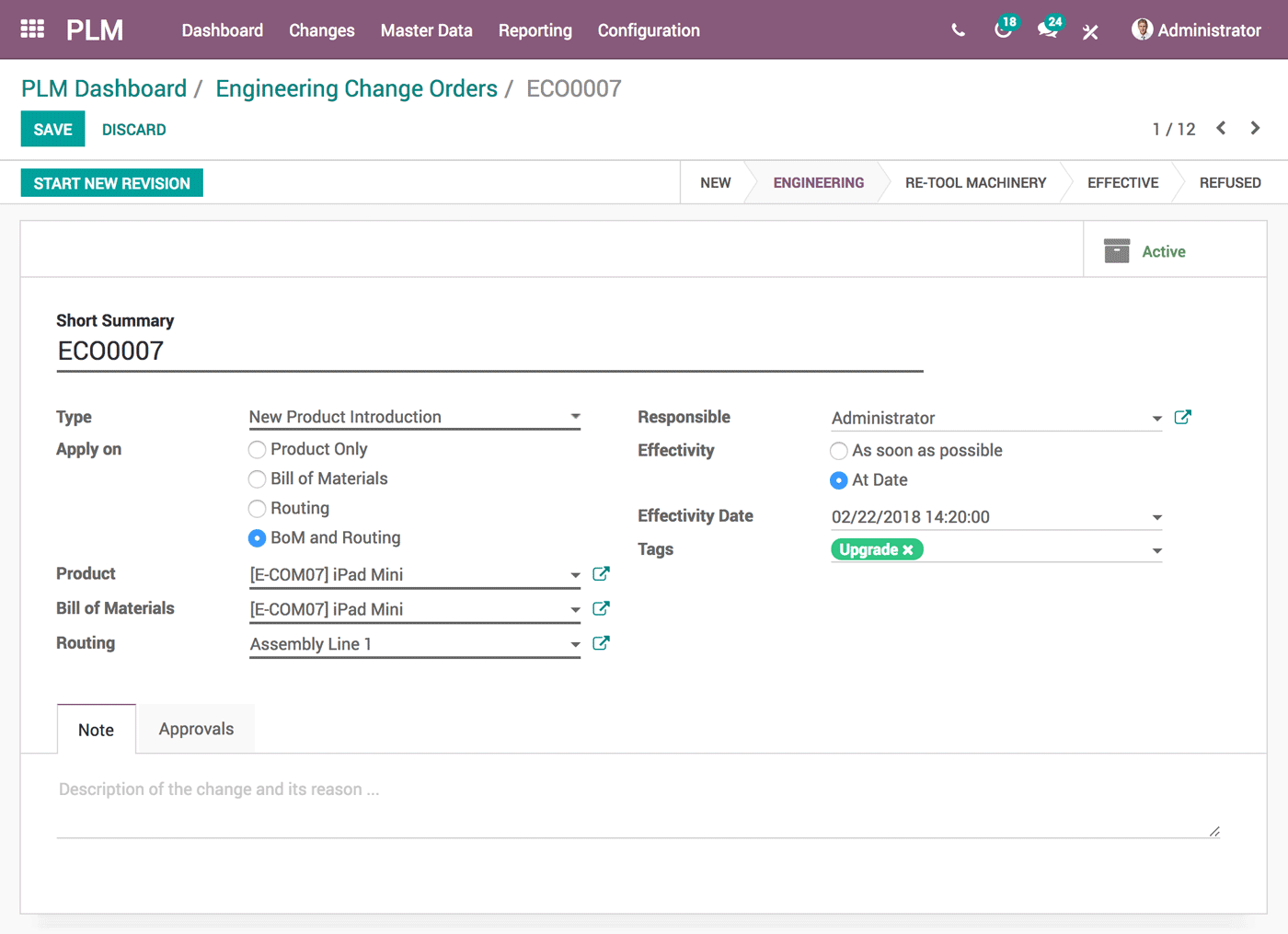
No need to synchronize EBoM and MBoM. Odoo coordinates the documents used by all departments, so you can effectively track document changes across multiple versions.
With Odoo Product Lifecycle, you can use multiple versions of the same BoM in parallel and apply only the differences to manage multiple changes.
EBOM, ECO, and Versions: How to Keep R&D Changes Under Control
Odoo 20 PLM introduces generic ECO reports, BOM comparison, product updates, and optional ECO version updates: view cost comparisons for all BOM changes in one comprehensive report, visually compare BOM differences, and more easily introduce new products and track versions when applying ECOs to products/BOMs.
Manufacturing companies need to link EBOM, MBOM, process BOM, alternative materials, versions/revisions, ECO/ECN, change impact analysis, CAD/PDM documents, trial production/mass production, and approval trails; a change is not just modifying a BOM, but synchronizing materials, processes, costs, inventory, and work orders in progress.
- BOM Comparison: EBOM/MBOM Differences and Cost Impact
- ECO/ECN: Change Requests, Impact Analysis, Approval, and Effectivity
- Versions and Alternatives: Product Versions, Material Substitution, and Optional ECO Versions
- Document Control: Drawings, Processes, Versions, Permissions, and Validity Periods
- From R&D to Manufacturing: BOM Release, Trial Production, Mass Production, and Cost Accounting
Is it the same BOM as in MRP?
Yes, PLM manages changes and versions, while MRP uses the effective version for scheduling and material calculation.
Will changes affect work orders in progress?
The scope of impact can be assessed, and whether to switch is determined by the effective date, avoiding confusion in work-in-process materials.
Further reading:Odoo 20 New Features Overview: 58 Modules, 673 Capabilities
PLM Product R&D and Open Source ERP: What Can Be Solved
From the perspective of open source ERP, the value of PLM product R&D lies not only in individual features, but in integrating business data, processes, and reports into a unified whole.
- Centralized management of product structures, versions, changes, and documents
- Change impacts can be assessed
- BOMs and process documents are directly released to production
Non-standard R&D BOMs are inherently multi-version parallel
Non-standard projects often have quotation BOM, design BOM, and manufacturing BOM simultaneously. When the customer changes requirements, all three versions need to be updated. In PLM, manage EBOM and MBOM separately, route changes through ECN, and impact analysis shows which materials and work orders are affected, so you can decide which version to switch from.
Drawings, processes, and inspection documents are archived with versions. When copying an order, you can directly retrieve the old version and modify it without starting from scratch. In the R&D phase of non-standard manufacturing ERP, clarify version relationships first so that subsequent procurement and production won't repeat work.
Frequently Asked Questions about PLM Product R&D
What types of enterprises is PLM Product R&D suitable for?
Suitable for enterprises that need centralized management of product structures, versions, changes, and documents, especially teams that want to integrate PLM Product R&D into an open-source ERP system and connect it with sales, procurement, inventory, and financial data.
Can PLM Product R&D be integrated with other modules of the open-source ERP?
It can share a single set of data with modules such as sales, purchase, inventory, production, finance, and customer service, reducing duplicate entry; the specific integration scope is configured according to business scenarios during the implementation phase.
How to start using PLM Product R&D?
Free trial is supported. OdooAi provides requirement analysis, implementation and go-live, training, and secondary development, covering integrated industry and trade and cross-border compliance scenarios.
Related solutions:Open Source ERP + Open Source MES Integration · Free Trial
Requirements met one by one
Scales as You Grow

Manufacturing
Comprehensive work center control panel solution
Purchase
Automated replenishment to maintain appropriate inventory levels.
Maintenance
Plan preventive maintenance and take quick corrective actions.
Quality Control
Define quality control points and easily trigger quality alerts.