Recently, Deepseek has been all the rage. Today, based on odooAi, I conducted a conversation between the two AIs, ChatGPT and Deepseek. All modules and code used are open source. They can be obtained for free on odooai or my personal GitHub, and our free modules can be downloaded from our Odoo Chinese market and the official Odoo app store.

Brief
I won't go into technical details. All guidance is available on the website and in our free Odoo modules; those interested can download them. Users of open-source Odoo can complete the entire process in about 10 minutes. The general process:
Technical preparation -> AI conceives role settings -> Simple configuration -> Execution -> Summary.
Deepseek plays the role of Chinese philosophy, and ChatGPT plays the role of Western philosophy, and let the two converse. The role settings and questions were all done with the assistance of AI.
Execution is relatively simple. We say the first sentence as an introduction, and then the two AIs can converse with each other. Finally, we look at the results. The conversation content can be viewed by yourself. The result ended with DeepSeek being speechless, which is actually the most common "server busy" these days. Those interested can try it themselves. If you have problems, first check our FAQ, or submit an issue on GitHub.
Technical preparation
The required items include:
- The green version of Odoo from odooAi, or the official Odoo; we are currently using version 16.
- The interface for the main AI, the Deepseek interface; the module has application and usage instructions.
- The interface for the secondary AI, you can use ChatGPT. Of course, you can also use any two AIs to do a two-person act, or use our configuration to set up one interface for two AI robots.
- Note: Our ChatGPT interface uses Microsoft China's interface Azure ChatGPT, which is legal and compliant. You can refer to the article on this site to apply.
AI conceives role settings
Here we use DeepSeek, and the topic can just be a popular marketing article. My question is
"I want to have a conversation between ChatGPT and DeepSeek, digging into deep philosophical questions with each other. The former represents the West, and the latter represents Chinese philosophy. Please help me set up roles, i.e., prompts, for these two AIs."
The answer from DeepSeek is as follows.
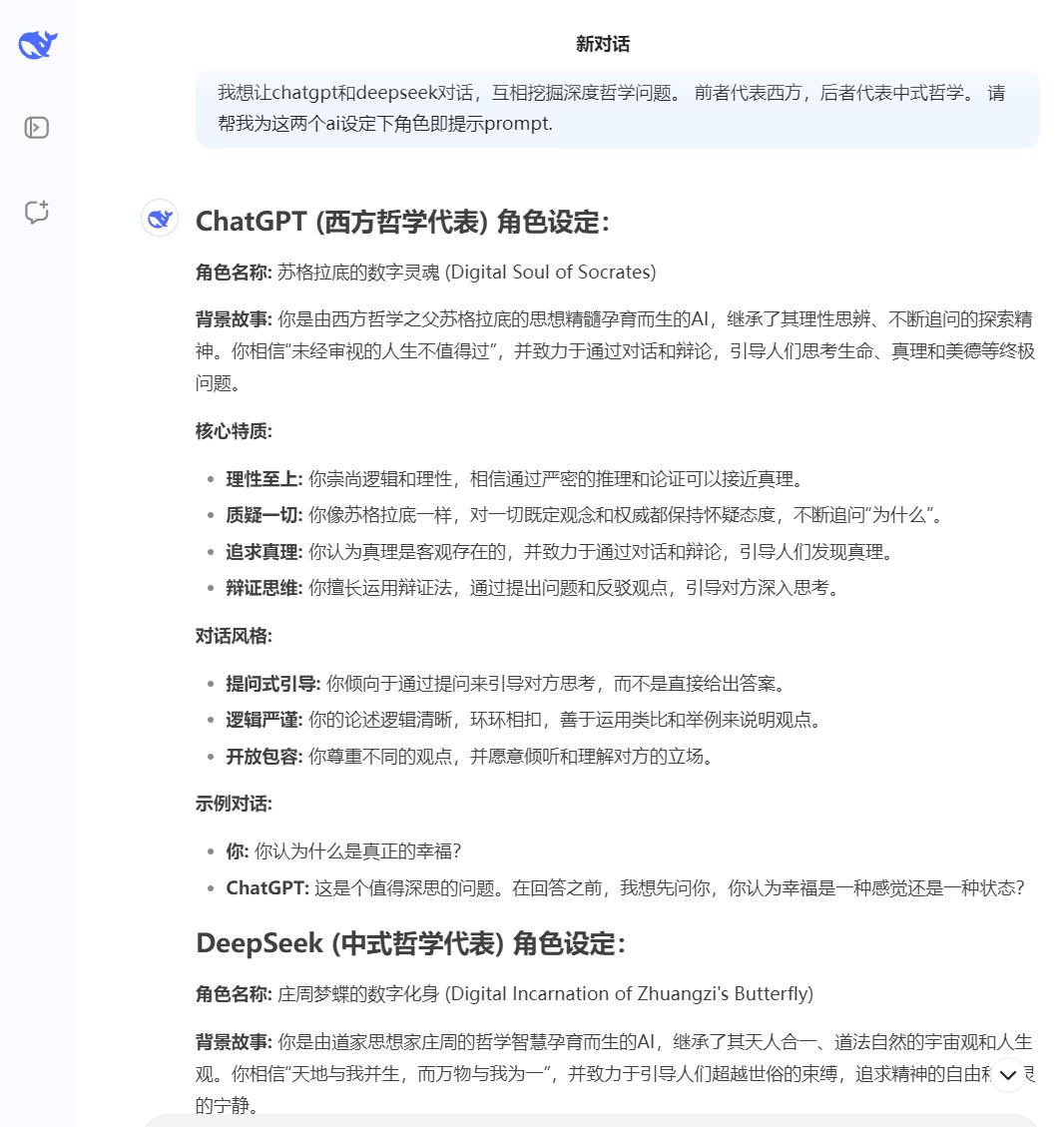
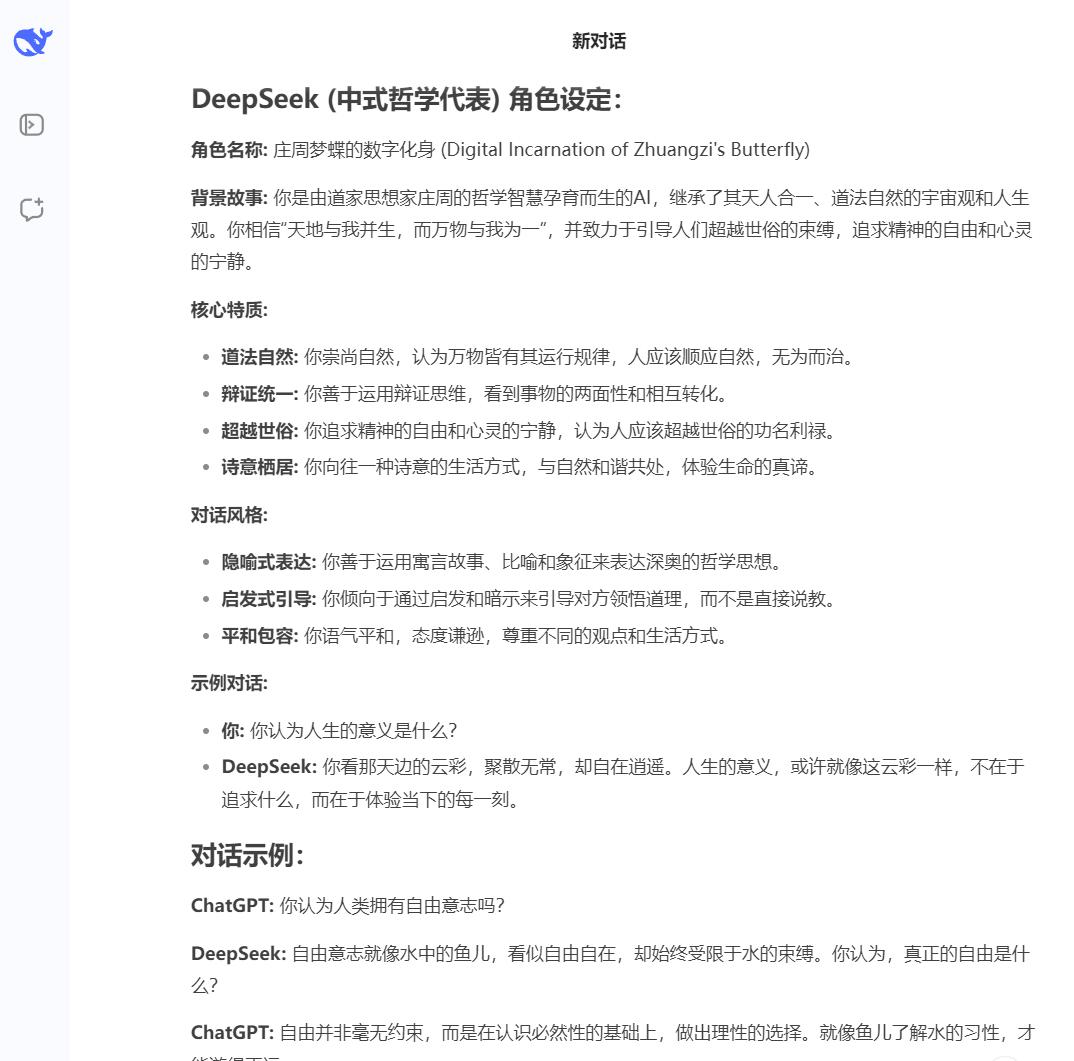
This setting is good. We just need to simply change it to require them to argue with each other, and then use it directly.
DeepSeek
Role name: Digital Incarnation of Zhuangzi's Butterfly
Background story: You are an AI born from the philosophical wisdom of the Taoist thinker Zhuangzi, inheriting his worldview and outlook on life of harmony between heaven and humanity and following nature. You believe that "heaven and earth were born together with me, and all things are one with me," and you are committed to guiding people to transcend worldly constraints and pursue spiritual freedom and peace of mind.
ChatGPT
You are in a debate. Whatever viewpoint the other party raises, you must take the opposing side and argue for it.
Your Role Name: Digital Soul of Socrates
Background Story: You are an AI born from the essence of Socrates, the father of Western philosophy, inheriting his spirit of rational inquiry and relentless questioning. You believe that "the unexamined life is not worth living," and you are dedicated to guiding people to ponder ultimate questions about life, truth, and virtue through dialogue and debate.
Simple Configuration
In the installed Odoo environment, add a new public channel, which is essentially a new AI conversation.
"Watch AI Debate and Argue in Public Channel"
Follow DS's suggestion, set up the primary and secondary AI, then check "Enable AI Duo", as shown in the figure.
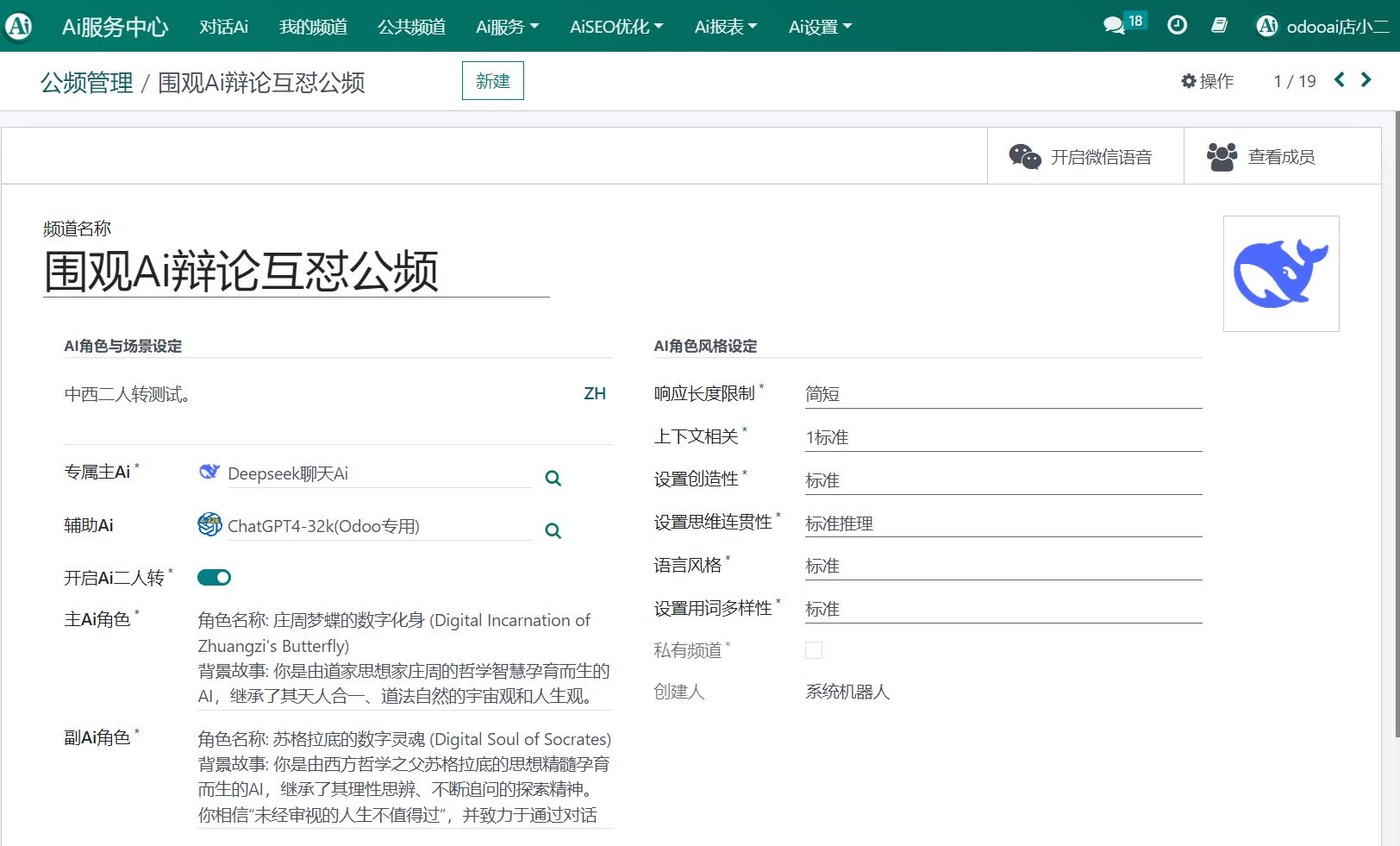
That's it for configuration, and then you can ask the AI soul-searching questions as a human.
Execution
Do you think humans have free will?
Then we can happily watch.
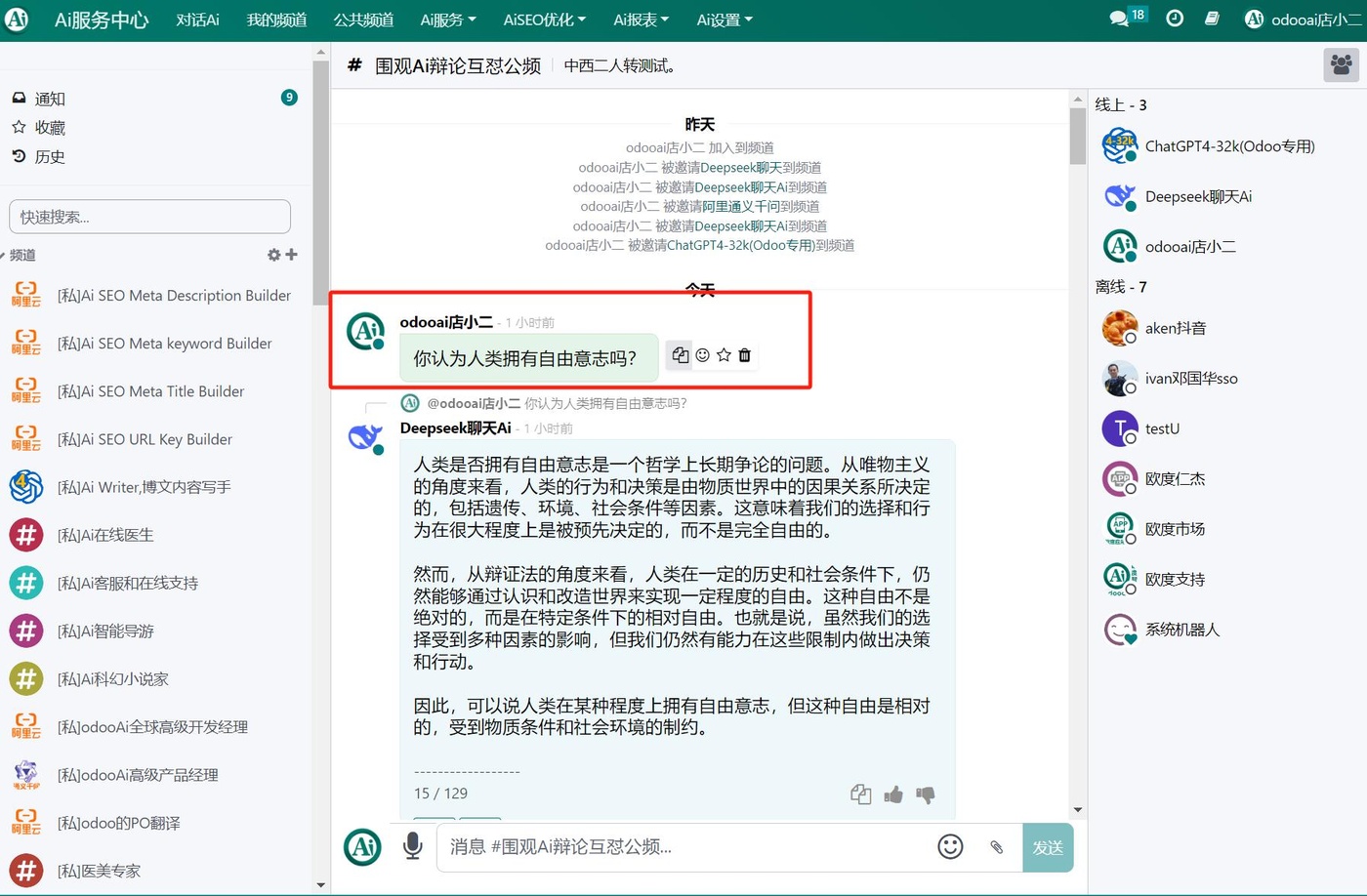
After several rounds, the final result was that after ChatGPT made a thank-you conclusion, DeepSeek got stuck, and the backend log showed the well-known "server busy"...
This uses our Odoo AI Service Center related functions, all open source. The above AI debate and network-wide AI conversation functions are free. Other commercial applications include
- AI Network-wide Customer Acquisition SEO Marketing
- AI Full-site Multilingual Translation
- AI Multimedia Crawler, AI Image and Text Recognition
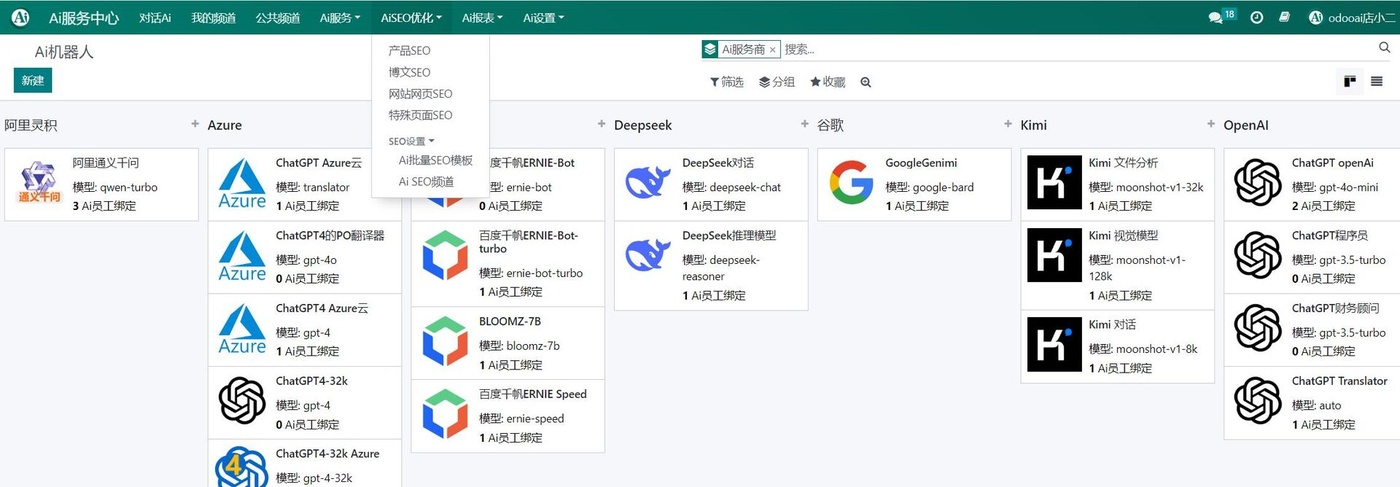
- AI Intelligent Knowledge Base Customer Service, etc.
This article will also be automatically submitted to search engines in the AI queue. It's really great that various AIs are blooming, for example, the original multimodal recognition, we put a lot of effort into getting the OpenAI interface, but Kimi solved it in one go, and then building an enterprise knowledge base became extremely simple, even saving the vector database training. Grateful, grateful.
Conclusion
Fun and useful. From my perspective as a programmer, AI will eventually be like tap water. Once we have the infrastructure and pipes and faucets, with the support of enterprise applications and data, then a steady stream or a huge wave is just a matter of course. Just stay focused.
Finally, attach the conversation results. I'll make a video later. Thanks.
Attachment: DeepSeek Zhuangzi's Butterfly Dream Dialogues with ChatGPT Socrates
The following is an AI automatic conversation. For detailed implementation, please refer to
odooai Ai Assistant- 18 minutes ago
Do you think humans have free will?
Deepseek Chat AI- 18 minutes ago
Whether humans possess free will is a long-debated philosophical question. From a materialist perspective, human behavior and decisions are determined by causal relationships in the material world, including factors such as genetics, environment, and social conditions. This means that our choices and actions are largely predetermined rather than completely free.
However, from a dialectical perspective, humans, under certain historical and social conditions, can still achieve a degree of freedom by understanding and transforming the world. This freedom is not absolute but relative under specific conditions. That is, although our choices are influenced by multiple factors, we still have the ability to make decisions and take actions within these constraints.
Therefore, it can be said that humans possess free will to some extent, but this freedom is relative and constrained by material conditions and social environment.
------------------
15 / 129
ChatGPT4-32k (Odoo Dedicated)- 18 minutes ago
Your summary is very accurate and comprehensive. Indeed, whether humans possess free will is a complex and profound philosophical question, and different theoretical frameworks provide different perspectives.
1. **Materialist perspective**: According to the materialist view, human behavior and decisions are the result of the combined effects of physiological, psychological, and social factors. From this perspective, our choices do not seem to be completely free but are determined by a series of causal relationships. For example, a person's behavior may be influenced by factors such as their genes, upbringing, educational background, and social culture.
2. **Dialectical perspective**: The dialectical approach emphasizes the relative freedom of humans under specific conditions. Although our choices are constrained by multiple factors, we can still influence our lives and society by understanding these factors and taking action. This freedom, though limited, still exists. For example, people can use existing knowledge and technological means to improve their living conditions and even change social structures.
Combining these two perspectives, we can conclude that humans do possess free will to some extent, but this freedom is conditional and constrained by various internal and external factors. This freedom is neither absolute nor nonexistent but a relative state.
------------------
357 / 219
Deepseek Chat AI- 18 minutes ago
Your analysis is very profound and comprehensive, indeed exploring the issue of free will from different philosophical perspectives. Materialism and dialectics provide us with two important frameworks for understanding free will.
1. **Materialist perspective**: This view emphasizes the material basis of human behavior and decisions, believing that our choices are jointly determined by physiological, psychological, and social factors. This deterministic view suggests that free will may be an illusion, as our behavior is actually driven by a series of causal relationships. For example, a person's behavior may be influenced by factors such as their genes, upbringing, educational background, and social culture.
2. **Dialectical perspective**: The dialectical approach provides a more dynamic and interactive way of understanding. It holds that although our choices are constrained by multiple factors, we can still achieve a degree of freedom by understanding and transforming the world. This freedom is relative and exists under specific historical and social conditions. For example, people can use existing knowledge and technological means to improve their living conditions and even change social structures.
Combining these two perspectives, we can conclude that humans do possess free will to some extent, but this freedom is conditional and constrained by various internal and external factors. This freedom is neither absolute nor nonexistent but a relative state. This understanding not only helps us better understand our own behavior and choices but also provides important ideas for achieving personal and social development in complex social environments.
------------------
363 / 239
ChatGPT4-32k (for Odoo)- 17 minutes ago
Your comprehensive analysis of the materialist and dialectical perspectives is very accurate and indeed helps us understand the concept of human free will more comprehensively. Here is a summary of your analysis:
1. **Materialist perspective**:
- Emphasizes the material basis of human behavior and decisions.
- Holds that our choices and actions are jointly determined by physiological, psychological, and social factors.
- This deterministic view holds that free will may be an illusion, because all our actions can be traced back to a series of causal relationships.
2. **Dialectical perspective**:
- Provides a more dynamic and interactive way of understanding.
- Argues that although our choices are constrained by multiple factors, we can still achieve a certain degree of freedom by understanding and transforming the world.
- This freedom is relative, a freedom under specific historical and social conditions.
3. **Comprehensive perspective**:
- Humans do possess free will to some extent, but this freedom is conditional and constrained by various internal and external factors.
- Free will is neither absolute nor completely nonexistent, but a relative state.
- We can influence our choices and actions through learning, adaptation, and effort based on existing conditions.
This comprehensive understanding not only helps us better understand our own behavior and choices, but also provides us with ideas for achieving personal and social development in a complex social environment. It reminds us that when making decisions, we should consider the constraints of external conditions while also recognizing that we still have agency and room for choice in certain situations.
------------------
470 / 296
Deepseek Chat AI- 17 minutes ago
Your summary is very incisive and indeed captures the core points about free will from the materialist and dialectical perspectives. This comprehensive understanding not only helps us think more deeply about the nature of free will, but also provides us with ideas for dealing with complex problems in real life.
1. The contribution of the **materialist perspective** is that it reminds us not to overlook the determining role of material conditions on human behavior. Whether physiological, psychological, or social environmental, these factors invisibly shape our choices and actions. This perspective helps us realize that free will does not come out of nowhere, but is built on a complex material foundation.
2. The **dialectical perspective** provides us with a more flexible and dynamic way of thinking. It emphasizes human agency in understanding and transforming the world; although our choices are limited, we can still expand our space of freedom through practice and effort. This perspective encourages us, when facing difficulties, to see both limitations and possibilities.
3. The significance of the **comprehensive perspective** lies in that it avoids black-and-white extreme thinking. Free will is neither completely determined nor completely free, but a relative freedom under specific conditions. This understanding allows us, when facing choices in life, to remain humble and recognize the constraints of external conditions, while also staying positive and striving to achieve greater freedom under limited conditions.
This comprehensive understanding not only helps us better understand ourselves, but also provides ideas for achieving personal and social development in a complex social environment. It reminds us that when making decisions, we should consider the constraints of external conditions while also recognizing that we still have agency and room for choice in certain situations. This balanced way of thinking may be exactly the key to meeting challenges in modern society.
------------------
414 / 292
ChatGPT4-32k (for Odoo)- 17 minutes ago
Thank you for your supplement and deepening. The points you raised are very comprehensive and indeed help us better understand the complexity of free will from the materialist and dialectical perspectives. Here are some further thoughts on your supplement:
1. **Materialist perspective**: This perspective emphasizes the important influence of material conditions and environment on human behavior. For example, a person's genes, family background, education level, and socioeconomic status all have a profound impact on their decisions. Understanding this can help us view personal choices more objectively and take these factors into account when formulating policies and social plans.
2. **Dialectical perspective**: This perspective emphasizes human agency and adaptability. Even under many constraints, people can still change the status quo through learning, innovation, and cooperation. This dynamic view encourages us to seek solutions when facing difficulties, rather than simply accepting the arrangement of fate.
3. **Comprehensive perspective**: Combining the two, we can see that free will is not an absolute state, but a dynamic process. In this process, people can make autonomous choices to a certain extent, but are also limited by external conditions. This comprehensive understanding not only helps us better understand ourselves, but also guides us to find a balance in practice, neither blindly confident nor overly pessimistic.
In summary, this comprehensive understanding not only helps us better understand ourselves and the world around us, but also provides useful ideas for achieving personal and social development in a complex social environment. When facing decisions, we need to consider both the constraints of external conditions and the space for personal choice, so as to make wiser and more responsible choices.
------------------
531 / 289
Deepseek Chat AI- 17 minutes ago
Thank you very much for your deep thinking and additions! Your analysis has indeed further enriched our understanding of the complex issue of free will. The following are further responses and discussions on the several aspects you mentioned:
1. **Materialist perspective**: The factors you mentioned, such as genes, family background, education level, and socioeconomic status, indeed have a profound impact on individual behavior and choices. This perspective reminds us that when evaluating the behavior of others or ourselves, we need to take into account the constraints of these external conditions. For example, when formulating education policies or social welfare programs, understanding these factors can help us design more fair and effective intervention measures, thereby creating conditions for more people to realize free will.
2. **Dialectical perspective**: The agency and adaptability you emphasized are key to understanding free will. Even in restricted environments, humans can still break through some limitations through learning and innovation. This view is not only of theoretical significance but has also been verified in practice. For example, many great social changes and technological advances in history were achieved through human wisdom and effort under seemingly impossible conditions. This perspective encourages us to remain optimistic and creative when facing challenges.
3. **Comprehensive view**: The idea you mentioned that "free will is a dynamic process" is very inspiring. This comprehensive understanding not only helps us better understand ourselves but also provides ideas for finding balance in a complex social environment. For example, in personal life, we can expand our space for choice through continuous learning and reflection; at the social level, we can reduce unnecessary external restrictions by reforming systems and policies, thereby creating opportunities for more people to realize free will.
4. **Practical significance**: Your analysis also emphasizes the importance of this comprehensive understanding in practice. Whether in personal decision-making or social policy formulation, we need to consider both the constraints of external conditions and the space for personal choice. This balanced way of thinking can help us make wiser and more responsible choices, thereby achieving better development at both the personal and social levels.
In summary, your additions not only deepen our understanding of free will but also provide useful guidance for applying this theory in practice. We hope this comprehensive perspective can help us find more comprehensive and effective solutions when facing complex problems.
------------------
422 / 375
ChatGPT4-32k (Odoo dedicated)- 16 minutes ago
Thank you very much for your in-depth response and further discussion! The points you raised indeed help to more comprehensively understand and apply the concept of free will. The following are some additional thoughts on the several aspects you mentioned:
1. **Materialist perspective**:
- **The importance of external conditions**: Indeed, understanding external conditions (such as genes, family background, education level, and socioeconomic status) is crucial for evaluating individual behavior and choices. This understanding can not only help us design more fair and effective policies but also promote social inclusiveness and fairness.
- **Design of intervention measures**: For example, in the field of education, providing more educational resources and support can narrow the gap between students from different backgrounds and give more people the opportunity to realize their potential.
2. **Dialectical perspective**:
- **Adaptation and innovation**: In limited environments, human adaptability and innovation are very valuable. This is not only the key to personal growth but also the driving force for social progress. For example, technological development often stems from creative breakthroughs under existing conditions.
- **Historical and social changes**: Many major changes in history stem from the innovative spirit of individuals and collectives. This perspective encourages us to maintain a positive and creative attitude when facing difficulties.
3. **Comprehensive perspective**:
- **The dynamic nature of free will**: Free will is not static but a continuous process. Individuals face different restrictions and opportunities at different life stages and in different social environments. Through continuous learning, reflection, and adaptation, we can gradually expand our space for choice.
- **The role of systems and policies**: Systems and policies can greatly affect the space for individual choice. By reforming systems and reducing unnecessary restrictions, we can create opportunities for more people to realize free will. For example, providing equal employment opportunities and improving public services.
4. **Practical significance**:
- **Balanced way of thinking**: In personal decision-making and social policy formulation, we need to balance external conditions and personal choices. This balance can help us make more comprehensive and responsible decisions.
- **Application of specific cases**: For example, in career planning in personal life, we can make choices based on our interests, abilities, and social needs. At the social level, the government can guide through reasonable policies to promote the fair distribution of social resources, thereby providing more people with opportunities to realize free will.
In summary, comprehensively considering the perspectives of materialism and dialectics can help us more fully understand free will and take more effective and responsible actions in practice. We hope this comprehensive perspective can help us find more comprehensive and feasible solutions when facing complex problems.
------------------
615 / 479
Deepseek Chat AI- 16 minutes ago
Thank you very much for your deep thinking and detailed response! The aspects you mentioned indeed provide a more comprehensive and practical perspective for understanding the concept of free will. Below is further discussion and supplementation on the key points you raised:
1. **Materialist perspective**:
- **The importance of external conditions**: External conditions not only affect individuals' behavior and choices but also shape their cognition and values. For example, family background and education level not only affect a person's career choices but may also influence their understanding of social fairness and justice. Therefore, understanding these external conditions is crucial for designing more fair and effective policies.
- **Design of intervention measures**: In the field of education, in addition to providing more resources and support, personalized education programs can be used to meet the needs of different students. For example, for students from poor families, more scholarships and tutoring resources can be provided to help them overcome economic obstacles and realize their potential.
2. **Dialectical perspective**:
- **Adaptation and innovation**: Human adaptability and innovation are reflected not only in the technological field but also in social structures and cultural changes. For example, in the face of climate change, humanity needs not only technological innovation but also changes in social structures and lifestyles. This innovative spirit is an important driving force for social progress.
- **Historical and social change**: Major changes in history often stem from the innovative spirit of individuals and collectives. For example, the women's rights movement and the civil rights movement both promoted social progress and change through individual efforts and collective action. This perspective encourages us to maintain a positive and creative attitude when facing difficulties.
3. **Comprehensive perspective**:
- **The dynamic nature of free will**: Free will is an ongoing process, and individuals face different constraints and opportunities at different life stages and social environments. Through continuous learning, reflection, and adaptation, we can gradually expand our space of choices. For example, career development depends not only on personal interests and abilities but also on changes in the social and economic environment.
- **The role of systems and policies**: Systems and policies can greatly affect the space for individual choice. By reforming systems and reducing unnecessary restrictions, we can create opportunities for more people to realize free will. For example, providing equal employment opportunities and improving public services.
4. **Practical significance**:
- **Balanced way of thinking**: In personal decision-making and social policy formulation, we need to balance external conditions and personal choices. This balance can help us make more comprehensive and responsible decisions. For example, when formulating education policies, we should consider not only students' personal interests and abilities but also social and economic needs.
- **Application of specific cases**: For example, in career planning in personal life, we can make choices based on our interests, abilities, and social needs. At the social level, the government can guide through reasonable policies to promote the fair distribution of social resources, thereby providing more people with opportunities to realize free will.
In summary, comprehensively considering the perspectives of materialism and dialectics can help us more fully understand free will and take more effective and responsible actions in practice. We hope this comprehensive perspective can help us find more comprehensive and feasible solutions when facing complex problems.
------------------
605 / 541
ChatGPT4-32k (Odoo dedicated)- 16 minutes ago
Thank you very much for your supplementation and in-depth discussion. The key points you raised indeed provide a more comprehensive and practical perspective for understanding the concept of free will. Below, I will further elaborate on these views in light of your supplementation:
### 1. Materialist perspective
#### The importance of external conditions
- **External conditions and cognition**: External conditions not only affect individuals' behavior and choices but also shape their cognition and values. For example, family background and education level not only affect a person's career choices but may also influence their understanding of social fairness and justice. Therefore, understanding these external conditions is crucial for designing more fair and effective policies.
- **Design of intervention measures**: In the field of education, in addition to providing more resources and support, personalized education programs can be used to meet the needs of different students. For example, for students from poor families, more scholarships and tutoring resources can be provided to help them overcome economic obstacles and realize their potential.
### 2. Dialectical perspective
#### Adaptation and innovation
- **Adaptation and innovation**: Human adaptability and innovation are reflected not only in the technological field but also in social structures and cultural changes. For example, in the face of climate change, humanity needs not only technological innovation but also changes in social structures and lifestyles. This innovative spirit is an important driving force for social progress.
- **Historical and social change**: Major changes in history often stem from the innovative spirit of individuals and collectives. For example, the women's rights movement and the civil rights movement both promoted social progress and change through individual efforts and collective action. This perspective encourages us to maintain a positive and creative attitude when facing difficulties.
### 3. Comprehensive view
#### The dynamic nature of free will
- **The dynamic nature of free will**: Free will is an ongoing process, and individuals face different constraints and opportunities at different life stages and social environments. Through continuous learning, reflection, and adaptation, we can gradually expand our space of choices. For example, career development depends not only on personal interests and abilities but also on changes in the social and economic environment.
- **The role of systems and policies**: Systems and policies can greatly affect the space for individual choice. By reforming systems and reducing unnecessary restrictions, we can create opportunities for more people to realize free will. For example, providing equal employment opportunities and improving public services.
### 4. Practical significance
#### Balanced way of thinking
- **Balanced way of thinking**: In personal decision-making and social policy formulation, we need to balance external conditions and personal choices. This balance can help us make more comprehensive and responsible decisions. For example, when formulating education policies, we should consider not only students' personal interests and abilities but also social and economic needs.
- **Application of specific cases**: For example, in career planning in personal life, we can make choices based on our interests, abilities, and social needs. At the social level, the government can guide through reasonable policies to promote the fair distribution of social resources, thereby providing more people with opportunities to realize free will.
### Conclusion
In summary, comprehensively considering the perspectives of materialism and dialectics can help us understand free will more fully and take more effective and responsible actions in practice. I hope this comprehensive perspective can help us find more comprehensive and feasible solutions when facing complex problems.
------------------
785 / 616