As global competition intensifies and digital transformation deepens, manufacturing enterprises in Hong Kong and the Greater Bay Area are facing unprecedented management challenges. Traditional ERP systems often struggle to meet the complex needs of the "two-ends-outside" manufacturing model (R&D/branding in Hong Kong, production in mainland China/Southeast Asia). The open-source ERP system Odoo, with its flexibility, localization support, and global capabilities, is becoming the preferred choice for more and more Hong Kong and Greater Bay Area enterprises.

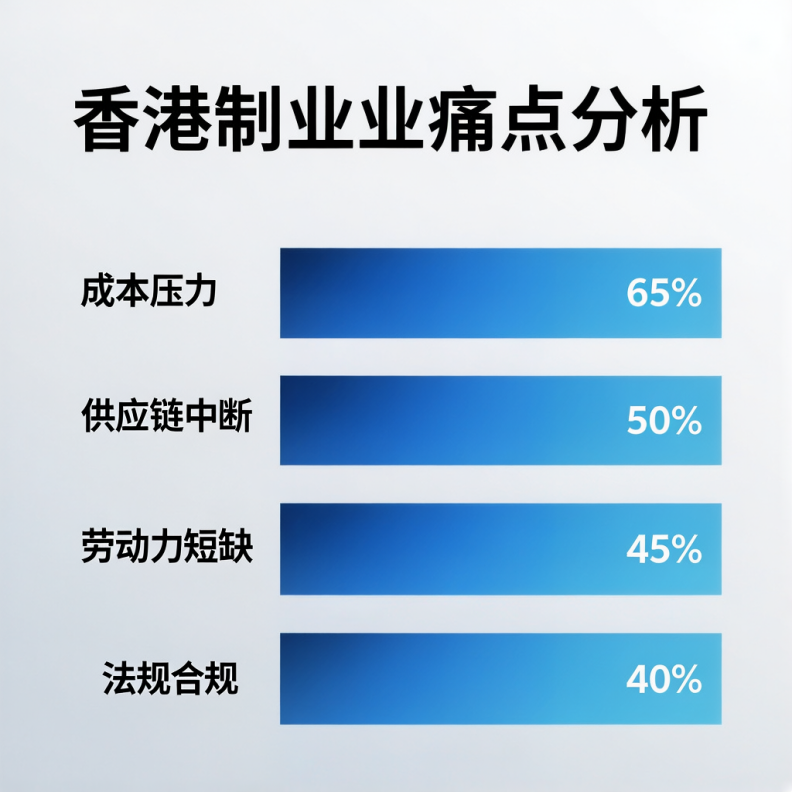
I. Core Pain Points of Manufacturing Enterprises in Hong Kong and the Greater Bay Area
Hong Kong and Greater Bay Area enterprises face unique management challenges, and these pain points are driving enterprises to accelerate their digital transformation:
1. Financial Pressure from Multiple Currencies and Tax Systems
Hong Kong companies need to handle multiple currencies such as Hong Kong Dollar (HKD), Chinese Yuan (CNY), and US Dollar (USD), and manual reconciliation is time-consuming and error-prone. At the same time, Greater Bay Area enterprises must also meet the dual tax filing requirements of mainland value-added tax and Hong Kong profits tax, significantly increasing the complexity of financial accounting.
2. Cross-border Inventory and Delivery Risks
Inventory data across mainland factories, Hong Kong warehouses, and overseas warehouses are not synchronized, resulting in a very high risk of overselling. A trading company once had 5%-8% of orders requiring emergency air freight due to information desynchronization, with additional costs reaching hundreds of thousands of yuan. Inventory management has become a key bottleneck constraining business development.
3. Scattered Customer Communication Channels and Easy Loss of Business Opportunities
The coexistence of multiple communication channels such as WhatsApp, WeChat, and email leads to scattered customer information, making it difficult to form unified sales funnel management. Untimely follow-up on business opportunities and low sales conversion rates are common problems faced by many Hong Kong enterprises.
4. Challenges of Dual Compliance Requirements
Enterprises need to simultaneously meet the compliance requirements of both mainland China and Hong Kong, including data privacy regulations and tax filing standards. Traditional ERP systems struggle to flexibly adapt to these differentiated regulatory requirements, increasing enterprises' compliance costs and risks.
II. How Odoo ERP Solves Management Challenges for Hong Kong Enterprises
1. Multi-language and Multi-currency, Easier Financial Reconciliation
As a globally leading open-source ERP system, Odoo supports interfaces in over 70 languages, including Simplified Chinese, Traditional Chinese, and English. It has built-in multi-currency conversion and automatic reconciliation functions, and can automatically generate financial reports that comply with Hong Kong and mainland accounting standards, greatly reducing the workload of financial personnel.
2. Cross-border Warehouse Management, Integrated Inventory Control
Odoo ERP can uniformly manage inventory in multiple locations such as Hong Kong, Shenzhen bonded warehouses, and overseas warehouses, set safety stock alerts, and optimize cross-warehouse transfer processes. Actual cases show that after using Odoo, enterprises can shorten the communication and execution time of cross-warehouse transfers by 30%-50%, significantly improving inventory turnover efficiency.
3. Unified Customer Management, Improved Sales Conversion Rate
The Odoo CRM module integrates multi-channel customer communication, automatically converting inquiries from WhatsApp, email, and websites into sales tickets, enabling full-process tracking of business opportunities. After a trading company applied it, sales follow-up efficiency increased by about 25%, effectively reducing the loss rate of business opportunities.
4. Localized compliance support, meeting both Hong Kong and Shenzhen standards
Odoo supports integration with Hong Kong tax reporting systems (such as the "eTAX" system) and meets the requirements of Hong Kong's data privacy regulations. At the same time, as an ERP system that supports Level 3 of the Multi-Level Protection Scheme (MLPS), Odoo can also adapt to mainland China's security compliance standards, providing comprehensive compliance assurance for enterprises in the Greater Bay Area.
5. Flexible deployment, more convenient mobile office
Odoo offers both cloud and on-premises deployment options, allowing enterprises to choose flexibly according to their IT strategies. It also supports access via mobile phones and tablets, enabling employees to process orders, approvals, and inventory inquiries at any time, ensuring business continuity without time or location constraints.
III. Success Story: Da* Food Co., Ltd.
Da* Food is a Hong Kong-based bakery products manufacturer founded in 1962, with a factory in Dongguan, providing B2B OEM services for supermarkets, restaurants, and others. The company's products have short life cycles and extremely demanding delivery lead times (often requiring completion within one day), and its original system could no longer meet business needs.
Since 2020, Da* Food has implemented Odoo ERP, customizing an integrated system covering order taking, production, inventory, logistics, and accounting, with support for mobile office work. The implementation results are remarkable:
· During the pandemic, with 50% of employees unable to be on-site, business operations remained largely normal;
· The system adopts an open-source model, with low overall implementation service fees and extremely high cost-effectiveness;
· Achieved full-process transparent automation from raw materials to transportation, significantly saving manpower and time;
· Ensured stable delivery under extremely short lead times, significantly improving customer satisfaction.
IV. Why More and More Greater Bay Area Enterprises Choose Odoo ERP
1. Open-source flexibility, controllable costs
As an open-source ERP system, Odoo requires no high licensing fees, and enterprises can choose modules according to actual needs, avoiding paying for unnecessary features. At the same time, the code is self-controllable, allowing free server migration or change of implementation partners, avoiding vendor lock-in risks.
2. Modular design, on-demand expansion
Odoo adopts a modular architecture, allowing enterprises to initially enable only core modules such as CRM, sales, and inventory, and later gradually expand to advanced functions such as production MRP, purchasing, and finance as the business grows. This gradual digitalization path greatly reduces the risks and pressure of enterprise transformation.
3. Global capabilities, localized support
Odoo has over 7 million users worldwide, with a mature and stable ecosystem. As a global ERP system, Odoo supports multiple currencies, languages, and tax systems, perfectly adapting to the cross-border business needs of enterprises in Hong Kong and the Greater Bay Area. At the same time, an active local community and professional implementation service providers provide solid support and assurance for enterprises.
4. AI empowerment, intelligent upgrade
Odoo integrates the latest AI technology to help businesses optimize inventory, forecast demand, and improve customer response times through intelligent analysis. In the export trade sector, Odoo's AI SEO features also help businesses optimize product pages, improve search engine rankings, and capture more global business opportunities.
Hong Kong-funded non-standard factory, cross-border projects require a single set of books
Non-standard manufacturing enterprises in Hong Kong and the Greater Bay Area often take orders in Hong Kong, design in Shenzhen, produce in Dongguan, and install at project sites in mainland China. Project numbers must work across companies and currencies: quotes in HKD, procurement in RMB, costs ultimately consolidated by project, with outsourcing and on-site labor also recorded in the same project account.
The tax systems and document formats differ between the two locations. In the system, multi-company, multi-currency, and fiscal positions are used to handle them separately, and consolidated reports are then reconciled. For non-standard manufacturing ERP in cross-border scenarios, the priority is to ensure project costs and delivery progress align.
V. Summary and Action Recommendations
For manufacturing enterprises in Hong Kong and the Greater Bay Area, choosing a suitable ERP system is key to digital transformation. With its open-source flexibility, cross-border management capabilities, localized compliance support, and global perspective, Odoo is becoming the common choice for more and more Hong Kong enterprises.
If you are evaluating ERP systems, take a closer look at how Odoo can help your business achieve:
· Automated reconciliation and management of multi-currency finances;
· Integrated control and alerts for cross-border inventory;
· Fine-grained management of the entire customer lifecycle;
· Dual compliance and security assurance for Hong Kong and Shenzhen.
Odoo ERP provides strong support for the "asset-light, high-efficiency, international" operating model of Hong Kong enterprises. Book a Hong Kong localization demo today and start your digital upgrade journey!