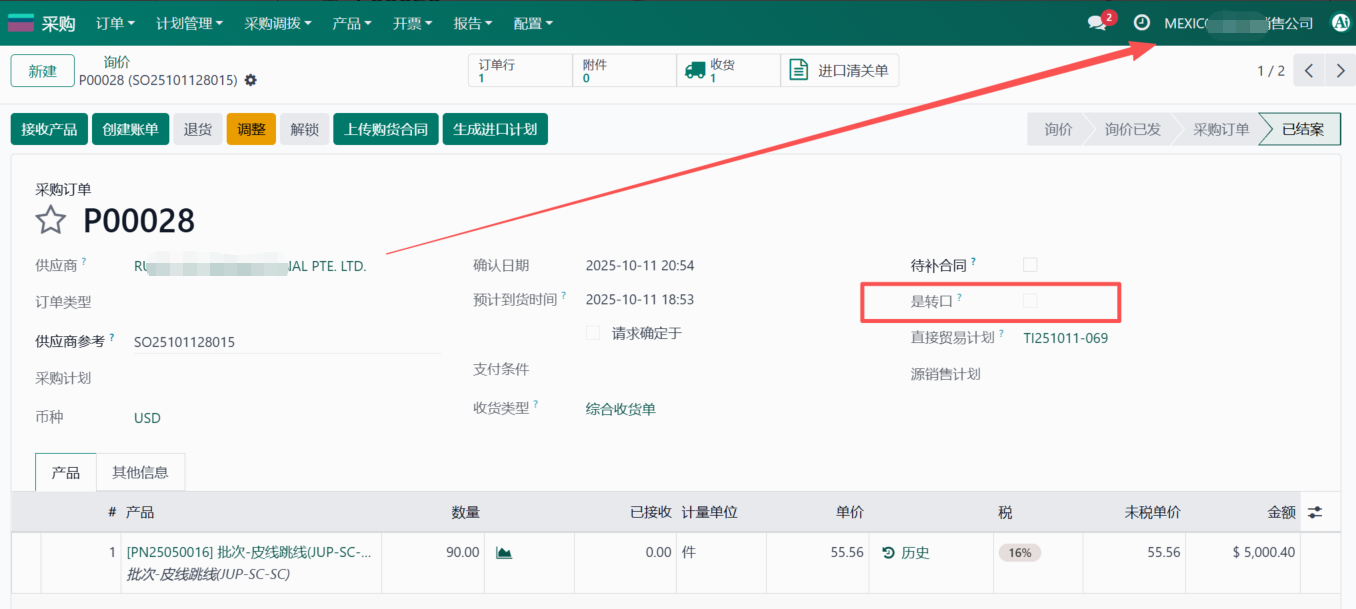
Odoo: Born for Foreign Trade
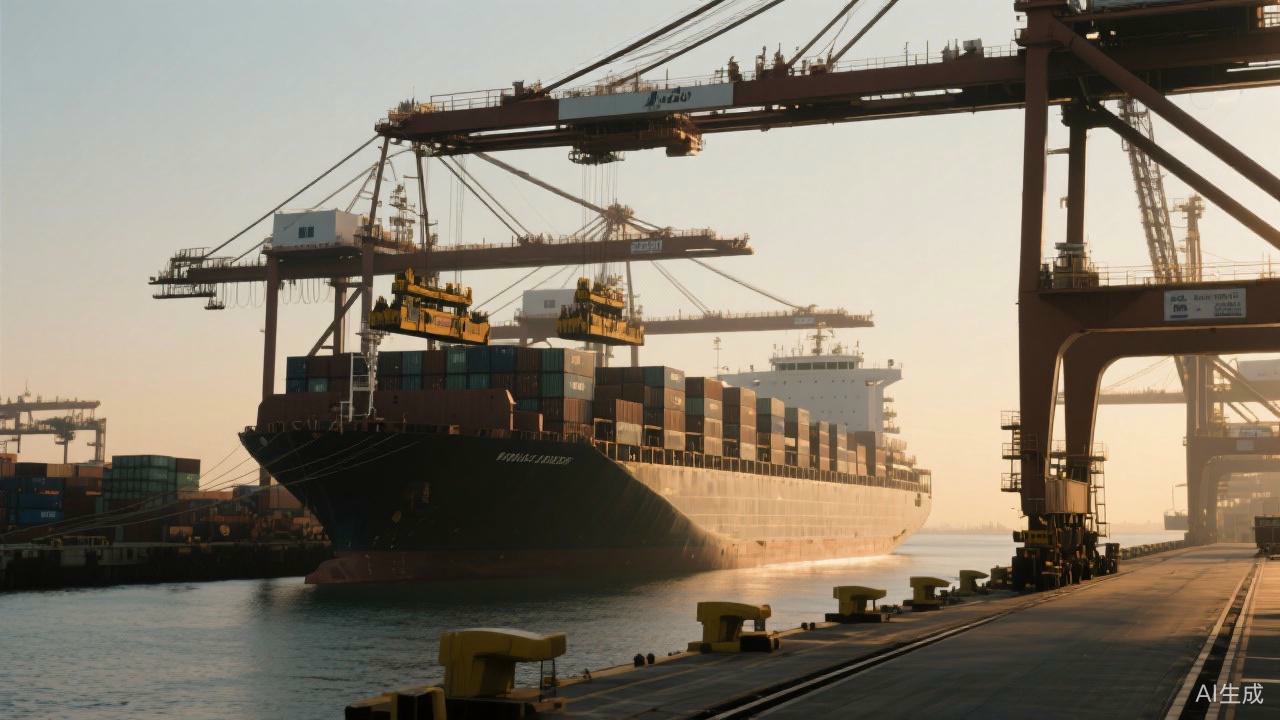
Entrepôt trade, also known as transit trade, refers to a trade mode in international trade where goods are not shipped directly from the producing country to the consuming country, but are transshipped and traded through intermediaries in a third country (or region). Intermediaries earn profits from the price difference between buying and selling, and the goods in the third country may not pass through customs (e.g., stored in bonded warehouses) or undergo only simple processing.
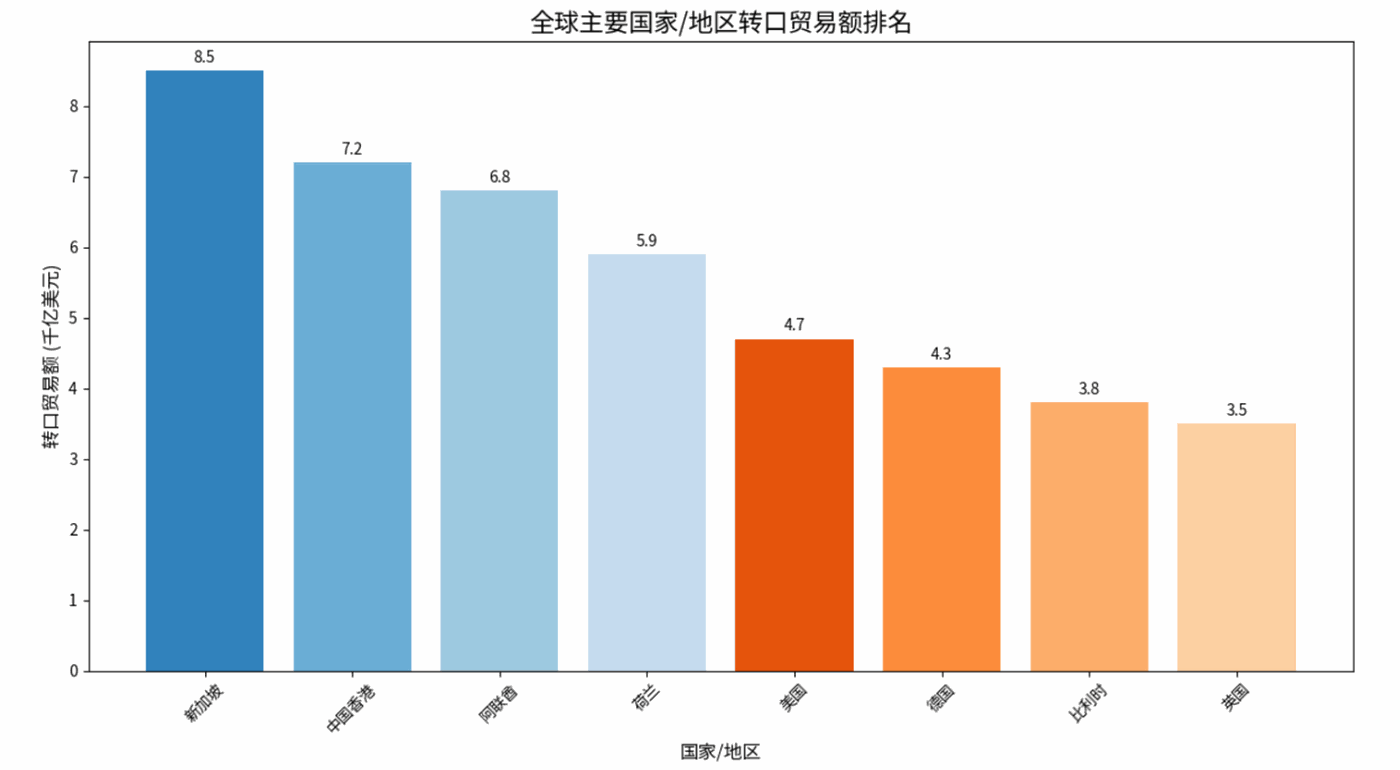
Entrepôt trade is a flexible but complex trade model. Its core lies in utilizing the transit position of a third country, controlling cargo ownership and manipulating trade documents to achieve the purposes of circumventing trade barriers, reducing costs, or protecting trade secrets. Xiamen ITG, COFCO, and Sinochem are typical enterprises engaged in entrepôt trade. Entrepôt trade enterprises are highly concentrated in areas such as the Shanghai Free Trade Zone, Guangdong Free Trade Zone (Qianhai, Nansha, Hengqin), and Hainan Free Trade Port, enjoying the special customs supervision policy of "first-line liberalization, second-line control, and freedom within the zone." This provides an excellent operating environment for entrepôt trade (bonded warehousing, simple processing, cargo classification, etc.).
Using ODOO in entrepôt trade enterprises can greatly solve the core pain points in their business, achieving processization, transparency, and efficiency. As a highly integrated, modular, and flexible open-source ERP system, ODOO is very suitable for managing the complex business of entrepôt trade, which involves multiple parties, multiple processes, and multiple documents.
Typical Entrepôt Trade Business Process
(Taking anti-dumping duty circumvention as an example)
Step 1: Finding Orders and Signing Contracts
The final importer (in Country A) makes an inquiry to the intermediary (in Country B, such as Hong Kong).
The intermediary makes an inquiry to the actual manufacturer (in Country C, such as China).
The intermediary signs contracts with the final importer and the manufacturer respectively. The contract prices and terms are different.
Step 2: Goods Shipment and First Leg Transport
1. The manufacturer (Country C) produces the goods according to the contract requirements.
2. The manufacturer arranges the goods to be shipped by sea.
🚩Bill of Lading 1 (B/L 1):
- Shipper: Manufacturer (Company in Country C)
- Consignee: Intermediary (Company in Country B) or To Order of Intermediate
- Notify Party: Intermediary (Company in Country B)
3. The manufacturer sends the first set of documents (Bill of Lading 1, Certificate of Origin of Country C, invoice, packing list, etc.) to the intermediary.
Step 3: Transshipment Operations (Core Step)
1. Bill switch: When the cargo arrives at the transshipment port (or while in transit), the intermediary exchanges Bill of Lading 1 with the shipping company for Bill of Lading 2 (B/L 2).
🚩Bill of Lading 2 (B/L 2):
- Shipper: Intermediary (Company in Country B)
- Consignee: Final importer (Company in Country A)
- Notify Party: Final importer (Company in Country A)
2. Apply for a new Certificate of Origin: The intermediary applies to the local chamber of commerce or relevant authority in Country B for a Certificate of Origin of Country B, certifying that the goods originate from Country B.
3. Issue new documents: The intermediary prepares new commercial invoices and packing lists in its own company's name for the final importer.
4. Warehousing/Container Switching: Goods may be stored short-term in a bonded warehouse at the transit location, or unloaded from the original container and loaded into a new container with new shipping marks to eliminate any trace of "Made in Country C."
Step 4: Second Leg Transport and Payment Collection
1. The intermediary sends the second full set of documents (Bill of Lading 2, Certificate of Origin of Country B, new invoice, new packing list, etc.) to the final importer.
2. The final importer uses the second set of documents to clear customs at the port of destination. Since the documents show the country of shipment and country of origin as Country B (not a country subject to anti-dumping measures), the high anti-dumping duties can be avoided.
3. The final importer pays the intermediary.
4. After receiving payment, the intermediary pays the manufacturer. The intermediary earns the price difference.
Key Considerations in the Entrepot Trade Process
Document Consistency: The information in the second set of documents (bill of lading, invoice, packing list, certificate of origin) must be strictly consistent. Any discrepancy may cause customs clearance failure at the destination port.
Operational Complexity: The process is more complex than general trade, involving two international settlements, two sets of documents, and logistics at the transshipment location, requiring high professional competence from operators.
Application Example of Odoo in an Entrepot Trade Company
Details of a Hangzhou Export Company's Entrepot Trade to Mexico via Singapore.
Goods flow: Hangzhou->Singapore->Mexico
Payment flow: Hangzhou<--Singapore<--Mexico
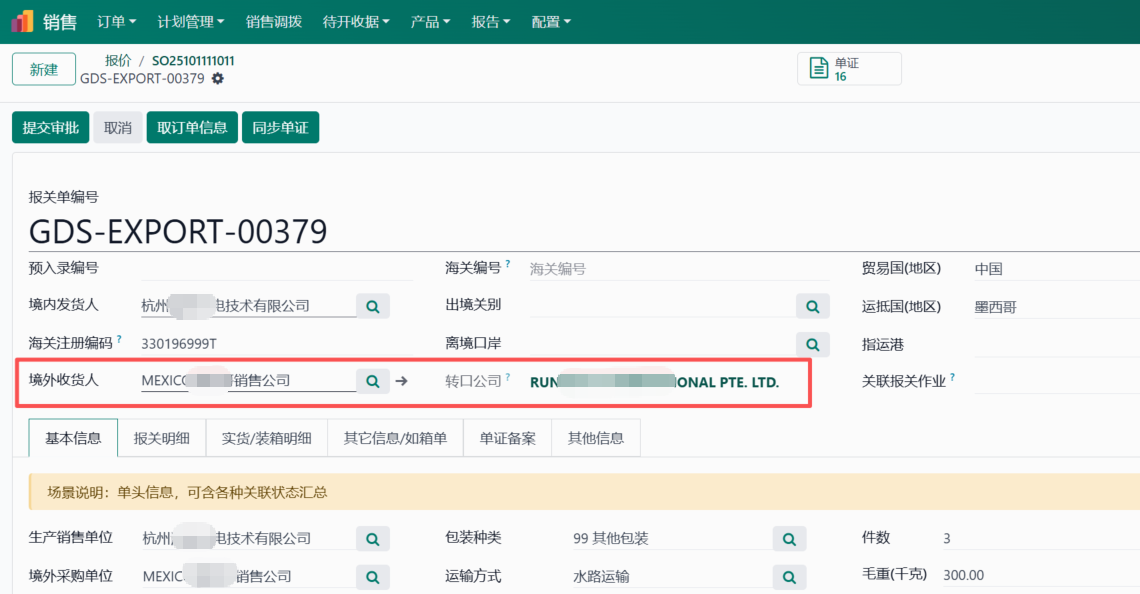
*Customs declaration: Hangzhou -> Mexico
1. There are two operation entry points. You can create a sales plan for a domestic company such as Hangzhou headquarters, or a purchase plan for an overseas company such as Mexico.
2. General business process: complete the conversion at the transit company, from transit trade -> direct trade:
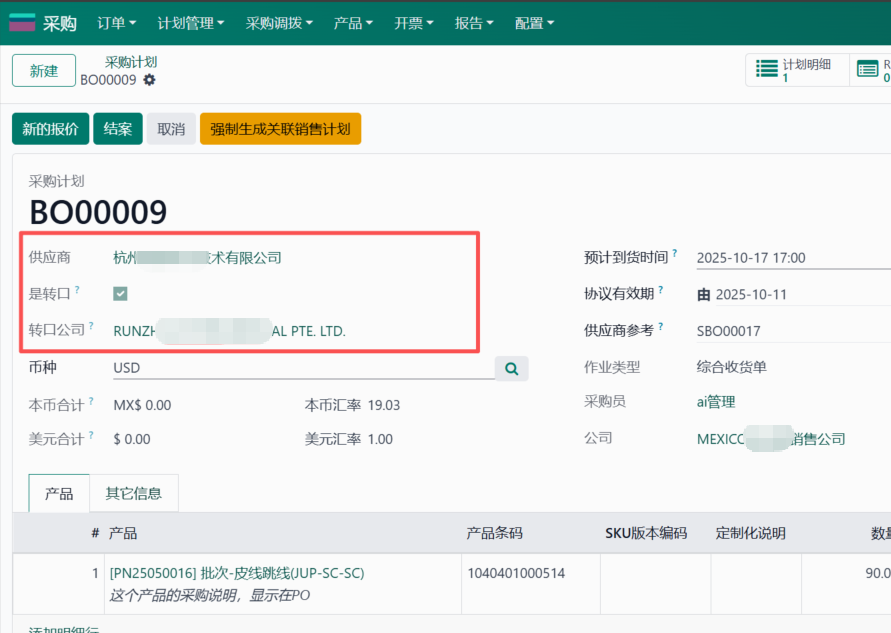
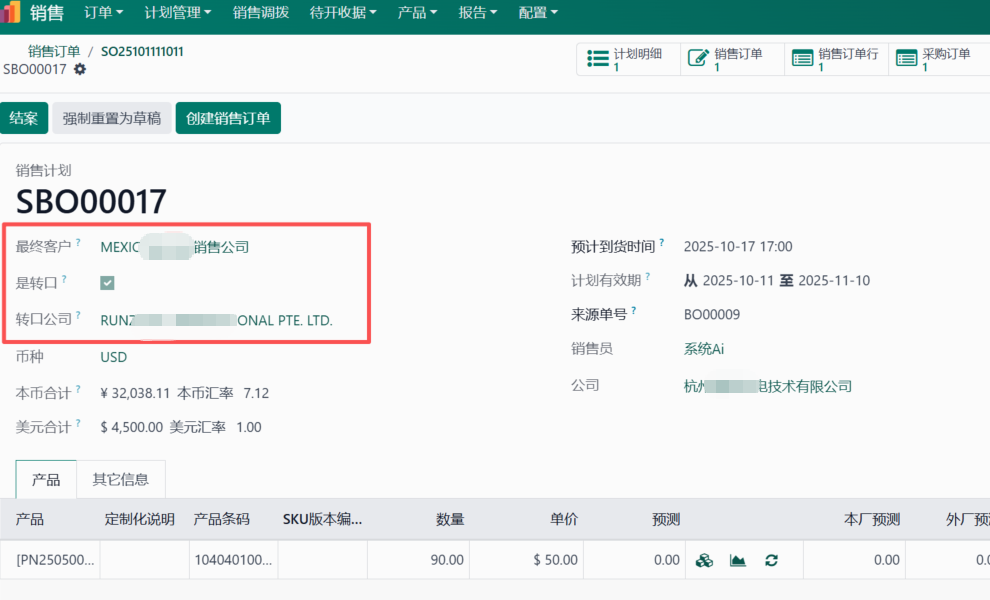
a. Mexico initiates a purchase plan PR, set as "is transit", and specify Singapore as the transit company.
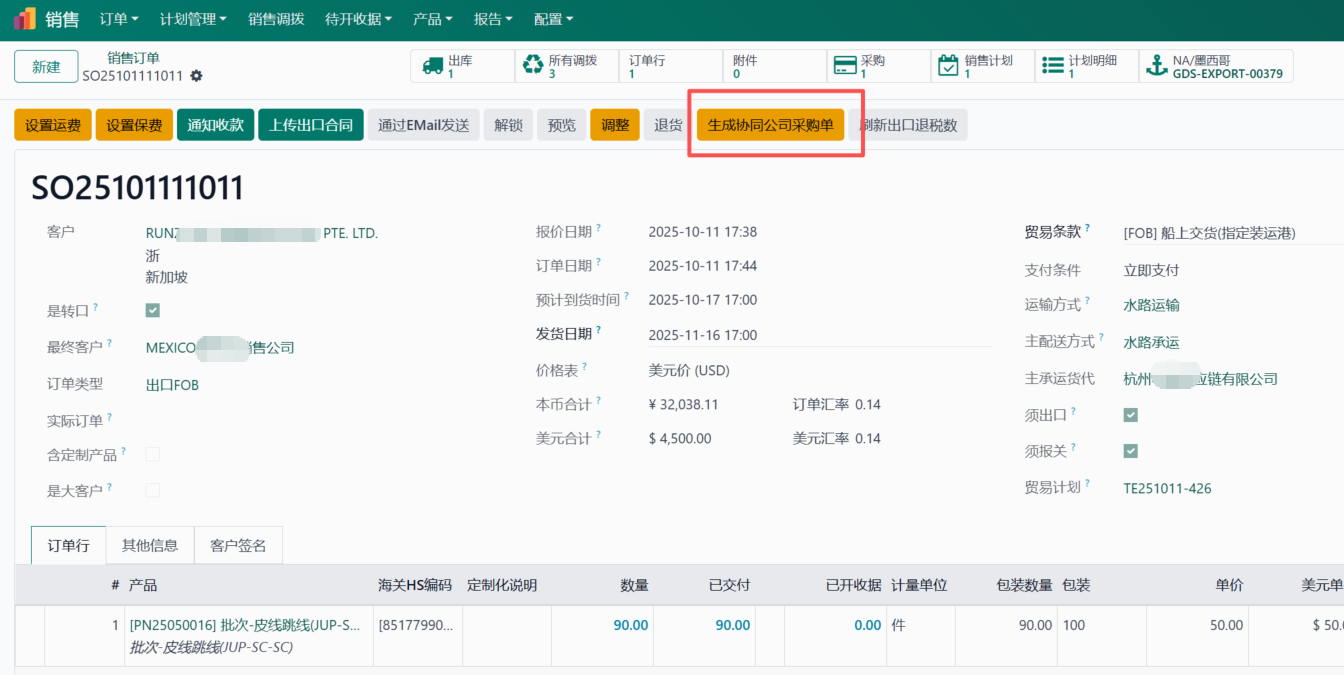
b. Generate Hangzhou headquarters sales plan SR, data transfer. Generate Hangzhou headquarters sales order SO, customer is Singapore, final customer is Mexico.
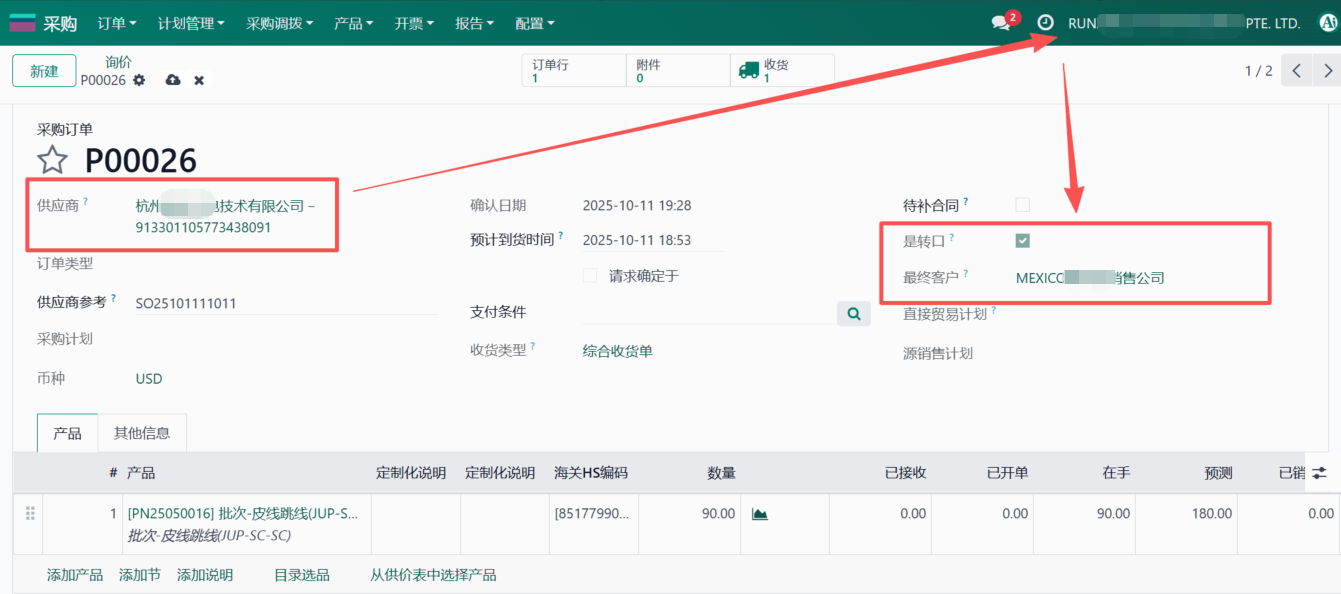
c. Hangzhou headquarters regular export process: after completing the SO, operate "Generate Collaborative Company Purchase Order" to generate the PO for the Singapore customer.
d. The Singapore PO will be automatically executed: the transit PO is automatically confirmed, and after generating the SO (non-transit) and automatically confirming it, generate the Mexico PO (non-transit).
e. Mexico executes the normal PO import process.
3. Price strategy is set according to profit margin requirements, such as in the Singapore company. Related taxes refer to the default tax settings for each company and the product.
4. Operations are as follows:
Mexico purchase plan PR
Hangzhou headquarters sales plan SR
Hangzhou headquarters sales SO
Hangzhou headquarters customs declaration
Singapore purchase PO
Singapore sales SO
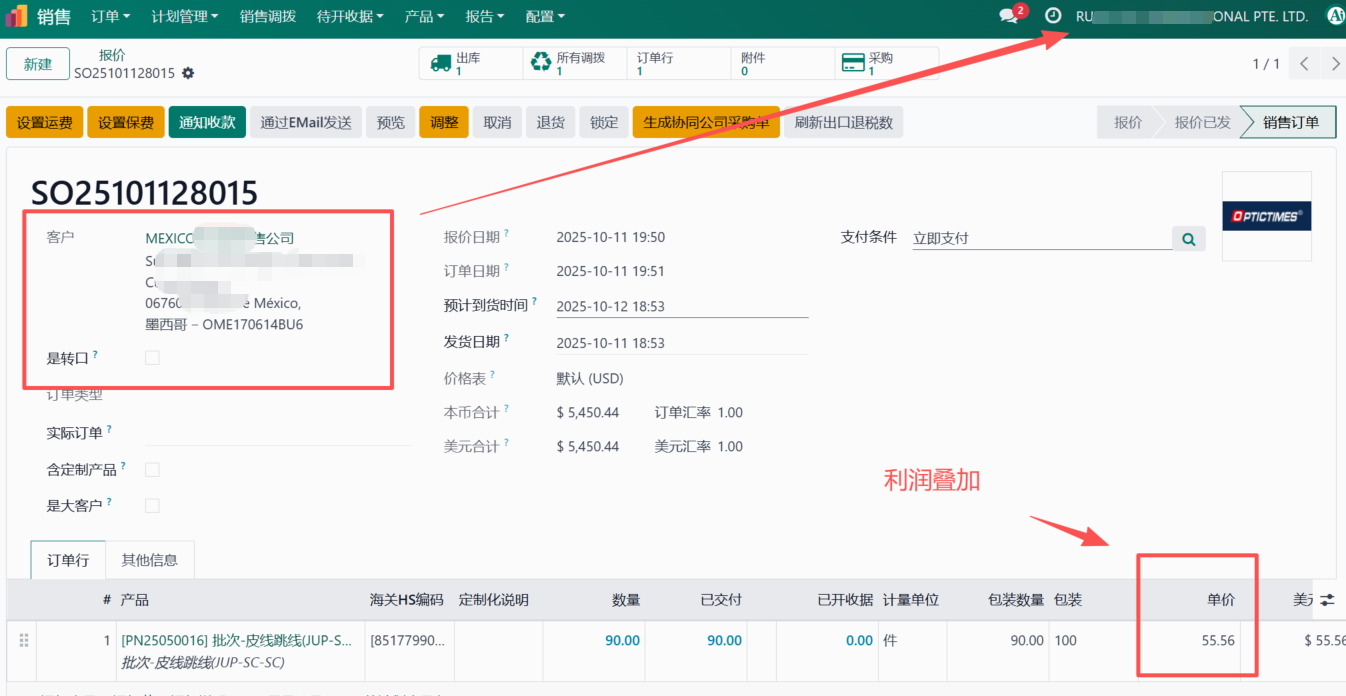
Mexico purchase order PO