Article No. 10102 Textbook Alignment Chapter 2 "International Trade Terms" of Li Xiaoxian's "International Trade Practice" systematically explains the classification rules, risk transfer points, and cost-bearing framework of the 11 trade terms in INCOTERMS 2020, serving as the first lesson for standardized operations in foreign trade enterprises; Content Description This article provides a complete explanation of building the master data system for overseas customers and suppliers, multi-currency exchange rate management, and global customs and port parameter configuration for foreign trade enterprises, providing foundational data support for subsequent import/export orders, customs declaration and inspection, and multi-currency settlement. System Platform The entire practical guide is based on the native architecture of Odoo 18~20 and the foreign trade-specific AiErp intelligent platform, transforming abstract terms into order fields, quotation templates, and risk control points in the system; Implementation Notes It covers the entire chain from trade term creation, sales/purchase order association, to document printing and output, complemented by the AiErp built-in Documents intelligent document library, ensuring that the trade terms in each contract correspond one-to-one with system documents, eliminating manual errors.
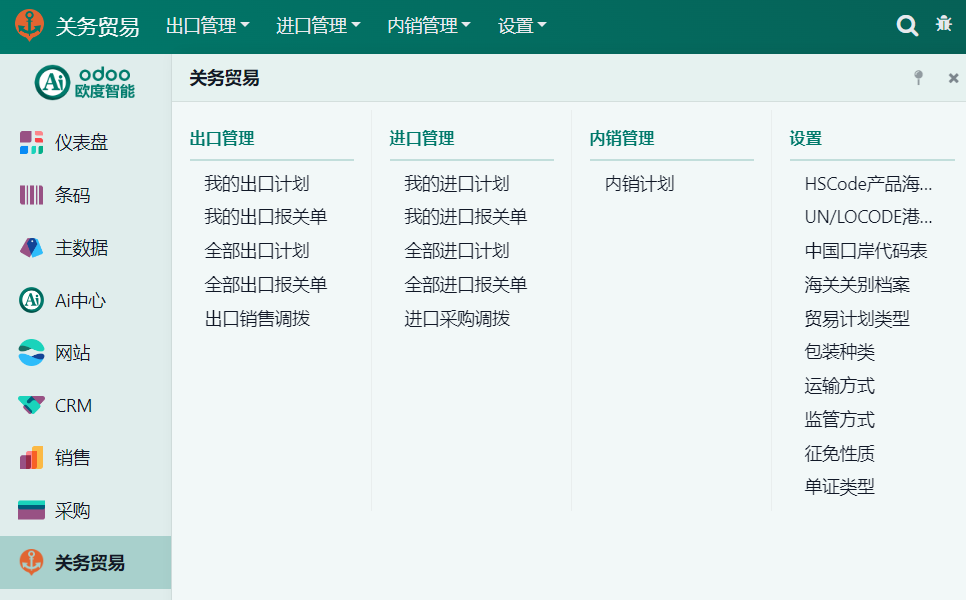
I. Key Theoretical Points of the Textbook
1.1 Overview of INCOTERMS 2020
INCOTERMS (International Commercial Terms) are revised every ten years by the International Chamber of Commerce (ICC). The latest version is INCOTERMS 2020, which officially took effect on January 1, 2020. It defines 11 trade terms, divided into four groups by their initial letters:
| Group | Term | Full English Name | Chinese Definition | Mode of Transport | Point of Risk Transfer | Seller's Core Responsibilities |
|---|---|---|---|---|---|---|
| Group E (Departure) | EXW | Ex Works | Ex Works | Any | When delivered at the seller's premises | Preparation only |
| Group F (Main Carriage Unpaid) | FCA | Free Carrier | Free Carrier | Any | Delivery to the First Carrier | Export Clearance |
| FAS | Free Alongside Ship | Free Alongside Ship | Waterway Transport | Delivery Alongside Ship | Export Clearance | |
| FOB | Free On Board | Free on Board | Waterway Transport | Goods Loaded on Board | Export Clearance | |
| Group C (Main Carriage Paid) | CFR | Cost and Freight | Cost and Freight | Waterway Transport | Goods Loaded on Board | Export Clearance + Main Carriage |
| CIF | Cost, Insurance & Freight | Cost, Insurance and Freight | Waterway Transport | Goods Loaded on Board | Export Clearance + Main Carriage + Insurance | |
| CPT | Carriage Paid To | Carriage Paid To | Any | Delivery to the First Carrier | Export Clearance + Main Carriage | |
| CIP | Carriage & Insurance Paid To | Carriage and Insurance Paid To | Any | Delivery to the First Carrier | Export Clearance + Main Carriage + Insurance | |
| Group D (Arrival) | DAP | Delivered at Place | Delivered at Destination | Any | Named Place at Destination | Export Clearance + Full Carriage |
| DPU | Delivered at Place Unloaded | Delivered at Unloading Place | Any | After Unloading at Destination | Export customs clearance + full freight + unloading | |
| DDP | Delivered Duty Paid | Delivered Duty Paid | Any | Named Place at Destination | All-inclusive (including import customs clearance) |
1.2 Core Theoretical Rules
(1) Risk transfer ≠ cost bearing
This is the most confusing concept for newcomers to foreign trade. Take CIF as an example—the seller bears the freight and insurance costs to the destination port (costs), but the risk transfers to the buyer when the goods pass the ship's rail (shipment rule). That is to say: if the goods are lost during sea transport, the buyer still needs to pay.
(2) Mode of transport determines the choice of terms
Key pairing rules:
| Mode of Transport | Applicable terms |
|---|---|
| Sea/inland waterway transport | FAS、FOB、CFR、CIF |
| Any mode of transport (including multimodal transport) | EXW、FCA、CPT、CIP、DAP、DPU、DDP |
⚠️ Common mistake: Using FOB for air/rail transport—this is a conceptual error. FOB is only applicable to water transport. For multimodal transport, FCA should be used instead of FOB.
(3) Minimum insurance coverage standards
INCOTERMS 2020 explicitly requires that under CIF and CIP terms, the seller's insurance coverage must be at least Institute Cargo Clauses (ICC) Grade C (CIF) or Grade A (CIP); the old version only required Grade C.
1.3 The relationship between trade terms and foreign trade ERP
In the manual processing era, every contract signing required repeatedly consulting the terms list and manually modifying quotation templates. When switching from an EXW order to a CIF order, price items, cost allocation, and document templates all had to be manually adjusted—for a $50,000 piece of equipment, just switching terms could result in errors or omissions of thousands of yuan in freight/insurance costs.
The value of Odoo/AiErp lies in: internalizing INCOTERMS rules as system fields, so that term selection automatically triggers the linkage of price clauses, expense items, document formats, and risk alerts.
II. Pre-system Configuration
2.1 Required modules
| Module | Purpose |
|---|---|
sale_management / sale |
Sales order management and quotation |
purchase |
Purchase Order Management |
stock |
Inventory and Logistics Integration |
account |
Accounting Module (Expense Integration) |
| AiErp Foreign Trade Exclusive Module | Foreign Trade Document Enhancement (with Incoterms Preset Data) |
Operation Path: Apps → Search Module Name → Install
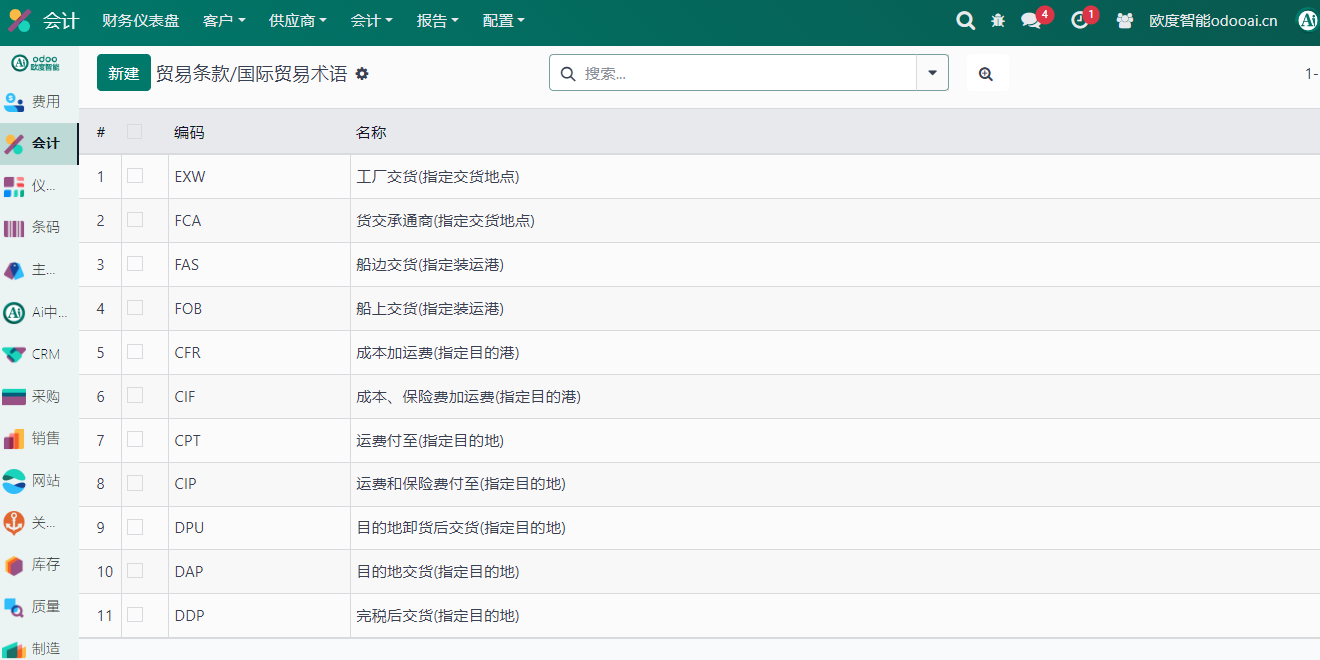
2.2 Configure Incoterms Terminology Library
In Odoo, trade terms are stored as Incoterm records. Each term contains three core attributes: - Code: Abbreviation (e.g., FOB, CIF) - Name: Full name of the term - Document Template: Term description in the associated quotation/order print template
The AiErp Foreign Trade Exclusive Module has preset standard data for all 11 INCOTERMS 2020 terms, eliminating manual entry.
2.3 Product Master Data Integration
In the "Sales" tab of each product, you can preset the default trade term:
- Domestic sales products → Default EXW
- Standard export products → Default FOB (or preset based on main routes)
- High-risk regions → Recommend CIF (including insurance)
2.4 Customer Profile Integration
In the "Sales & Purchase" tab of the customer (res.partner) profile, you can preset the customer's usual trade term. When creating a new sales order, the system automatically fills in the customer's preferred term, reducing manual selection errors.
III. AiErp Step-by-Step Guide
3.1 Create/Maintain Trade Term Records
Operation Path: Sales → Configuration → Incoterms → Create
Example: Creating a new FOB:
| Field | Fill in the content |
|---|---|
| Code | FOB |
| Name | Free On Board (Named Port of Shipment) |
| Used for Sales Orders | ✅ Check |
| Used for Purchase Orders | ✅ Check |
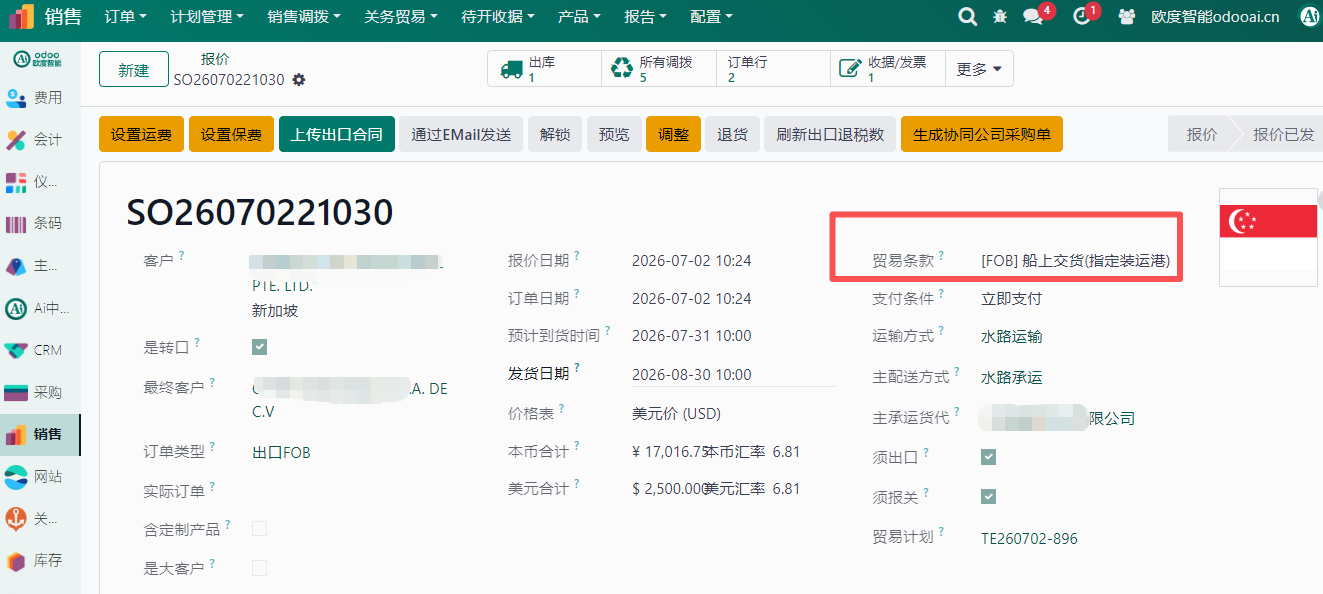
3.2 Linking Incoterms to Sales Orders
Path: Sales → Orders → Create → Other Info → Incoterms
After selecting FOB, the quotation PDF template will automatically display in the footer:
Incoterms: FOB — Free On Board (Named Port of Shipment) The risk transfers to the buyer after the seller completes export clearance and loads the goods onto the vessel nominated by the buyer at the named port of shipment.
Downstream linkage: - Select EXW → The system automatically prompts "Logistics costs are not included in the quotation" - Select CIF → The system automatically adds two expense line items: insurance and freight (requires coordination with product pricing strategy)
3.3 Linking Incoterms to Purchase Orders
Path: Purchase → Orders → Create → Other Info → Incoterms
For import purchase orders, Incoterms are also linked. For example, purchasing equipment from a German supplier under EXW:
- Select EXW → We bear all logistics and customs clearance costs from the German factory to the destination in China
- AiErp automatically marks the estimated logistics cost as an item to be accounted for, which can later be reconciled with actual freight charges
3.4 Customizing Document Print Templates
Odoo supports customizing print templates by term, displaying different liability clauses and risk warnings for different terms:
Path: Settings → Technical → Views → Search sale.report_saleorder_document → Edit
Conditional statements can be embedded in the template:
<t t-if="order.incoterm.code == 'FOB'">
  <p>Risk transfer: The risk transfers to the buyer after the goods pass the ship's rail at the port of shipment.</p>
  <p>Cost allocation: The seller bears costs up to the port of shipment (including export clearance), and the buyer bears ocean freight and subsequent costs.</p>
</t>
3.5 Incoterms Error Validation Rules
AiErp adds foreign trade business validation logic on top of native Odoo:
| Validation Rule | Trigger Condition | Prompt Content |
|---|---|---|
| Transport Mode - Incoterms Matching | Air freight order uses FOB | "FOB is only applicable to water transport. The current transport mode is air freight. It is recommended to switch to FCA." |
| High-Risk Region Insurance | High-risk region + CIF | Automatically prompt "It is recommended to increase CIF insured amount to 110%" |
| DDP Import Customs Clearance | DDP + customer without import qualification | "Under DDP terms, the seller must complete import customs clearance. Please confirm customs clearance qualification." |
3.6 Sales Analysis by Incoterms Dimension
Operation Path: Sales → Reporting → Sales Analysis → Group By: "International Commercial Terms"
You can view the sales amount distribution and order quantity under each Incoterms with one click, identify the main Incoterms, and optimize quotation strategies. For example, a company's data analysis shows:
| Term | Order Proportion | Main Customer Region |
|---|---|---|
| FOB | 62% | Southeast Asia, Middle East |
| CIF | 23% | Europe |
| EXW | 10% | Domestic entrepot traders |
| DAP | 5% | Central Asia land transport |
Management can adjust pricing strategies and freight budgets for each region accordingly.
IV. Key Pitfalls to Avoid in the Foreign Trade Industry
4.1 Wrong Incoterm Selection Leads to Hundreds of Thousands in Compensation
A Shenzhen electronics exporter signed an FOB contract with a European customer but habitually selected CIF in the system, causing the system to automatically include ocean freight and insurance in the quote—for one batch of products, freight was undercharged by 120,000 yuan (the seller should not bear freight under FOB). Ultimately, the seller had to bear the price difference.
System solution: AiErp supports binding default Incoterms in customer profiles. When sales create orders, the Incoterm field is automatically populated and highlighted in red to prevent manual selection errors.
4.2 FOB ≠ Free Alongside Ship: The Big Pitfall in Air Freight Contracts
A Guangzhou business owner exporting electronic components used FOB terms for air freight to Germany. As a result, the concept of "loading on board" on the bill of lading is completely invalid in air freight—the freight forwarder used this as an excuse to shirk liability for cargo damage, resulting in a loss of over 200,000 yuan. For export contracts involving air, rail, or multimodal transport, always use FCA instead of FOB.
System solution: AiErp has added dynamic validation between Incoterms and transport modes. When "Air Freight" is selected as the transport mode, choosing FOB triggers a red warning pop-up (see Section 3.5).
4.3 The Hidden Trap of DDP: Import VAT
Many foreign trade companies, when taking DDP orders, only calculate ocean freight, insurance, and customs duties, but overlook import VAT—at a 17% tax rate, for a piece of equipment worth 1 million RMB, the seller must advance 170,000 yuan in VAT under DDP terms (although it can be deducted later, the cash flow pressure is significant).
System solution: In AiErp quotations, DDP terms automatically trigger a prompt for "Estimated VAT" to remind users to include it in price negotiations.
4.4 The Risk of "No One Picking Up Goods" After CIF Arrival
Under CIF terms, risk transfers to the buyer upon loading, but demurrage and detention charges caused by the buyer's failure to pick up goods on time often lead to disputes—the seller has received payment but the goods remain unclaimed at the destination port.
Risk control recommendations: - Clearly stipulate in the contract that "if the buyer fails to pick up the goods within X days after arrival, demurrage shall be borne by the buyer" - Pre-set standard CIF clauses in the "Terms and Conditions" of AiErp sales orders, and force printing for each order - Use AiErp's "Shipment → Arrival → Pickup" node monitoring, with automatic alerts for delays
4.5 Ignoring the Linkage Between Incoterms and Payment Methods
When a new customer in a high-risk region uses EXW terms (goods are delivered at the factory), if combined with "T/T 60 days after shipment" payment—it means the goods have been picked up by the customer but payment will arrive two months later. The risk is extremely high.
Risk control recommendations: Establish a rating matrix for different Incoterm-payment method combinations:
| Term | Recommended payment methods | Risk Level |
|---|---|---|
| EXW / FCA | 100% prepayment | 🔴 High |
| FOB / CFR | 30% prepayment + 70% against copy of bill of lading | 🟡 Medium |
| CIF | Letter of Credit (L/C) | 🟢 Low |
| DAP / DDP | 30% prepayment + 70% against copy of bill of lading or L/C | 🟡 Medium |
Related Chapters
- Previous:Odoo International Trade Practice - General Introduction - Overall ERP Architecture for Foreign Trade Enterprises and Exclusive Initial Configuration (10101)
- Next article:Odoo International Trade Practice - General Fundamentals - Setting Up Overseas Customers, Suppliers, Currencies, and Customs Port Parameter System (10103)
- Related Business Chapter:Odoo International Trade Practice - Export Business - Full Process of Export Contracts and Document Management (10201) — Practical Implementation of Terms in Contracts
- Related Finance Chapter:Odoo Foreign Trade Accounting Practice - Export Receivables - Revenue Recognition and Settlement by Terms (10701) — Revenue Recognition Timing under Different Terms
Supporting Materials
INCOTERMS 2020 Quick Reference Card
| Code | Point of Risk Transfer | Seller bears freight costs | Seller arranges insurance | Export Clearance | Import customs clearance |
|---|---|---|---|---|---|
| EXW | Seller's premises | ✗ | ✗ | ✗ | ✗ |
| FCA | Delivery to the First Carrier | ✗ | ✗ | ✓ | ✗ |
| FAS | Delivery Alongside Ship | ✗ | ✗ | ✓ | ✗ |
| FOB | Goods Loaded on Board | ✗ | ✗ | ✓ | ✗ |
| CFR | Goods Loaded on Board | ✓ | ✗ | ✓ | ✗ |
| CIF | Goods Loaded on Board | ✓ | ✓ | ✓ | ✗ |
| CPT | Delivery to the First Carrier | ✓ | ✗ | ✓ | ✗ |
| CIP | Delivery to the First Carrier | ✓ | ✓ | ✓ | ✗ |
| DAP | Delivered at Destination | ✓ | ✗ | ✓ | ✗ |
| DPU | After Unloading at Destination | ✓ | ✗ | ✓ | ✗ |
| DDP | Delivered at Destination | ✓ | ✗ | ✓ | ✓ |