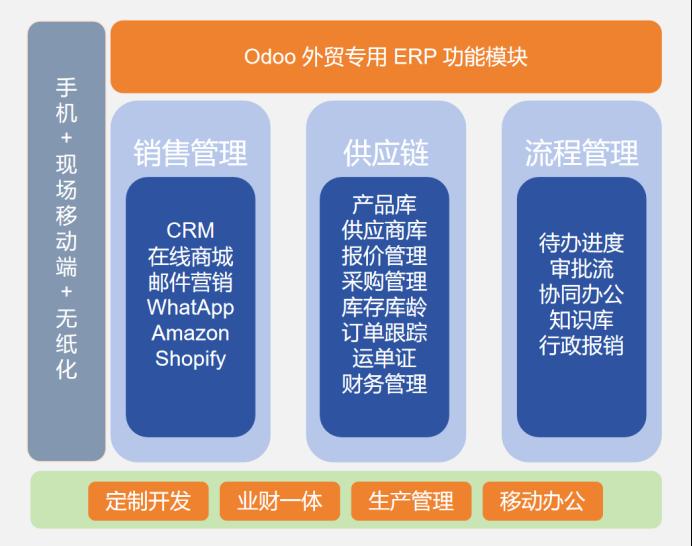
China is currently in a critical period of transition from a major trading nation to a strong trading nation. Foreign trade is continuously advancing toward the mid-to-high end of industrial and value chains, and trade digitalization is playing an increasingly important role in the high-quality development of foreign trade. For foreign trade enterprises, achieving high-quality development through trade digitalization has become the key to reshaping their international market competitiveness. Using a dedicated foreign trade ERP developed on Odoo 18, it connects the full life-cycle management of the foreign trade industry—"management + marketing + sales"—from leads to closed deals, enabling refined customer value operations and deep exploration of potential business opportunities.
Unlike domestic foreign trade management systems built around email management, Odoo18 delivers a comprehensive domestic and international trade management system that integrates CRM, ERP, independent websites, email marketing, WhatsApp marketing, Instagram, Facebook, LinkedIn, Amazon, Shopify, and other multi-platform management in one.
Comprehensive Domestic and Foreign Trade Management System
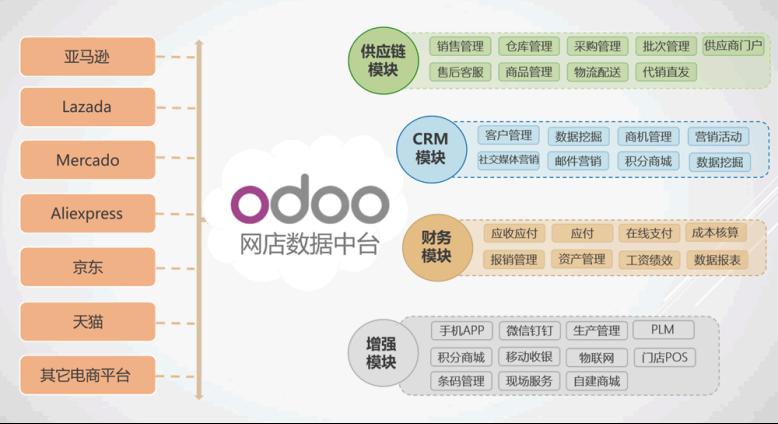
Building a multi-terminal integrated data platform for foreign trade enterprises
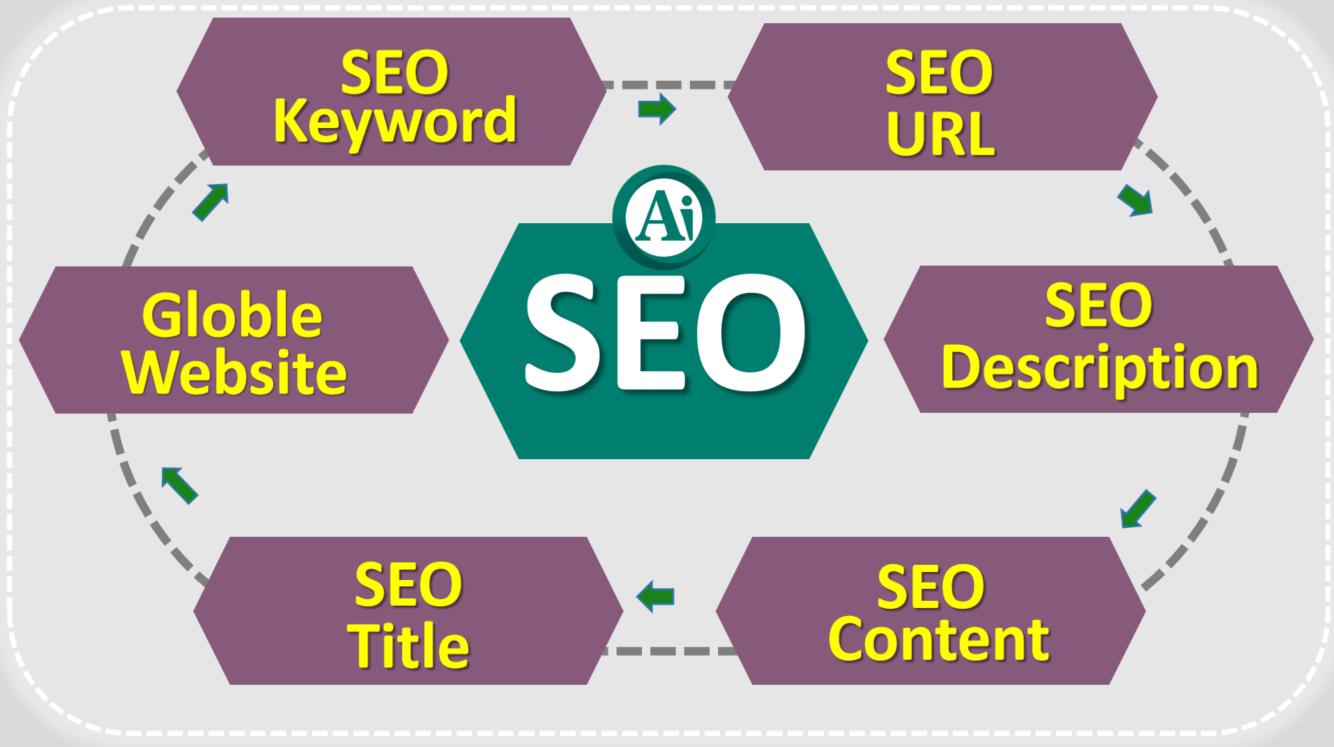
AI-Powered Foreign Trade Customer Acquisition:Omnichannel Customer Acquisition and Traffic Generation - SEO Search Optimization[Click the link to open the AI SEO introduction video]
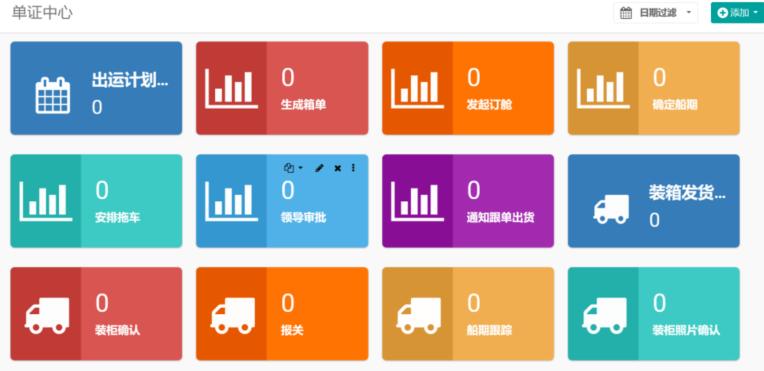
Integrate with third-party systems essential to business processes such as customs, ocean shipping, tax authorities, and specialized licenses, with visual waybill tracking management applied throughout
The foreign trade industry generally has the following pain points:
Business processes are cumbersome and error-prone: There are many sales stages, including internal product pricing, external quotations, order procurement, production follow-up, order tracking, shipping,commodity inspection, customs declaration, etc., which are prone to problems.
Existing systems have outdated functions: They cannot meet management needs. They cannot achieve a closed loop of foreign trade business from marketing to customer management. Materials are still using EXCEL, increasing the difficulty of access and management.
The order follow-up process cannot be supervised: Low customer satisfaction. Information is not shared, customers are repeatedly followed up, and quotations are chaotic.
Odoo 18 Foreign Trade Business Management Solution
The foreign trade ERP developed on Odoo 18 provides complete solutions for all types of foreign trade enterprises. From a unified platform and inventory control to financial accuracy and intuitive visual tracking, Odoo adapts to the individualized needs of every foreign trade company. Odoo is easily scalable, free from software limitations, and meets the growing needs of foreign trade enterprises.
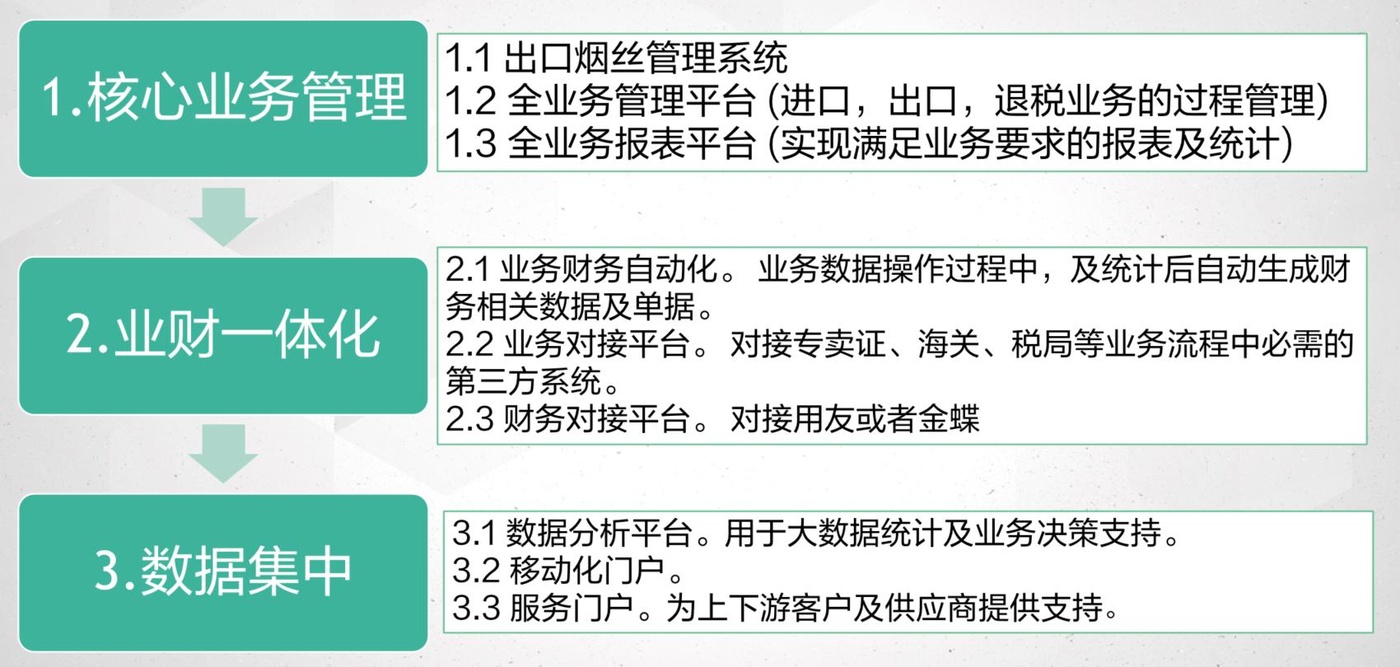
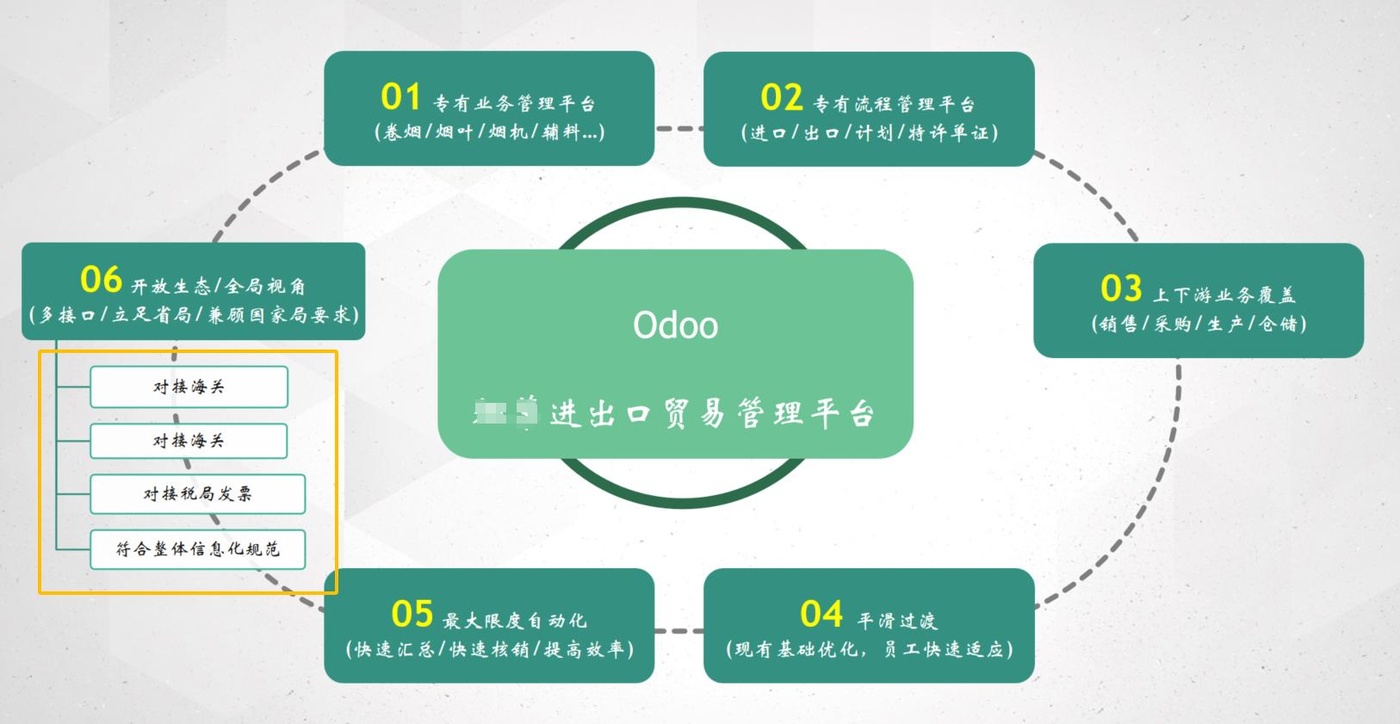
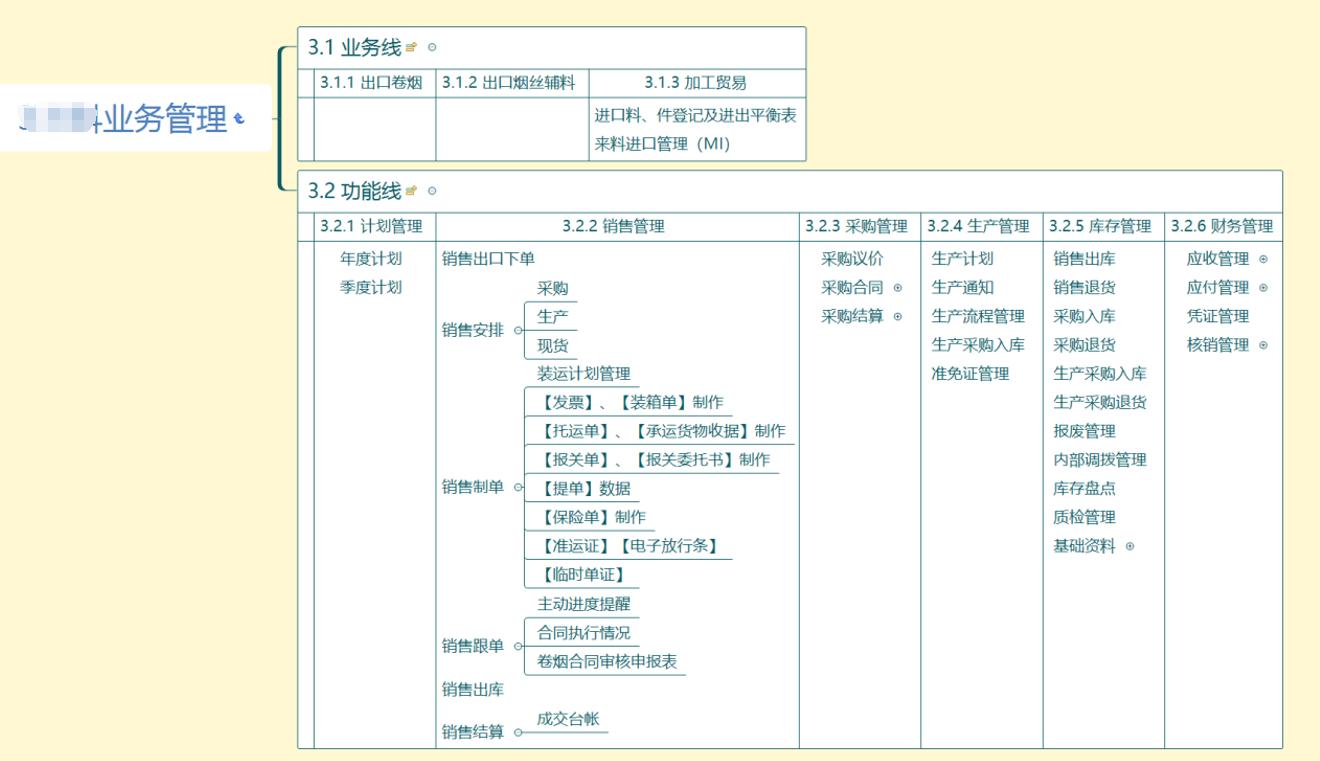
1. Customer Management:
- Information recording: Comprehensive recording of company information, contact information, historical communication information, etc., realizes digital management of foreign trade customer assets, prevents loss of customer data, allows other employees to quickly take over without interruption.
- Full customer lifecycle management: A customer-centric approach that makes the entire business process traceable from inquiry to deal closure.
- Revitalize customers with the public pool strategy: The customer public pool reassigns and reclaims customers, ensuring every foreign trade customer receives effective follow-up and keeping customers flowing.
2. Product Management:
- The system enables refined management of export product parameters, combination accessories, packaging, and production proofing; the system supports multiple units for the same product, different sales orders can enter different units, procurement and customs declaration can use different units, and the relationship between quantity and unit price can be automatically calculated.
3. Sales Price Management:
- Solve the problem of "one inquiry per order". Through the supplier quotations recorded in the system and the maintained material, packaging, and color libraries, the processing fee for each supplier is calculated. When a customer inquires, the salesperson only needs to enter product-related information in the system, and the system will automatically provide the price.
4. Supplier price management:
- Supports import and export of inquiry sheets, procurement formulates purchasing strategies, the system pulls corresponding supplier quotations for comparison, and selects the supplier with the highest cost-effectiveness.
5. Workflow Engine:
- Push each task to be completed directly to the associated employee's desktop, with to-do, in progress, and completed clearly visible, realizing a "tasks find people" working style.
6. Process automation:
- Intuitively display the work status of each node, design an automated order approval mode, orders that meet the conditions can be directly approved, those that do not meet the conditions go through manual approval, improving enterprise managers' ability to control the process, and for each tasknodeensure no omissions and timely and accurate processing.
3. Visual Management:
- Timely supervise the work status of each node in the business execution process, and conduct statistical analysis of work efficiency.
Core functions overview
1.1 Core Functional Requirements
1.1.1 Multi-Organization and Multi-Tenant Support
The platform supports multi-group management. Enterprises can quickly onboard and rapidly build their own business ERP system.
1.1.2 Internationalization and Multilingual Support
The platform provides at least Chinese and English versions and can support different languages for customers from different countries. Business document reports can support documents in different languages, including at least five languages: Chinese, English, French, Japanese, and Arabic (right-to-left).
1.1.3 International Multi-Timezone Support
The platform supports management across different time zones, recording times in different time zones for users/customers in different countries and time zones within the system.
1.1.4 International Multi-Currency Support
Supports multi-currency management for all business documents. At minimum, it supports RMB, USD, EUR, and HKD, and can convert multiple currencies into RMB for settlement based on exchange rates.
1.1.5 International Standard Trade Terms Support
The platform supports various international standard trade terms (such as CIF, FOB, etc.) and can settle according to different trade terms.
1.1.6 Full Barcode/RFID Support
The platform supports barcode scanning for core business management. Barcodes/QR codes/RFID tags can be used for business operations in sales, purchasing, warehousing, quality inspection, and production, and supports multiple standards such as EAN13, Code128, ISO/IEC 18000-6, etc.
1.1.7 Mobile Support
Core business operations must be supported on mobile devices, including Android and Apple phones and tablets, allowing smooth business operations.
1.1.8 Low-code support
For example, users can use a visual interface to build system operation interfaces and business functions through drag-and-drop.
Develop foreign trade-specific terminology fields
- Inquiry, Offer, Counter-offer
- Acceptance
- Place order
- Contract
- Shipment
- Packaging
- Transportation
- Insurance
- Payment
- Claim
- Arbitration
- Force Majeure
- Trade Terms
- FOB (Free on Board)
- CIF (Cost Insurance and Freight)
- DDP (Delivered Duty Paid)
- DDU (Delivered Duty Unpaid)
- CNF (Cost and Freight)
- CIF Valuation with Paid Insurance and Freight
- CIF Valuation with Paid Insurance only
- On Deck Basis Duty Unpaid
- On Deck Basis Duty Paid
- FAS (Free Alongside Ship)
- FOB Valuation with Freight Carried Forward CNF Valuation with Carriage Forward
- Ex Dock
- Ex Quay (delivered at the port of shipment wharf)
- Ex Ship (delivered on board at the port of shipment)