Quick summary: For foreign brands entering China and joint ventures operating in China running nationwide promotions, the hard part is not the creative idea, but whether the prizes, inventory, batches, and redemption records across 700 stores can be reconciled. This article breaks down a system that actually ran through a full Chinese Super League season in 2017, and also explains clearly which parts should use standard Odoo capabilities when Odoo is used as the backend, and which parts must be customized.
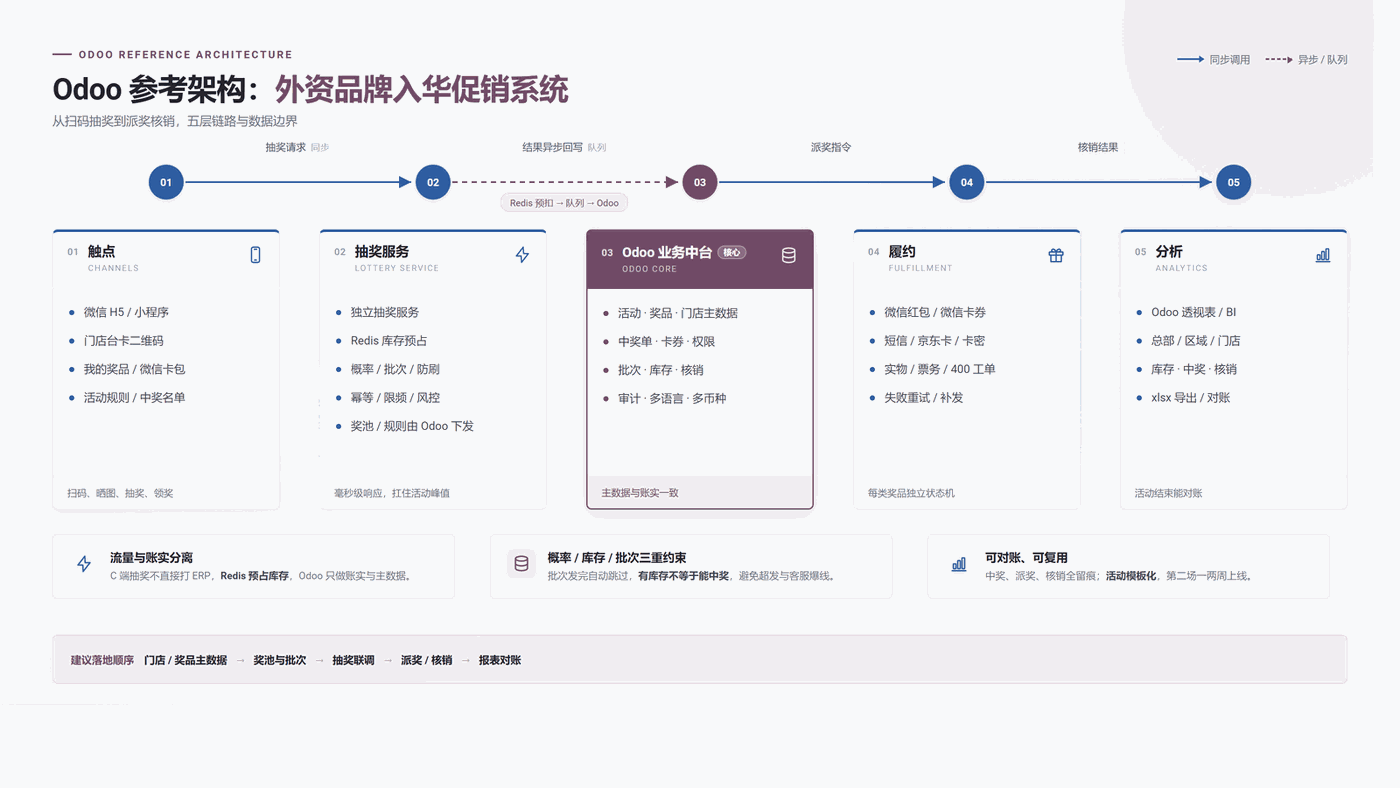
Odoo Nationwide Promotion Lucky Draw Management Architecture: Five-layer horizontal architecture: touchpoints, lucky draw service, Odoo business middle platform, fulfillment, analytics
I. Results First: Three Key Sets of Hard Numbers from a Nationwide Promotion
In the 2017 season, Shell China ran the 'Share CSL, Meet Stars' campaign around the Chinese Super League. Consumers scanned QR codes, uploaded CSL-related photos, and played a 3x3 grid lucky draw with a 100% win rate; prizes ranged from signed jerseys and CSL tickets to JD cards, WeChat red packets, and Shell synthetic oil coupons, all distributed online and redeemed offline.
| Dimension | Actual Numbers | System Requirements Behind It |
|---|---|---|
| Store | 700+ stores nationwide | Store master data, exclusive QR codes, store passwords, branch inventory |
| Participation Frequency | Each mobile number up to 2 times per day | Anti-fraud, idempotency, frequency control |
| Winning | 100% win rate | Triple safeguard: probability + inventory + batch |
| Cities | Beijing, Shanghai, Guangzhou, Nanjing, etc. | Configure prizes and inventory by city |
| Prizes | Prize pool: 2 million yuan, including physical items, match tickets, JD cards, red packets, and coupons |
Multiple fulfillment paths and different redemption methods |
| Match ticket prize claim | Contact via 400 hotline within 24 hours | Work orders, list export, manual collaboration |
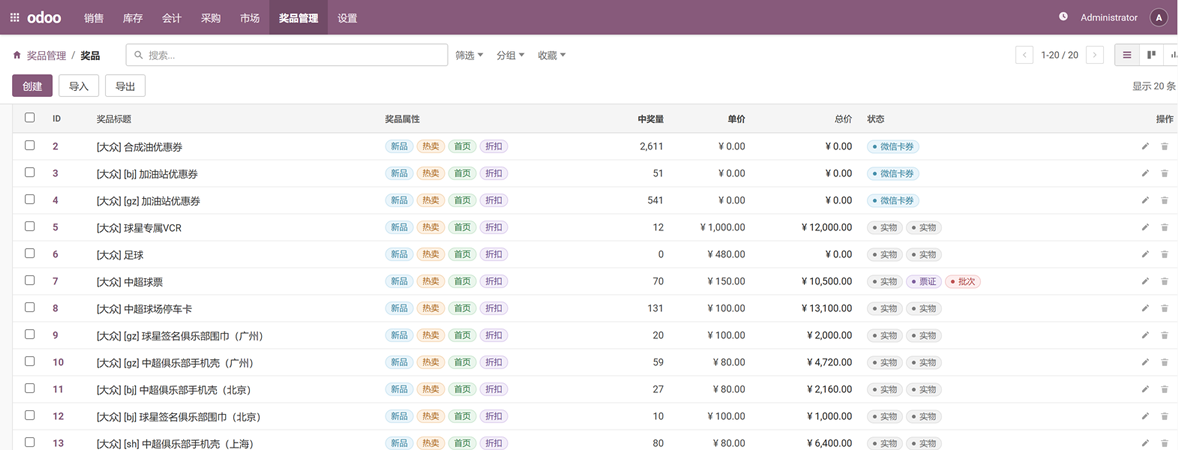
A set of real numbers from the screenshot of the prize page in the backend is more direct than any adjective: 100,972 WeChat red packets won; 20,000 50-yuan JD cards, with a face value close to 1,800,000 yuan; 2,145 CSL match tickets; 601 fan jerseys; 12 exclusive star VCRs. At the end of the campaign, these numbers must reconcile with inventory, finance, and stores.
II. The gameplay is not complicated; what is complicated is that every step must be "traceable"
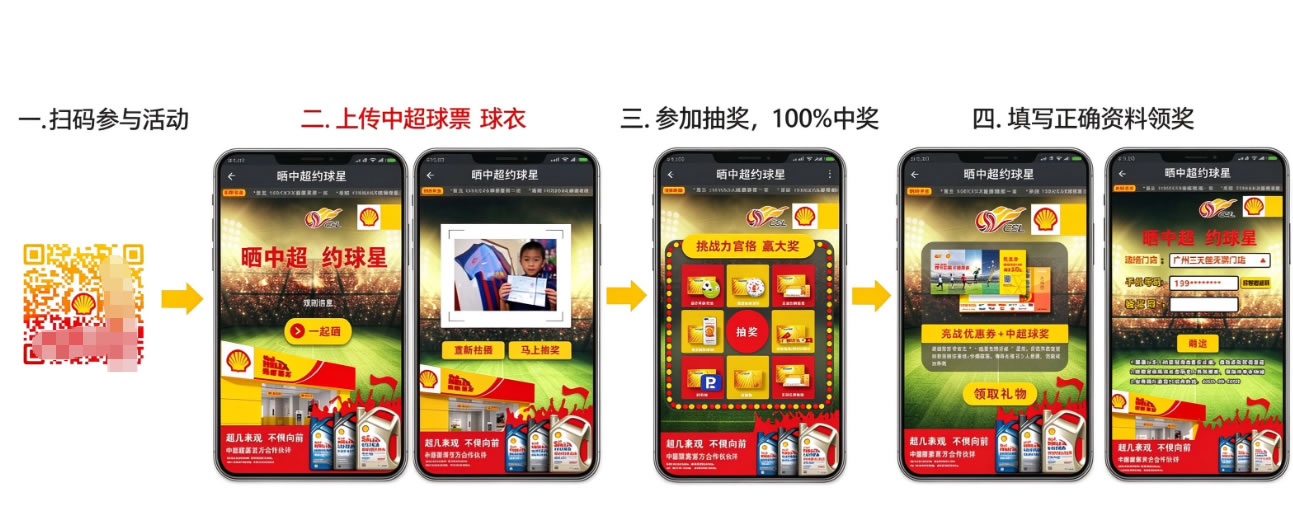
But if you break down these four steps, each step is connected to the backend:
| Stage | Frontend action | Questions the backend must answer |
|---|---|---|
| Scan code | Scan the table card QR code to enter the city campaign | Which city and which store does this code belong to? |
| Participate | Upload photos of match tickets, jerseys, and billboards | Where are the images stored? Are they compliant? Are they duplicates? |
| Draw | Click the nine-grid, 100% win rate | Which prize? Is there still stock? Is there still a batch? |
| Fill in information | Mobile number, address, SMS verification | Is the information complete? Is it a duplicate claim? |
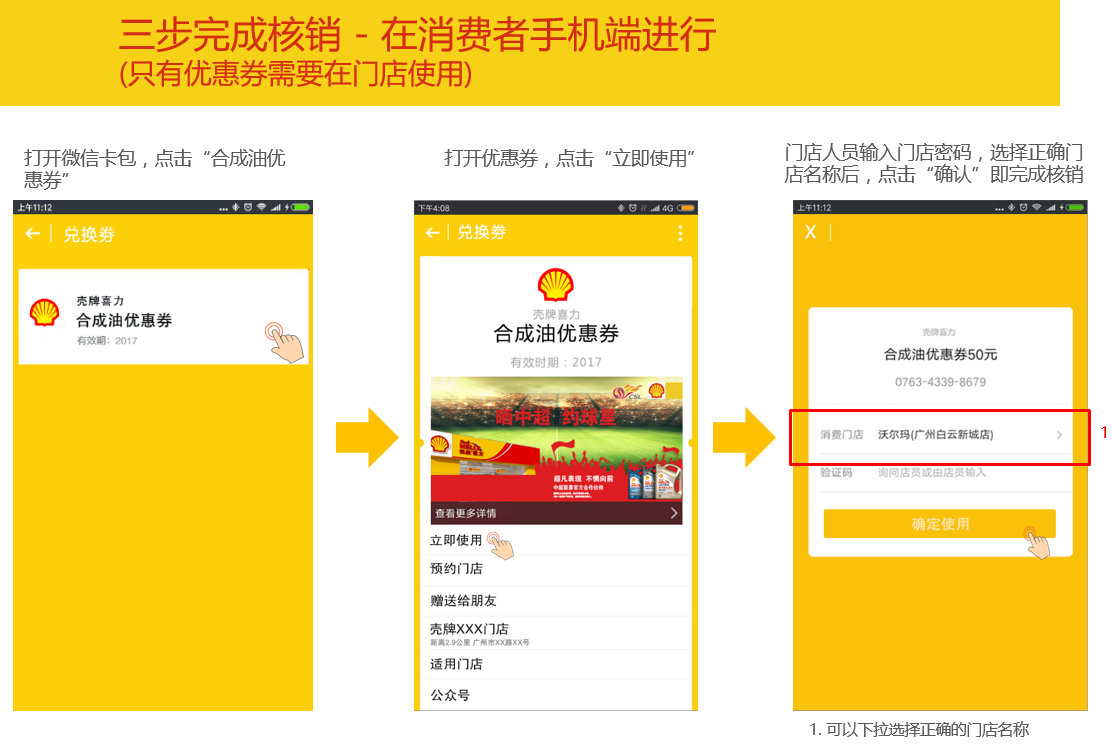
| Claim physical item | Staff confirms redemption | Does this store still have this prize? |
| Claim card/voucher | Red packet to WeChat, JD card password sent, coupon to card wallet | Was it sent successfully? Was it redeemed? How to handle refund or resend? |
| Claim match ticket | Contact via 400 hotline within 24 hours | Who follows up? Which batch does the ticket come from? |
100% winning is not a marketing slogan, but an inventory commitment. If even one prize pool is miscalculated, the front end becomes "can win, can't claim".
Three or four real issues: anyone who has done large-scale national promotions understands
1. Prizes are not "configuration", but inventory
Many campaign backends treat prizes as a configuration table: name, image, probability. But when it comes to 700 stores nationwide, prizes are inventory: how many in the central warehouse, how many in city warehouses, how many left in this store, which stores don't get any at all. At that time, Guiyang did not distribute jerseys, so the corresponding store inventory in the system was disabled, and needed to be enabled/disabled in batches by store code or city code.
Therefore, there are three levels of inventory in the system: total prize inventory, city or store inventory, and batch inventory. If any level is not deducted, over-issuance will occur the next day; if any level is not rolled back, at the end of the campaign there will be a bunch of prizes that are "on the books but not in the warehouse".
2. Having inventory does not mean you can win: triple constraints of probability, inventory, and batch
This is the most underestimated aspect of this system. JD cards and CSL match tickets are not only limited by winning probability and inventory, but also by batch: when this batch of tickets or cards in the batch library is exhausted, even if the total inventory shows more, the system will automatically skip to the next prize until all prizes are drawn, without the user noticing.
If you only rely on "probability + total inventory," the campaign will stall by the third day: users keep drawing "Thank you for participating," and customer service gets flooded with calls. Batch constraints translate the actual supply rhythm of ticketing and card vendors into system rules.
3. Prize distribution involves four external systems, not just a single database write
Even though all are "wins," the fulfillment methods are completely different:
| Prize Type | Distribution Method | What to Do on Failure |
|---|---|---|
| WeChat Red Packet, WeChat Coupon | Call WeChat Red Packet API, direct to wallet | Retry, escalate to manual handling on failure |
| Send to WeChat Card Wallet, redeem at store with password | Reissue, void, extend | |
| JD Card | Send card code via SMS | Resend, replace card, register |
| Physical items (jerseys, scarves, phone cases) | In-store redemption or courier delivery | Store inventory adjustment, reship |
| CSL Tickets | Issue tickets by batch, contact via 400 hotline | Ticket exchange, batch reallocation |
Each category must have an independent state machine: pending issuance, issued, redeemed, failed, reissued. If the backend only has a single "won" status, neither finance nor customer service can use it.
4. Master data for 700 stores—in the pre-AI era, all manually cleaned
Store name, store code, city, affiliated distributor, business status, redemption password, QR code—these fields look ordinary, but they are the index for all inventory and redemption. The document repeatedly emphasizes "do not change the code" for a very practical reason: once the code is changed, historical winning orders, inventory, and QR codes will all fail to match.
The backend also makes enabling/disabling store inventory a batch operation: enter store codes or city codes, e.g., gy for Guiyang, filter prizes, and batch enable or disable. This feature is more important during campaign execution than any fancy report, because prize distribution scope is often adjusted temporarily after the campaign starts.
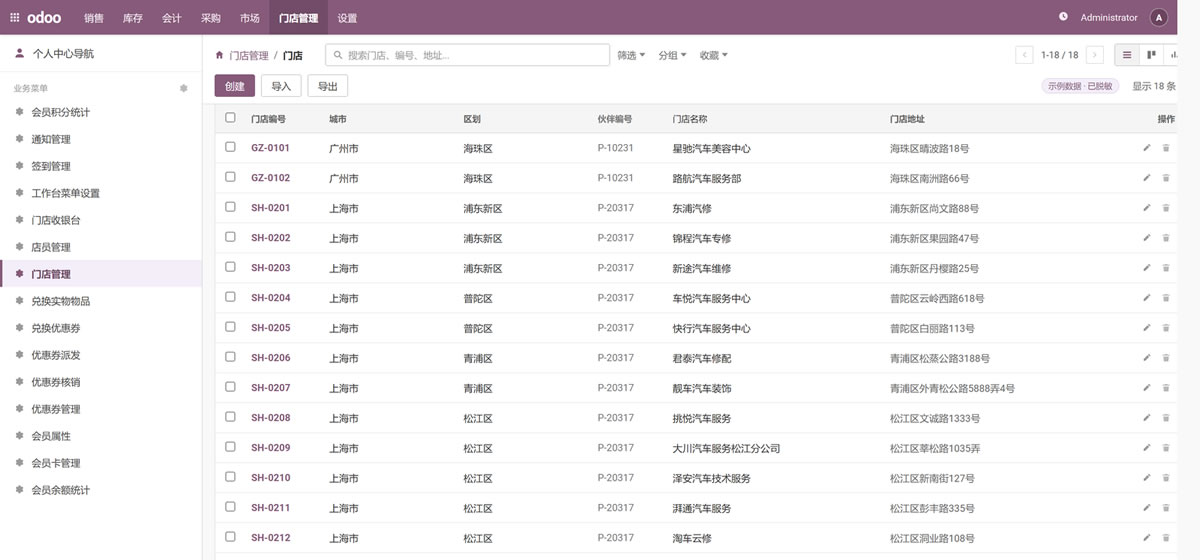
IV. The business skeleton of this system
Translating frontend features into business objects, there are actually only seven categories:
| Business object | Function | Key fields |
|---|---|---|
| Campaign | Boundary of a promotion | City, time, rules, prize scope |
| Store | Entity for participation and redemption | Store code, city code, password, status |
| Prizes | Goods or benefits that can be won | Type, face value, cost, fulfillment method |
| Inventory | Four levels: central warehouse, city, store, batch | Inbound, outbound, lock, rollback |
| Winning order | Result of a single draw | User, prize, batch, status, time |
| Coupons | Redeemable benefits | Coupon code, validity period, redemption store, redeemer |
| Transaction records | Audit and reconciliation | Operator, before/after values, source IP and device |
This model does not depend on any specific technology. In 2017, we implemented it on a self-built backend plus WeChat H5; today, for similar projects, I would put master data and accounting records into Odoo and separate the high-concurrency lottery.
The value of the backend is not “being able to draw prizes,” but that after the event ends, every prize can be clearly accounted for.
V. Reference Architecture for Customizing This Platform with Odoo
For foreign brands entering China and joint ventures in China undertaking such projects, common demands are: the Chinese team needs speed, headquarters needs to understand, finance needs reconciliation, and IT needs auditability. Odoo's advantage is not in “lottery,” but in that it already has inventory, batches, permissions, multi-language, multi-currency, and reporting.
| Capability | 2017 Approach | Today's Odoo Mapping |
|---|---|---|
| Stores and Distributors | Self-built store table | res.partner with store fields, or stock.warehouse |
| Prizes | Self-built prize table | product.product with product categories (physical goods, coupons, services) |
| Store Inventory | Custom Inventory Table | stock.quant plus custom store inventory model (consignment scenario) |
| Lot | Custom Lot Table | stock.lot or serial number, lock tickets and cards by lot |
| Winning order | Custom Order Table | sale.order or custom prize.order |
| Prize Distribution Outbound | Manual Status | stock.picking plus state machine |
| Card/Coupon Redemption | Custom Coupon Code Table | Coupon or gift card model, plus redemption records |
| Permissions | Simple Account | res.groups plus record rules (headquarters, region, store) |
| Reports | CSV plus Excel Pivot | Pivot view, charts, xlsx export |
| Audit | Partial logs | ORM logs, mail.thread, audit module |
The reference architecture consists of five layers:
| Layer | Component | Responsibility |
|---|---|---|
| Touchpoint | WeChat H5, Mini Program, in-store table cards | Scan QR code, share photos, lucky draw, my prizes |
| Lucky draw service | Standalone service with Redis | Probability, inventory reservation, batch validation, anti-fraud, idempotency |
| Business middle platform | Odoo | Prize pool, stores, batches, winning orders, coupons, permissions |
| Fulfillment | WeChat red packets and coupons, SMS, JD cards, 400 work orders | Actual distribution and redemption |
| Analytics | Odoo pivot tables or BI | Three-level review: headquarters, region, store |
Do not send C-end traffic directly to the ERP. Lucky draws are millisecond-level, highly concurrent actions. Odoo handles accounts and master data; use a queue for asynchronous write-back in between, preserving both user experience and data consistency.
VI. 6 Reminders for Foreign Brands Entering China and Joint Ventures
- The WeChat ecosystem is a channel, not a plugin. Official accounts, WeChat card packs, red packets, mini-programs, and WeCom each have their own qualification and API restrictions; domain filing, JS security domains, and subscription message templates all need to be scheduled in advance. Overseas teams often think “just connect an API and it's done,” but in reality it is part of China's local operations system.
- Personal information protection must be redone according to Chinese rules. Phone numbers, addresses, and photos are personal information; collection must be minimized, purposes must be informed, and winner announcements must be anonymized. Foreign companies also need to handle headquarters' access to Chinese data. Dual compliance with PIPL and GDPR is not just a legal statement; it must be implemented in fields, permissions, and logs.
- Align prize tax and invoicing with finance in advance. Physical gifts, WeChat red packets, and coupons have different tax treatments, involving individual income tax withholding, deemed sales, input tax transfer-out, and other criteria. The system must be able to export “who, when, what they won, and how much it is worth”; otherwise, finance can only manually check the ledger.
- Govern store master data first, then discuss campaign configuration. Store codes, cities, distributors, open/close status, and redemption passwords must have a single source of truth. The most common rework in past projects is not the lottery algorithm, but “which city does this store actually belong to.”
- Headquarters reports must be designed from the start. Foreign headquarters usually require an English interface, multiple currencies, and multi-dimensional views by country, region, city, and store; the Chinese team needs same-day export and verification. Odoo's multi-language, multi-company, and pivot tables can save a lot of custom development, but metric definitions must be set in advance.
- Make campaigns into templates, not one-off projects. Once the prize pool, probabilities, batches, store scope, and redemption rules are configurable, the second campaign may go live in one or two weeks; if code changes are needed every time, the money saved on the first campaign will be paid back on the second.
Entering China is not about translating overseas systems into Chinese. Channels, compliance, tax, and store organization—all four must be redesigned according to China's operating methods.
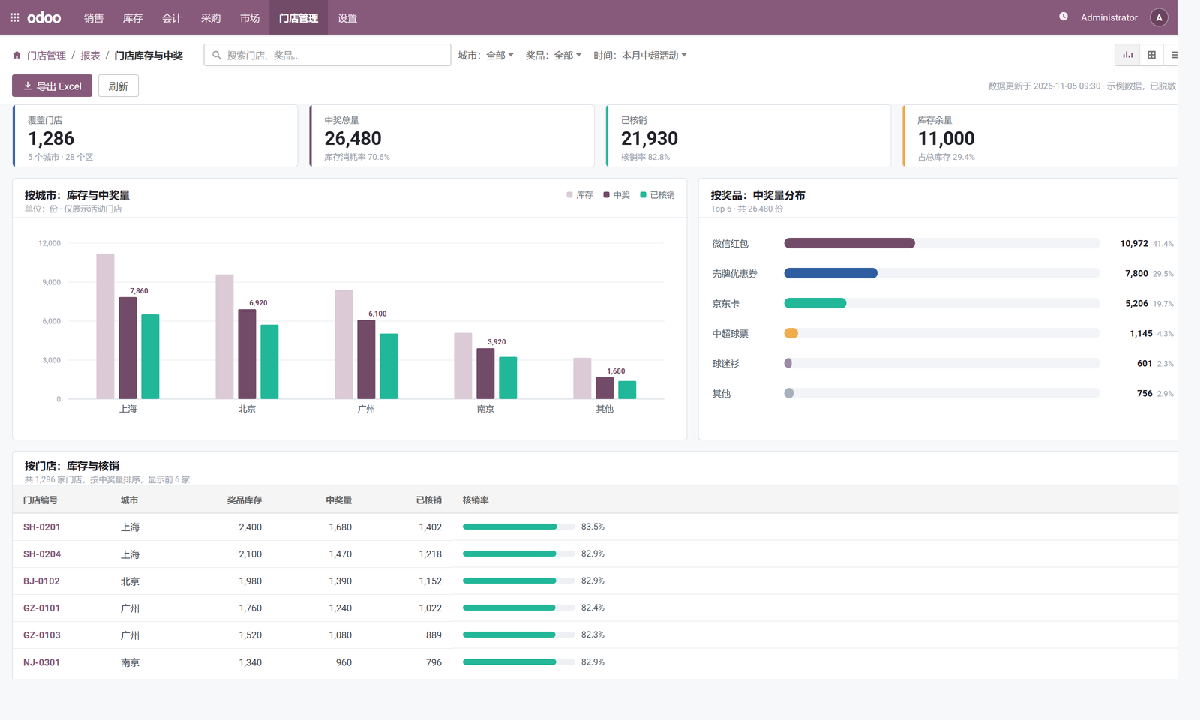
Store inventory and winning reports: inventory and winning distribution by city, store, and prize
VII. Traditional Outsourcing vs. Odoo Customization: What's the Difference
| Dimension | Traditional hard-coded outsourcing | Odoo customization |
|---|---|---|
| Prizes and inventory | Write a separate logic for each prize type | Reuse standard models for products, inventory, and batches |
| Store extension | Adding stores requires code changes or data migration | Backend maintenance, permissions assigned by organization |
| Campaign reuse | One development per campaign | Campaign templating, reusable with configuration |
| Reports | Export CSV then manually pivot | Pivot views and charts, export anytime |
| Permissions | Account plus menu | Groups, record rules, field permissions |
| Audit | Logs rely on development to supplement | ORM logs, change tracking, operation traces |
| Phase 2 expansion | Redo when changing suppliers | Modular expansion, source code controllable |
This is not to say that Odoo is ready to use out of the box for everything. Lottery engines, WeChat red packets, store consignment inventory, coupon redemption still require custom development; the difference is that what is customized is business plugins, not building an ERP from scratch.
VIII. Our approach to such projects
Odoo Smart (formerly Guangzhou Shangpeng) has long been engaged in Odoo custom development and implementation, with clients including Chinese companies going global as well as foreign brands and joint ventures entering China. The "Show CSL, Meet Stars" system for Shell China was delivered by our team in 2017, covering store QR codes, prize pools, batch constraints, and the distribution and redemption of red packets, coupons, and match tickets, running through a complete CSL season.
Today, when doing similar projects, we usually follow four steps:
- Business modeling: First define the seven types of objects—campaigns, stores, prizes, inventory, winning orders, coupons, and transactions—clearly, then discuss pages.
- Minimum closed loop: First get the chain of "scan, draw, award, redeem, report" working, and deliver a usable version to the business side within two weeks.
- Local integration: WeChat ecosystem, SMS, payment, e-invoicing, 400 ticketing, integrated according to actual service providers.
- Delivery and reuse: Deliver source code, deployment, permissions, and operation manuals together, and consolidate campaigns into templates.
If you are evaluating your first marketing or channel system after entering China, you can first ask yourself four questions:
- For the three-tier master data of stores, distributors, and cities, is there a unique code and a single source of truth?
- Are prizes treated as "configuration" or "inventory"? Have you thought through batches, store scope, and rollback rules?
- Do red envelopes, coupons, physical goods, and ticketing each have their own state machine for fulfillment and failure handling?
- Can the China team export the reports headquarters needs on the same day and reconcile them with the accounts?
Once these four questions are answered clearly, system selection will basically stay on track.
If you'd like to discuss a specific Odoo customization plan, you can visit odooai.cn or odooapp.cn, or leave a message directly on our official account.