Odoo is the world's No. 1 open-source ERP
Odoo is a globally popular open-source enterprise management suite, a one-stop full-featured ERP and e-commerce platform.

Its features cover a full range of enterprise IT needs, including CRM, production management ERP, sales, purchasing, warehouse management system WMS, MRP manufacturing, internal instant messaging IM, barcode traceability management, quality management system QMS, full-featured HR, financial management, project management, manufacturing execution system MES, product lifecycle PLM, VOIP, e-commerce, and POS.
Odoo's unique integrated product positioning helps enterprises quickly integrate complex digital needs. Thanks to its modular, low-code, and open-source characteristics, it has won the favor of tens of millions of users worldwide. Currently Odoo has 28 million+ users, 1,700+ developers, and 11+ global branches.
Odoo is fully internet-based in technology, built on mainstream open-source technologies: Ubuntu + Postgres SQL + Python + JS, with a complete enterprise application ecosystem. The official Odoo app store has over 40,000 enterprise application modules, and the China app store covers 15,000 Chinese users, making it easy for enterprises to use on demand with fully centralized data.
Odoo core features
Odoo includes one-stop enterprise functions.
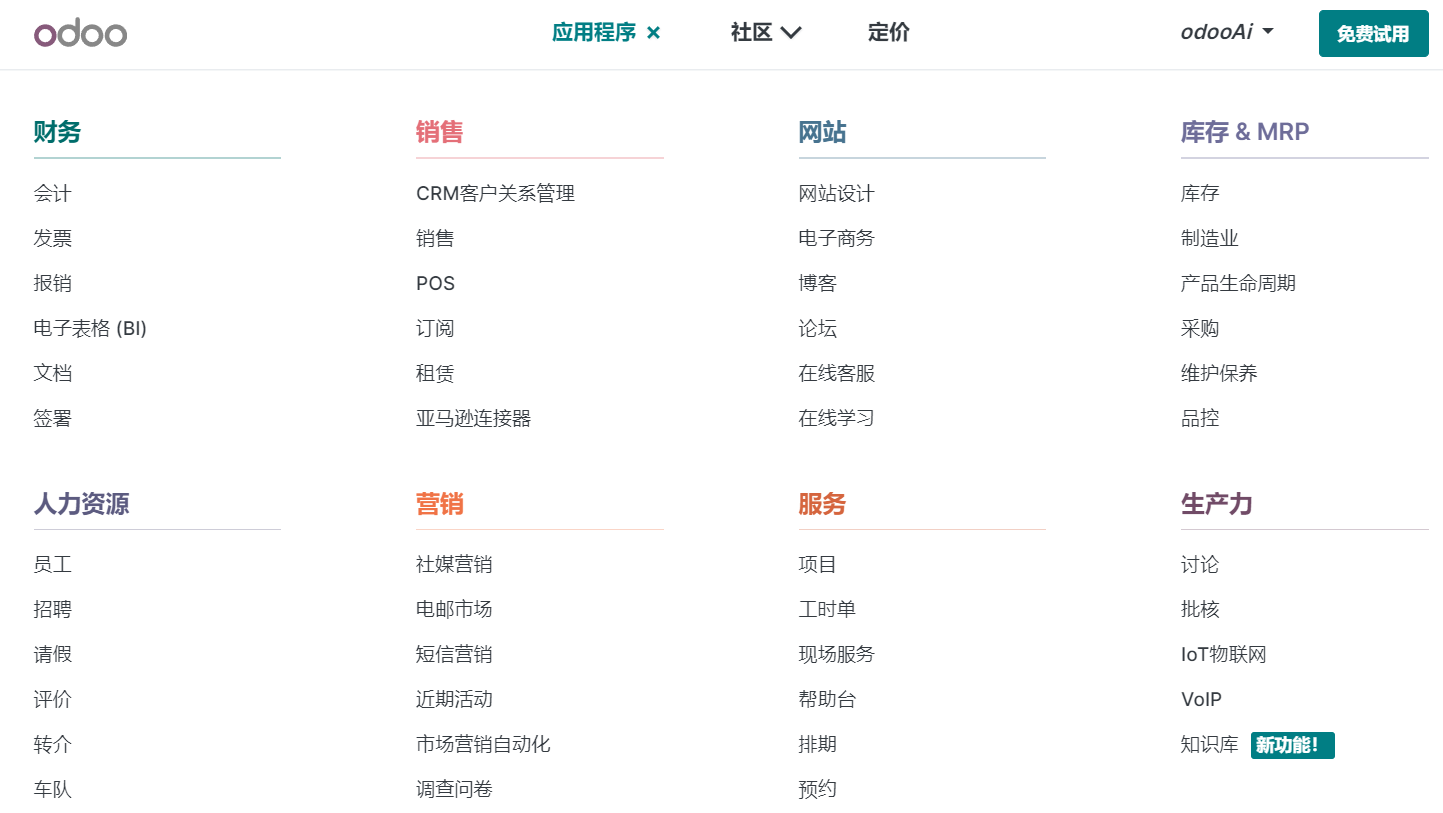
Sales management: order processing, quotations, customer relationship management, etc.
Purchasing management: supplier information, purchase order tracking, etc.
Inventory management: product categories, stock control, and transfers.
Manufacturing: production planning, routing, and cost analysis, etc.
Financial accounting: financial report generation, tax processing, and budget control, etc.
Odoo has Community and Enterprise editions
ODOO has two versions - Enterprise and Community. Both are open source. The Enterprise version actually adds more application modules on top of the Community version, and the core of both is the same.
What are the differences between the two versions?
Based on actual business conditions, which version should we choose?
Free Community Edition
The Community Edition includes the foundational framework for most of Odoo's core features, including:
Production, quality control, PLM, MES, batch
Sales, e-commerce, purchasing, warehouse management, barcode
Finance, projects, online courses, HR, reimbursement, etc.
Paid Enterprise edition
The Odoo Enterprise version is a great enhancement of the Community version. In addition to adding many features, the biggest functional difference is: the Enterprise version has complete financial accounting functions, while the Community version only has simple accounts receivable and payable management. Starting from version 13, Odoo introduced group finance, mainly for consolidated financial statements of multi-company groups.
The Enterprise version supports mobile barcode applications and social media management (we have added Chinese social media matrix management). The Enterprise version has better mobile support and a separate APP.
The most valuable service difference is: the Enterprise version provides underlying technical support while the Community version does not. Only with a purchased license number can you open a ticket with Odoo official to resolve technical issues, which is crucial for commercial applications.
Advantages of Odoo
1. Open-source nature: Odoo is an open-source ERP software, which means enterprises can freely choose deployment methods (such as cloud or on-premise servers) and customize development according to their own needs. This provides enterprises with greater flexibility and control.
2. Modular design: Odoo adopts a modular design, allowing users to select different modules as needed to form a complete solution. This enables enterprises to easily expand functionality and reduces implementation and maintenance costs.
3. Easy integration: Odoo supports seamless integration with other systems, such as e-commerce platforms (e.g., Amazon, eBay, Lazada, AliExpress, Taobao, etc.), logistics companies such as UPS and SF Express, third-party payment channels (such as WeChat Pay, Alipay, PayPal, etc.), as well as CRM, DingTalk, WeCom, WeChat Mini Programs, financial software such as Kingdee and Yonyou, and manufacturing industrial software such as cutting and material calculation tools like Zhumu. This helps improve data flow and work efficiency.
4. User-friendly interface: Odoo provides an intuitive and easy-to-operate interface, lowering the barrier to use. Even employees without a professional technical background can quickly get started.
5. Strong community support: As a popular open-source software, Odoo has a large and active community resource. Users can obtain technical support, tutorials, and plugins from it to help solve problems and accelerate project progress.
6. Adaptable to various industry needs: Odoo covers a wide range of industry fields, including retail, manufacturing, services, and more, and is optimized and configured for various enterprise sizes. Therefore, whether it is a startup or a large enterprise, they can find a solution that suits their needs.
7. Mature, stable, and continuously updated and upgraded: Odoo has undergone multiple version iterations and has demonstrated a high level in both functionality and stability; at the same time, the official team will promptly launch new features and fix vulnerabilities based on market feedback, ensuring that its products remain competitive.
8. Smart version goes deep into industries, quickly enables WeChat and DingTalk mobile office.
9. AI-driven, lean production, business-finance integration, IoT.
10. Internet-native by design, implemented with the most popular development languages Python + Javascript.
Guangzhou OdooAi
Guangzhou OdooAi Technology Co., Ltd.
Odoo China Official Partner, formerly Guangzhou Shangpeng
Source code control:11 years of deep Odoo expertise, controllable source code delivery with no lock-in
Complex customization:Standardized engineering system, group customization delivered on time
Worry-free operations:Rapid bug response, full support throughout go-live and upgrades
Global delivery:Based in the Greater Bay Area, multilingual and multi-currency coverage across Asia, the Americas, and Europe
Official recognition:Core contributor to the Odoo App Store in China

Customer proof:Trusted by 1000+ enterprises, 100% successful project delivery
Guangzhou OdooAi is a technical team long focused on enterprise ERP. We serve over 2,000 enterprise customers worldwide using Odoo. Key members come from SAP, WeChat, Alibaba Koubei and other companies, focusing on the development and implementation of Odoo open-source ERP and mobile e-commerce platforms. With 11 years of Odoo experience, we have multiple successful cases in manufacturing and FMCG retail. Serving users in Guangzhou, Shenzhen, Hong Kong, Foshan, Dongguan, Shunde and the Greater Bay Area.
Success stories
Many well-known enterprises and institutions around the world have chosen to use Odoo, such as Shell China, Baiyun Airport, Wanda, Geely Auto, TOYOTA, FedEx, Fosun, ZTE, Lenovo, UPS, ZTE, New Hope Group, etc.
Odoo installation - Windows
Installation under Windows is relatively simple, directly at GitHub download address Or Gitee download link Get the Odoo 16 x64 portable version and you can use it.
Click here for detailed instructions。
The 64-bit version performs much better than 32-bit, including efficient instructions and faster addressing with large memory. For Odoo, which is resource-intensive, using 64-bit is essential.
This version, built on 64-bit, optimizes PostgreSQL and uses nginx as a reverse proxy to implement longpolling, enabling Odoo desktop message notifications and reducing frequent errors. A complete high-performance Odoo environment has been set up on Windows.
## Version information
1. python 3.10.10, 64-bit
2. postgresql 13.4, 64-bit
3. Nginx 1.15.5, 64-bit
4. Odoo 16 Community Edition, 20230721
5. Added sphinx and tx_client for documentation and translation
6. Run gi.bat locally to clone the latest original Odoo to local .\source_git, run gu.bat to update
7. Handling of breakpoint debugging: if a new Odoo version is updated, overwrite .\source content with .\fixed directory content
Odoo installation - Ubuntu or Linux
On Ubuntu, you can use our one-click installation script to directly install the latest
Odoo 16~11 Community and Enterprise + postgresql12/11/10 + nginx
This is an automatic installation script on Ubuntu, tested on Alibaba Cloud/Tencent Cloud.
Continuously updated, as follows:
Log in to your Ubuntu host as root and execute the following commands. Fully automatic installation script, suitable for Odoo 16 (recommended)
wget https://www.odooai.cn/download/odoo_install_16.sh && bash odoo_install_16.sh 2>&1 | tee odoo.log
For other versions such as 15~13, please execute the following commands
wget https://www.sunpop.cn/download/odoo_install.sh && bash odoo_install.sh 2>&1 | tee odoo.log
After installation is complete, you can see all Odoo 16 applications

If you encounter difficulties during installation, you can refer to the Odoo official installation documentation.
https://www.odooai.cn/documentation/16.0/zh_CN/administration/install/install.html
How to configure Odoo
The above Odoo portable version and one-click installation version have already completed initial configuration.
If you want to make more configurations, mainly modify the odoo.conf file. For details, refer to the official configuration documentation
https://www.odooai.cn/documentation/16.0/zh_CN/administration/install/deploy.html
Odoo cluster high availability deployment
Odoo is a full-featured ERP platform and also an online service portal. As Odoo becomes more and more popular, there are already many high-availability deployments for massive users.
For example, the official 7 million users and hundreds of enterprise SaaS users each month, a domestic Odoo e-commerce app with 5 million+ registered users, etc. The online applications we support for our clients have also reached the level of hundreds of thousands of users. Massive data applications are everywhere; listed companies in China using Odoo, especially in the manufacturing industry, have SKU counts in the hundreds of thousands or more.
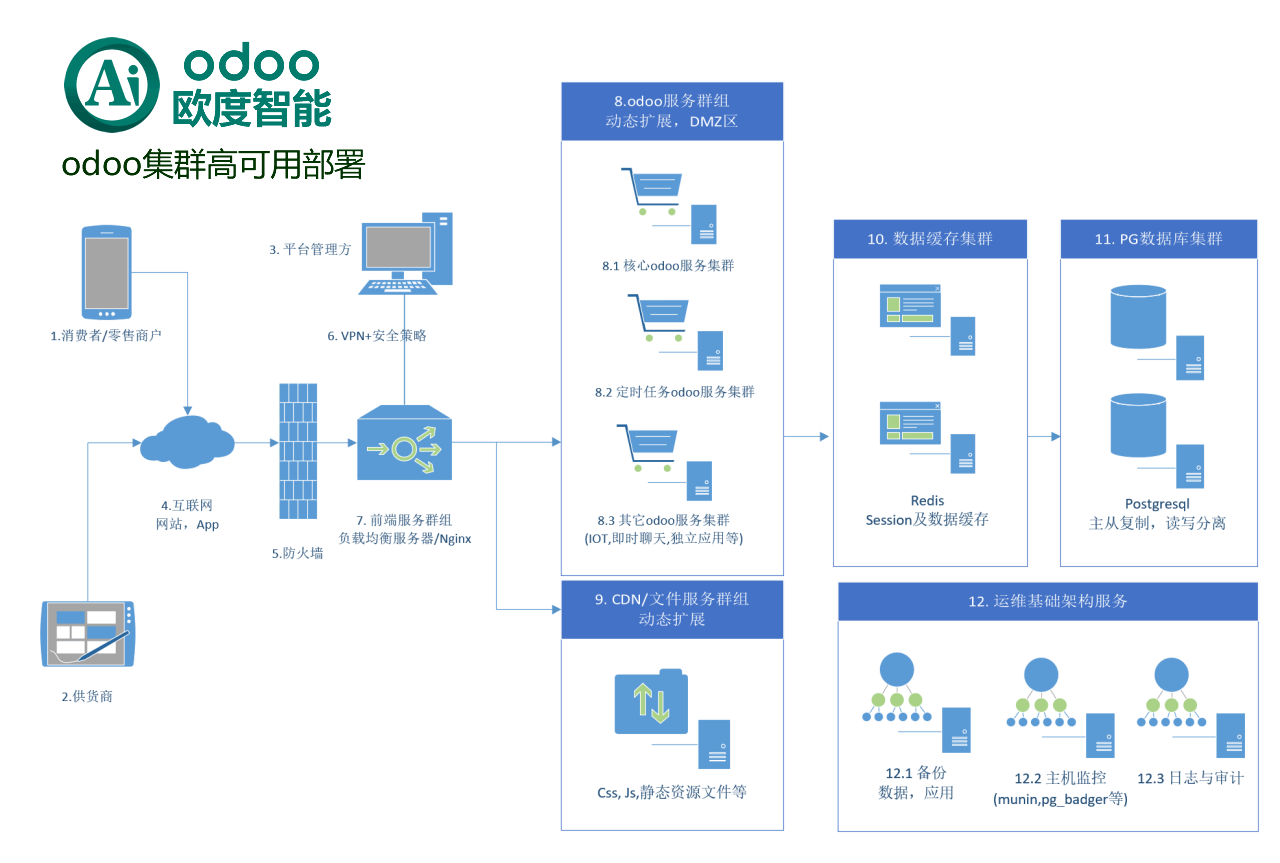
To better support massive users and massive data, especially for multi-city, multi-company deployments of group companies, we need to deploy Odoo with high availability to achieve high performance, high stability, high scalability, and high security. We take a multi-tenant e-commerce supply chain portal application as an example to briefly describe the deployment of a high-availability architecture. Since Odoo itself is a B/S architecture application, this architecture can also apply to all Odoo deployments.
Odoo adopts industry-popular infrastructure, including:
- Operating system: Linux, officially recommended Ubuntu
- Database: PostgreSQL
- Web server: built-in Werkzeug, the front end generally uses Nginx, Apache, or other proxies
- Frontend: JavaScript-based rich client, calling backend data via JSON-RPC. Technology based on jQuery + Backbone + Owl (the MVVM architecture adopted since Odoo 14).
- Backend: Python 3.6+, using threading + gevent to achieve multi-threading and multi-coroutines. Also supports multi-process startup.
These general, open-source-centric architectures ensure excellent scalability and facilitate cluster and high-availability deployment.
In this application scenario, the management party is a group company with multiple subsidiaries. Each subsidiary provides mobile e-commerce wholesale and retail services to its own B2B and B2C customers, and each subsidiary manages its own supply chain business. Each B2B customer then provides retail services to end B2C consumers through store POS. At the top level of the platform, the group company uniformly manages all customers and products, and formulates business rules through Odoo to standardize the daily operations of subsidiaries and B2B customers. The system must ensure millions of users online, achieve rapid response, hot backup, hot update, dynamic expansion and other requirements.
Odoo development and framework
Many people will question Odoo development and also compare the pros and cons of Odoo ERP with ERP developed based on languages such as Java.
Odoo is an ERP application-level platform that fully uses internet architecture. Its main development languages are currently Python 3 + JavaScript (TypeScript).
Python and Java are both now among the top three languages in the world. Regarding the characteristics of the two languages, it can be said that there are many similarities, but also many essential differences. So when comparing these two languages, which one should we choose?
The answer is simple: there is no better, only more suitable. From an ERP perspective, we often say, "Life is short, I use Python". So let's explain our selection logic, mainly for ERP and portal platform construction.
Technology is a tool that serves business outcomes. Each technology has its strengths; the key is to fulfill business needs faster and better.
| JAVA + vendor proprietary ERP | Python + OdooERP framework | |
| Basic framework | JAVA was and still is the most widely used programming language. A vast system with powerful functions, it is the most fundamental development tool and can implement various functions. The downside is that it is "heavy", requiring a large amount of development and taking a long time. Most of the Shangpeng technical team were also once JAVA programmers, but have now moved away, feeling they have "escaped the sea of suffering". | Motto: Life is short, I use Python Python became the #1 development language in May 2018. It now hovers around #2 and #3, and is a mainstream development language at Google/Facebook/BAT. Python has a long history. Its philosophy is to develop main functions into general modules, combined as building blocks on demand. In recent years, it has flourished with the development of new technologies such as AI/blockchain/IoT. |
| Maturity | It depends on the maturity of the development team. The ERP industry is fragmented. | Over 20 years of accumulated enterprise management philosophy, ERP and its layers have accumulated years of experience from 5 million users worldwide, forming business standards. |
| Openness | Most Java development companies only provide compiled software, binding the enterprise. Like Kingdee and Yonyou, if you want to add business requirements, you must wait for the vendor to update the version. | Native Python is open source only, giving enterprises full control and long-term freedom to choose vendors. Development and implementation can be adapted on demand, provided that code version management is done well. |
| Implementation speed | Proprietary ERP, using the vendor's own development. Core system functions and extensions depend on the development team's capabilities and standards. Development may not fully follow standardization; early speed is faster, but later maintenance has strong dependency. | Open ERP, a product of collaboration among massive global developers. There are over 30,000 third-party enterprise applications alone. Built on a standardized model refined over years. A large library of ready-made modules can be quickly assembled and deployed to match customer needs. Ready to use out of the box. |
| User/developer frontend | Requires development and maintenance teams to have deep understanding of JAVA and other development tools, highly specialized | Adopts drag-and-drop interface for rapid building with mature modules like building blocks, low learning cost, and no need for much underlying technical knowledge. Heavy use of JavaScript |
| Cross-platform/cross-terminal capability | Different versions need to be developed for different operating systems and terminals. | Adopts B/S architecture, supports all mainstream operating systems and browsers, automatically adapts to computer and mobile use, and supports mobile business processing. |
| Feature richness | Depends on the investment and capabilities of the original development team; features are fairly complete in niche industries. However, new features and business extensions require custom development from scratch. | After more than ten years, with development accumulated by the official team of over a thousand people and a community of tens of thousands, the built-in features are very complete, and it is used across industries by very large enterprises, including SoftBank in finance, Toyota and Ford in automotive, and BMW Brilliance and Geely in China. |
| Support for long-term development | Requires long-term reliance on the original development team, high cost of building own team. Different teams have inconsistent development styles, making it difficult for other teams to take over maintenance, often requiring rewriting to take over. | All modules adopt unified standards, many support teams are available, and internally trained personnel can easily continue and take over. The core of Odoo is that it has not only development standards but also business standards. The advantages are high compatibility and high standardization of the development team; the disadvantage is high training cost, and developers must be familiar with Odoo's business logic before development. |
| Secondary development capability | All modifications require the participation of the development team | Built-in website builder, reporting system, workflow management, email, IM and other collaboration tools; people without technical skills can quickly achieve customization. Key point! Developers must be familiar with industry business; this cost is high, but it is also essential for ERP! |
| Cloud system support | Most systems only support internal company use. Opening cloud-architecture SaaS services to partners requires separate development. | The Odoo architecture supports cloud deployment and SaaS models, making upstream and downstream connections and integration very convenient. |
| Application architecture | Developed modules are usually tightly coupled; development of one part may trigger modifications to many related modules. | Adopts a standardized plug-in architecture; module development does not affect the core system. |
For detailed development standards, refer to the official developer documentation, which is comprehensive.
https://www.odooai.cn/documentation/16.0/zh_CN/developer.html
Odoo vs. other ERPs
Here we mainly discuss the core advantages of Odoo compared to domestic ERPs such as Kingdee and Yonyou, as well as SAP.
As a former SAPer and the Chinese partner with the most downloads and the largest sales on the official Odoo marketplace, we have a deep understanding of Odoo's power and flexibility.
Odoo's core advantage, most visibly, is being inexpensive: a seemingly low price provides comprehensive ERP functions. Extremely low license fees allow users to focus more on business customization and reduce IT costs in subsequent stable operations.
Odoo's core advantage lies in being open source and open. Open source ensures cost and technology controllability. Open refers to its massive app market and partners supported by a standardized framework.
Open source and openness also ensure that you can fully utilize the most core internal resource, "people". IT personnel can quickly develop business platforms with independent intellectual property rights belonging to the enterprise, firmly holding the core competitiveness in hand. Within a visible schedule, we provide you with a high-quality, network-wide ERP solution.
For medium and large enterprises, Odoo's 7 million users worldwide and tens of thousands of enterprise applications in the open market form a strong ecosystem moat, enabling fully internet-based open-source adaptability on demand. At the same time, in core cities such as Beijing, Shanghai, Guangzhou, and Shenzhen, there are strong development, implementation, and training partners, ensuring that enterprises are not locked in by a single integrator.
ERP is business; evolving business requires an extensible open-source ERP. In short, choosing Odoo means choosing
- Now meet your need to manage the entire enterprise with one set of software
- Definitely meets your future needs
- Not expensive, costs are calculable, progress is visible
-
Odoo vs SAP Business One comparison

Network-wide platform application
In comparison, 'network-wide' means that most Kingdee and Yonyou systems are always internal systems, unable to extend to customers and suppliers, and unable to achieve network-wide collaborative business processing, whereas Odoo can. Odoo uses an internet-based, mobile-oriented architecture that is optimal for enterprises, meeting customers' various current business needs with ready-made functions, and enabling on-demand adaptation with an agile development framework, thereby meeting customers' continuously expanding business needs.
Controllable. True software as a service
Clients often choose Odoo starting from its price advantage. Generally, for conventional ERP customization with Kingdee or Yonyou, the cost is a million-level ERP, and even a million-level Kingdee is just a starting point with no bottom. With Odoo, the starting point is often in the hundreds of thousands. This is not to say Odoo is not worth a million; on the contrary, enterprises often use Odoo to make a more reasonable investment allocation between software implementation and licensing, ultimately getting returns exceeding the investment and more deeply experiencing "software as a service." Near-free software licensing allows Odoo to well control schedule and cost, and better reflects the value of consulting and implementation services, enabling the implementer and client to become one, with the vendor considering business system implementation more from the client's perspective. As a commercial company, Odoo had over 1,700 employees in 2021, a large and stable technical team, has provided continuous technical support for over 10 years, and is still open source and free for the community. It is easy to judge its cost-effectiveness.
Strong technical DNA
The fully internet-based framework based on Python and JavaScript allows it to use the latest global open-source resources at any time, making development more efficient and costs more controllable. The pure B/S architecture facilitates rapid on-demand adaptation based on customer needs, and the ecosystem facilitates instant purchase of needed modules in the open app market. The existing nearly 30,000 app modules can basically solve common individual needs, which is especially important in today's internet-based ERP applications. This is beyond the reach of Kingdee, Yonyou, SAP, Oracle, and even Salesforce. Fast sales! The app market is two-way: you can buy and also sell. The Odoo global ecosystem gives technology companies or individuals a broader stage. You can easily put your solutions on the Odoo app market for sale; good apps are easily recognized, generating revenue and customers. So functionally, Odoo is a network-wide ERP for large enterprises like SAP and Oracle, but at a lower cost. At a time when Kingdee and Yonyou are vigorously promoting cloud applications, Odoo lets you own your enterprise informatization platform, no longer working for others, and ensures the security of your own data.
Solvable "bottlenecks"
Most people think that Python, as an interpreted language, will bring concurrency issues to Odoo. Not to mention that Python is continuously maturing and has become the world's #1 most popular language; in today's increasingly mature hardware and network environments, concurrency can be quickly resolved through matrix and distributed deployment, and of course, there is the even easier option of directly using Alibaba or Tencent cloud services. In the operations systems of BAT giants, Python has long been dominant. It can be seen that the real bottleneck is the 'high cost of people', having to compete with big data, AI, and internet companies for talent. Fortunately, Odoo's app market ecosystem has solved many problems, and there are also many Odoo developers on Upwork and Freelancer. Therefore, the way to solve the bottleneck is to train your Odoo programmers and consultants well and take good care of them, or find a good Odoo partner.
The ever-rising Odoo
In 2018, Odoo began to make a push in China, and the milestone event wasStrategic cooperation between Odoo and Inspur (official announcement), and launched pscloud. Unfortunately, it has now disappeared; one can only say the DNA is different. Fortunately, Odoo itself has done well. Even with the lowest revenue in the China region, it invested technical resources to make a big leap in the localization of version 16, and Chinese translation was also promptly ranked at the top.
Driven by internet companies, open source has gradually become the first choice for enterprises to embrace new ideas. As the world's number one open-source ERP, Odoo's influence has risen significantly.
Choose the ERP that fits you best
When selecting an ERP, enterprises should clarify their specific needs and goals. Understanding factors such as industry, size, operational characteristics, and pain points helps determine the required functional modules and optimization direction. Odoo's customizability and flexibility are better suited to meet special enterprise needs. In addition, ease of use is one of the important indicators for evaluating an ERP system. Odoo's good user experience reduces employee learning costs and cuts training time and expenses. Odoo's integration capabilities better support seamless integration with most existing systems.
Due to its open-source nature, modular design, ease of integration, and strong community support, Odoo is favored by many small to large enterprises worldwide. Therefore, Odoo is undoubtedly a one-stop enterprise management suite worth using for all types of businesses, especially growing ones.