FEFO removal
The First Expired, First Out (FEFO) removal strategy targets products for removal based on their assigned removal dates.
Enabling the FEFO removal strategy
Lots and serial numbers differentiate identical products and track information like arrival or expiration dates. To enable this feature, navigate to . Under the Traceability heading, check the box beside Lots & Serial Numbers. After Lots & Serial Numbers is enabled, the Expiration Date feature appears. Enable it to track expiration dates, best-before dates, removal dates, and alert dates.

Enable tracking by lots or serial numbers
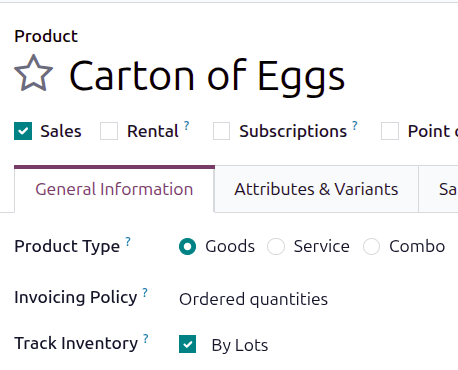
Next, ensure the intended product is tracked by lots or serial numbers by navigating to the product form through and selecting the desired product. On the product form, open the General Information tab and select the check box next to the Track Inventory field, then select either By Unique Serial Number or By Lots.
Setting dates
Next, set the Expiration Date, Best Before Date, Removal Date, and Alert Date settings for the product. In the Inventory tab of the product form, under the Traceability heading, select the Expiration Date check box. The Dates heading appears. See Removal date for more information.
Assigning lots and serial numbers
After enabling the features, assign lot or serial numbers to products using an inventory adjustment or during product reception.
Setting removal strategies
After lot or serial numbers have been assigned, set the removal strategy on the storage location or product category.
On the location
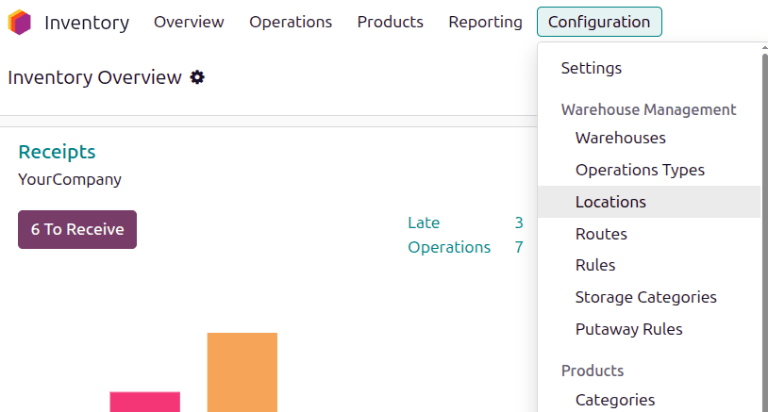
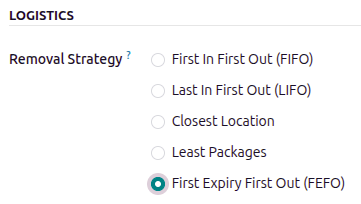
Open . Select the desired location. On the location form, under the Logistics heading, select First Expiry First Out (FEFO) from the list of removal strategies.
On the product category
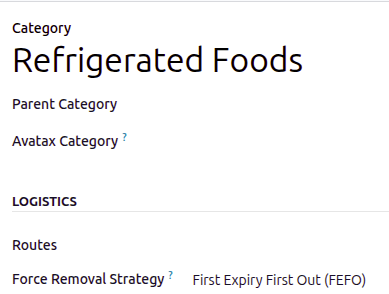
Configure removal strategies on product categories by going to and selecting the intended product category. Next, in the Force Removal Strategy field, specify First Expiry First Out (FEFO).
Important
When there are different removal strategies applied on both the location and product category for a product, the value set on the Force Removal Strategy field set on a product category form is applied as top priority.
Removal date
Products must be removed from inventory before their removal date, which is set as a certain number of days before the product’s expiration date.
The user sets this number of days by navigating to the product form’s Inventory tab. Under the Traceability section, ensure the Tracking field is set to either By Lots or By Unique Serial Number.
Next, select the Expiration Date option, which makes the Removal Date field (and other date fields) appear.
Important
The Lots and Serial Numbers and Expiration Dates features must be enabled in to track expiration dates.
The expiration date of a product is determined by adding the date the product was received to the number of days specified in the Expiration Date field of the product form.
The removal date takes this expiration date, and subtracts the number of days specified in the Removal Date field of the product form.
Example
In the Inventory tab of the product, Egg, the following Dates are set
by the user:
Expiration Date:
30days after receiptRemoval Date:
15days before expiration date
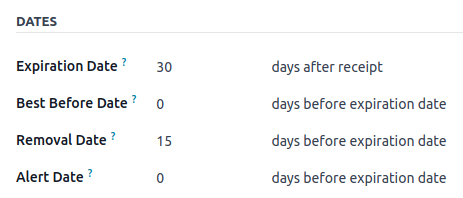
A shipment of Eggs arrive at the warehouse on January 1st. So, the expiration date of the Eggs is January 31st (Jan 1st + 30). By extension, the removal date is January 16th (Jan 31 - 15).
To view the expiration dates of items in stock, go to . By default, this report is grouped by location. If necessary, remove that grouping in the search bar and group by product. Expand the product to show its lots. Next, click the (settings adjust) icon, located on the far-right, and select the columns: Expiration Date and Removal Date.

Alternatively, view these dates by clicking the Lot/Serial Numbers smart button on the product form.

Workflow
Using the FEFO removal strategy ensures that products with the nearest removal date are picked first.
To understand how this removal strategy works, consider the following example below about the
product, Carton of Eggs, which is a box containing twelve eggs.
The product is tracked By Lots, and the product category’s Force Removal Strategy is set to First Expiry First Out (FEFO).
LOT1 |
LOT2 |
LOT3 |
|
|---|---|---|---|
On-hand stock |
5 |
2 |
1 |
Expiration date |
January 8, 2026 |
January 15, 2026 |
January 22, 2026 |
December 24, 2025 |
December 31, 2025 |
January 7, 2026 |
To see the removal strategy in action, go to the and create a new quotation.
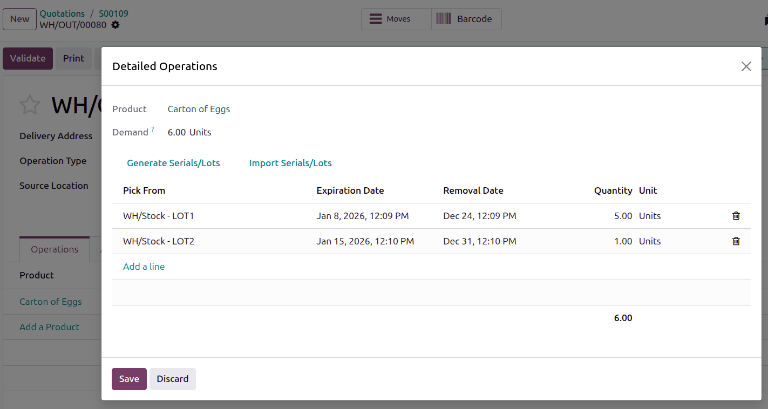
Clicking Confirm creates a delivery order for today, December 9th, and the lot numbers with the soonest expiration dates are reserved, using the FEFO removal strategy.
To view the detailed pickings, click the Details link, located on the far-right of the Carton of Eggs’ product line, in the Operations tab of the delivery order. Doing so opens the Detailed Operations pop-up window.
In the Detailed Operations pop-up window, the Pick From field displays where the quantities to fulfill the Demand are picked from.
Since the order demanded six Cartons of Eggs, using the FEFO
removal strategy, all five Cartons from LOT1, with the removal date of December 24, are picked.
The remaining Carton is selected from LOT2, which has a removal date of December 31.