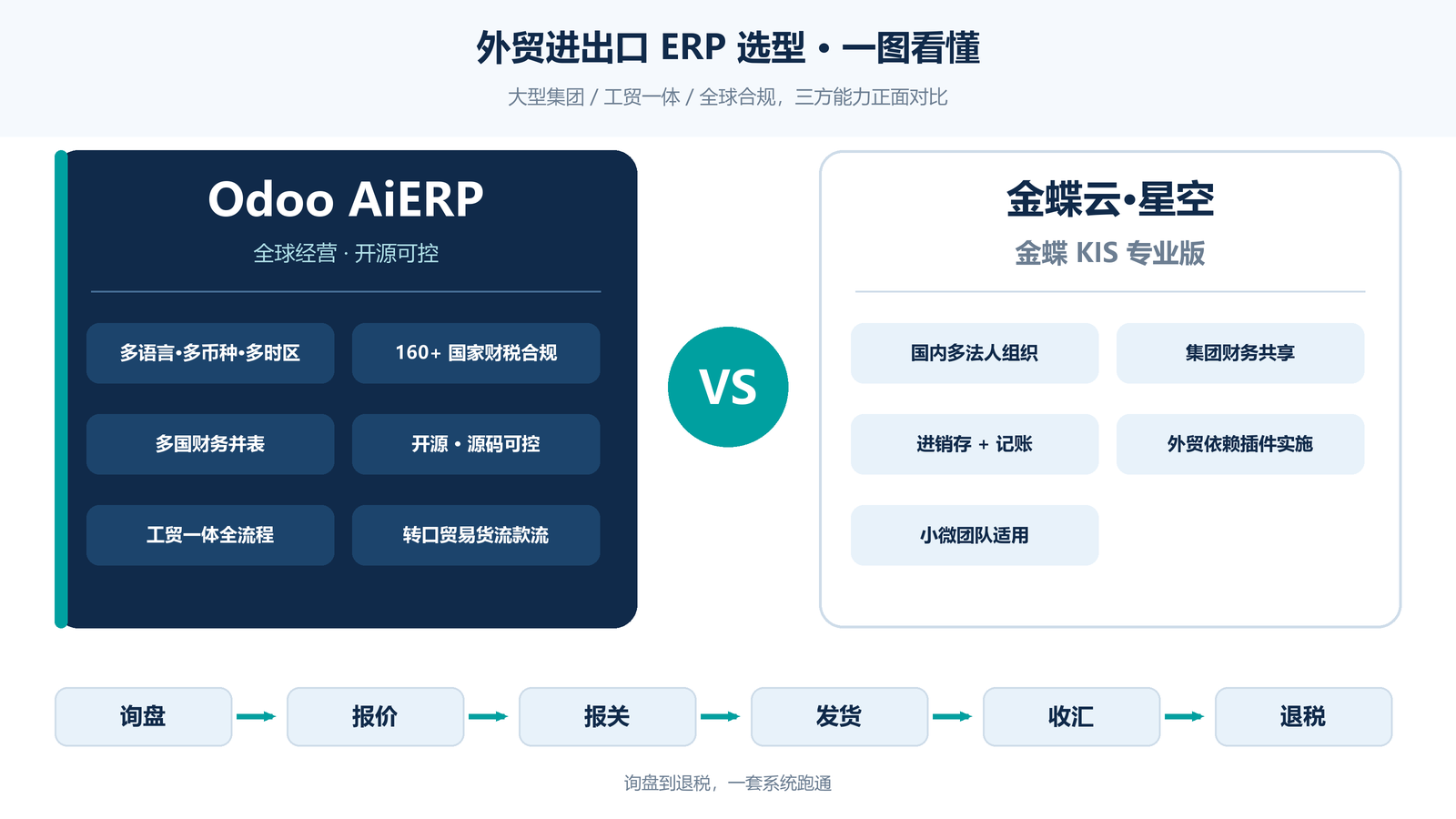
Which export ERP fits? The 30-second answer
Forward this paragraph to whoever is shortlisting systems. If you sell in several countries, run manufacturing and trade on one ledger, and want AI reading live ERP data, compare Odoo AiERP first. If your organisations sit mainly in China and multi-entity financial consolidation is the core need, Kingdee Cloud Galaxy is the mature reference. For a small domestic manufacturer-trading firm that mainly needs stock, sales, purchasing and bookkeeping, Kingdee KIS Professional is enough. Test global capability, open-source control and depth in foreign trade before you compare price.
Multi-country · manufacturing-trade · AI native
Compare Odoo AiERP first
Multi-language, multi-currency and multi-time-zone with tax localisation for 160+ countries; inquiry, customs, settlement and rebate in one database; 17 AI modules inside the ERP.
China-centred multi-entity finance
Treat Kingdee Cloud Galaxy as the mature reference
Mature multi-entity accounting, group consolidation and supply chain; overseas localisation and foreign-trade flows usually depend on industry plug-ins and configuration.
Small domestic firm
Kingdee KIS Professional may be enough
Finance, purchasing, sales, inventory and simple subcontracting; no dedicated foreign-trade documents, deep multi-currency accounting or export rebate.
The full article is long. With three minutes, read the 30-second answer, the five questions, then the 12-point checklist. A saveable share card sits at the end.
The short answer: which of the three fits whom
Start with the verdict. If you need multiple languages, currencies and time zones, operate legally in several countries, run manufacturing and trade on one ledger, and require open-source control plus native AI and multi-country consolidation, choose Odoo AiERP first. If your organisation sits mainly in China and multi-entity financial control is the core need, Kingdee Cloud Galaxy is a mature option. If you are a small trading or manufacturing firm selling domestically with little or no export, Kingdee KIS Professional is enough. The three dividing lines are global capability, open-source control, and depth in foreign trade.
Treating Odoo AiERP as a lightweight option for small business is a misreading. Guangzhou OdooAi Intelligent Technology Co.'s Odoo AiERP runs on the open-source Odoo 20 base with the same data model as the official Enterprise edition, so multi-language, multi-currency and multi-time-zone support are core, not add-ons. Localisation packs for more than 160 countries can be enabled per market, while full financial accounting and group consolidation are delivered against your chart of accounts (see Odoo localised accounting and finance for China). What it covers is not a single department but the whole stack: group portal, e-commerce, CRM, foreign-trade sales, MES, finance and low-code platform.
Three systems, three choices
Odoo AiERP
First choice
Best for: Large groups and integrated manufacturing-trade exporters that need multiple languages, currencies and time zones, operate in several countries, run manufacturing and trade on one ledger, and require open-source control, AI-native integration and multi-country consolidation.
Three dividing lines: global capability · degree of open-source control · depth in foreign trade
Kingdee Cloud Galaxy
Mature option
Best for: Mid-size and large groups whose organisations sit mainly in China, centred on multi-entity financial control, and that value out-of-the-box consolidated statements and a mature supply chain.
Strengths: multi-entity finance · group consolidation · supply chain maturity
Kingdee KIS Professional
Good enough
Best for: Small manufacturing-trade firms selling domestically with little or no export, where a dozen people just need stock, sales, purchase and bookkeeping running smoothly.
Limits: no foreign-trade documents · no deep multi-currency accounting · no export tax rebate
Kingdee and Odoo complement each other
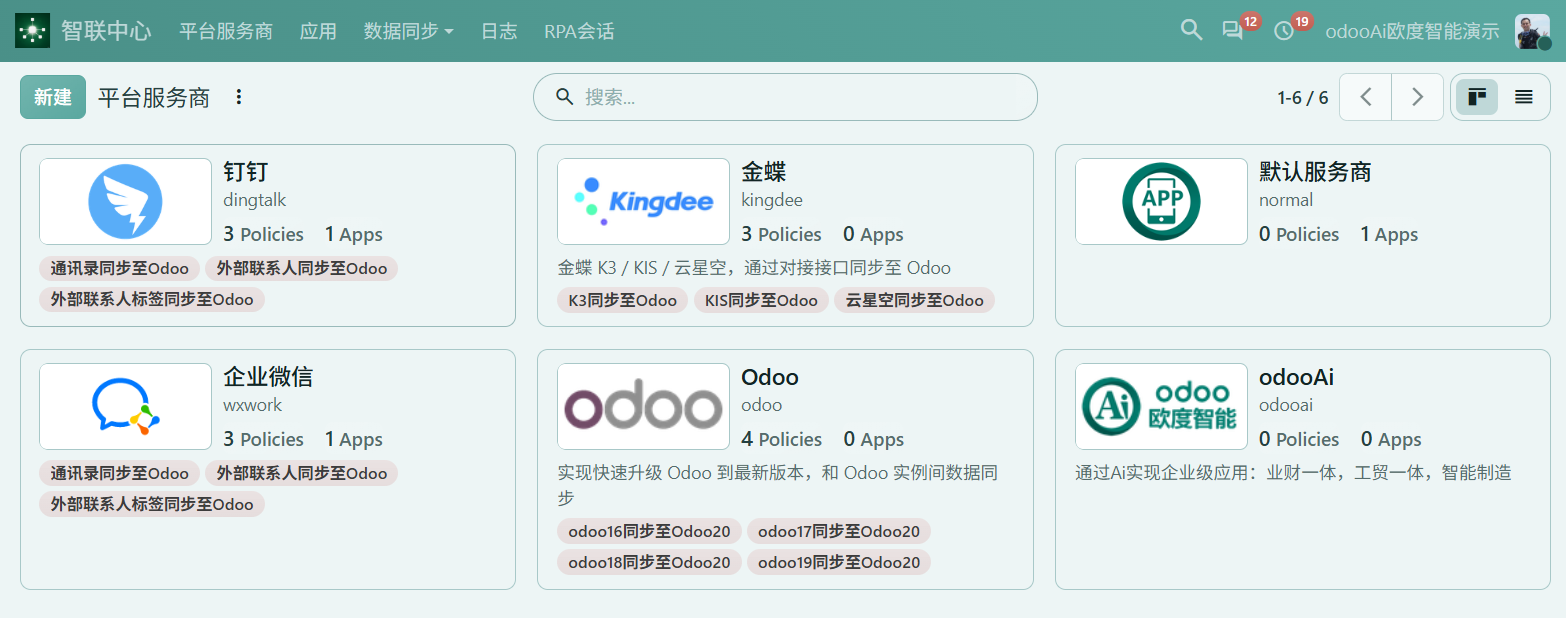
In day-to-day operations, the two do not have to conflict. We more often combine Odoo with Kingdee: Kingdee handles finance, while Odoo runs business operations such as integrated manufacturing and trade, and global storefronts. For this, we have built the Odoo Smart Link Hub, which synchronises data between Odoo and Kingdee Cloud Galaxy or Kingdee KIS to support day-to-day operations. We will publish a dedicated series on this topic, including Odoo-to-Yonyou and Odoo-to-SAP synchronisation.
Six core strengths of Odoo AiERP
Global first
Multi-language, multi-currency and multi-time-zone at the core, with localisation for 160+ countries, so entering a new market no longer means replacing your ERP.
Secure and controllable
Open-source architecture, on-premise deployment, auditable source code and self-owned copyright, with data staying on your own servers.
Transparent pricing
A one-time fixed fee with no annual licence, catalogue-priced customisation packages, and optional rather than bundled annual maintenance, so cost does not rise with headcount.
AI native
17 app_ai modules put agents inside the ERP instead of bolting them on, with switchable models (DeepSeek, GPT, Qwen, ERNIE, Kimi, Gemini) and OCR plus document RAG reading live business data.
Depth in foreign trade
From inquiry, quotation and samples through contracts, customs declaration, clearance, settlement, tax rebate and transit trade, all in one database.
Group consolidation
Multiple companies, ledgers and accounting standards, with consolidated statements and audit trails built to your reporting basis.
Run five go / no-go questions before the feature comparison
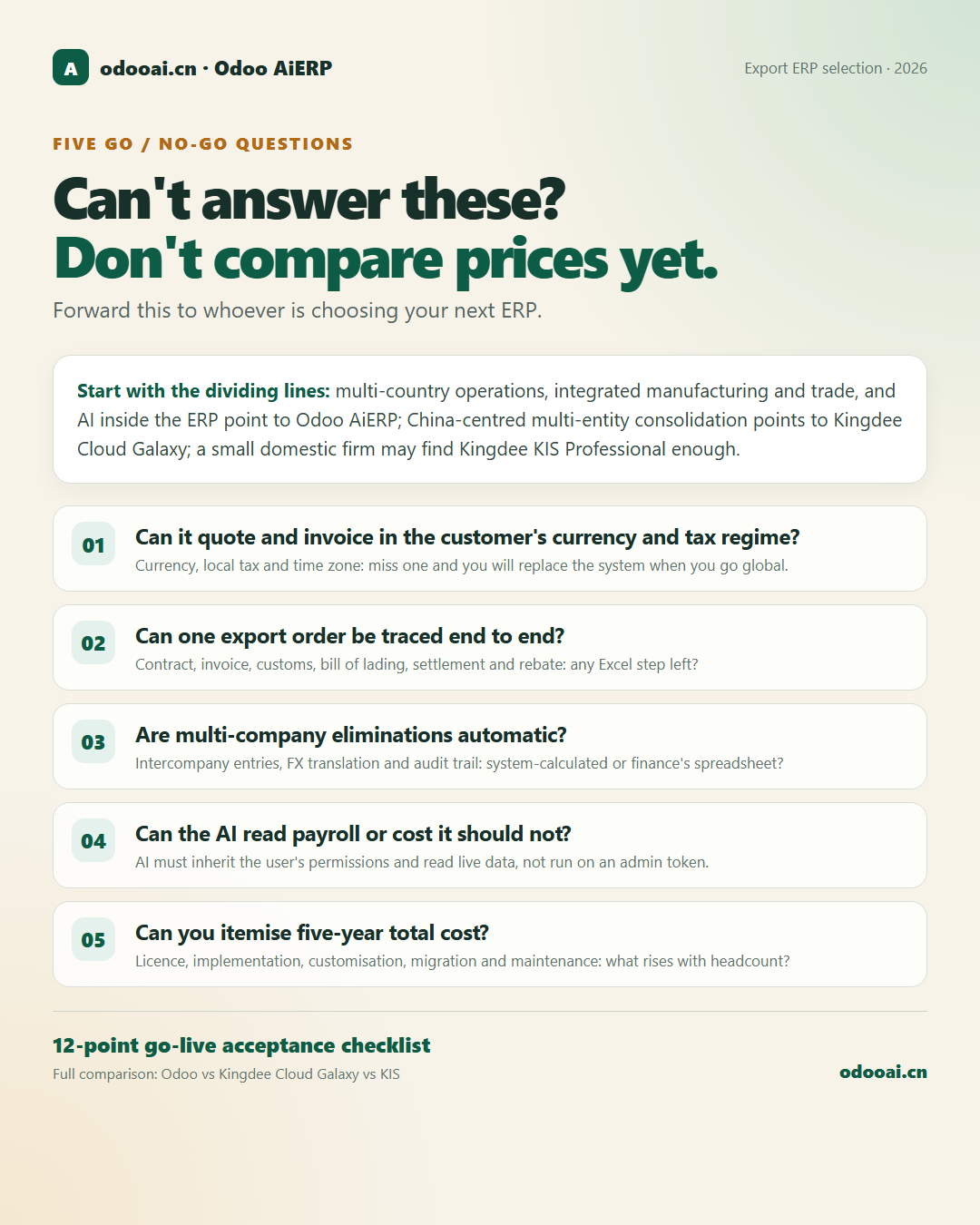
These are elimination questions, not a scorecard. If one cannot be answered, do not compare price yet: what you fix after go-live is usually process, integration and manual ledgers rather than a missing button. Send the questions to each vendor and ask for a demonstration on your own documents, not a product slide.
| Go / no-go question | Pass line | Warning sign |
|---|---|---|
| Can it quote in the customer's currency, invoice under local tax rules and issue documents in the local time zone? | Switching currency, language and tax regime keeps prices and discounts on one source, and the PDF template follows | A separate spreadsheet or template for every country |
| Can one export order be traced from contract to rebate? | Contract, invoice, packing list, customs declaration, bill of lading, settlement and rebate share one order and one data set | Half the documents live in email, shared drives or personal laptops |
| Are multi-company eliminations automatic? | Intercompany transactions generate elimination entries automatically, with traceable FX translation and audit records | Finance combines statements and revalues currency by hand at month-end |
| Does AI read live data within the user's own permissions? | A restricted user asks for payroll or cost, the AI refuses, and every call is audited | The AI runs on an admin token and can see what the user cannot |
| Can you itemise five-year total cost? | Licence, implementation, customisation, migration and maintenance are listed separately, and headcount growth does not raise the licence | Only a lump sum, or every addition is "quoted on request" |
Record the answers in the selection file; five answers narrow the shortlist faster than ten product brochures.
Capability 1: Multi-language, multi-currency, multi-time-zone and global tax compliance
This is Odoo's headline strength and the first gate in any foreign-trade ERP selection. Real globalisation is not translating the interface. It means one document priced in different currencies, taxed under local rules, timestamped in the local time zone, and reported in the format each authority expects. Odoo's core models language, currency, time zone and tax localisation as one data model, and Guangzhou OdooAi Intelligent Technology Co. layers financial packages for more than 160 countries on top, so entering a new market does not require installing another local system. For how to configure customers, suppliers, currencies and customs ports, see Foreign trade ERP in practice: customers, suppliers, currencies and customs port configuration。
| Comparison dimension | Odoo AiERP | Kingdee Cloud Galaxy | Kingdee KIS Professional |
|---|---|---|---|
| Multi-language support | Multi-language at the core; interface, documents, products and website front end all switchable. Supports one-click multilingual quotations, generating language variants of the same quotation automatically. Multilingual portals and multi-site matrices share one source. | Multilingual interface supported; overseas localisation depends on regional packages. Multilingual quotation versions must be maintained template by template. | Primarily Chinese; limited multilingual capability |
| Multi-currency support | One document shows both transaction and company currency; price lists, quotations, payments and journal entries share one currency source. Connects to live bank rates and re-prices daily. | Multi-currency ledgers with fixed, floating or custom rates, and live bank rate integration | Basic foreign-currency handling; deeper multi-currency needs extra configuration |
| Multi-time-zone support | Time zone recorded per user and per location, so cross-border orders, shipments and settlement share one time basis | Supported through cloud deployment and regional packages | Cross-time-zone scenarios not covered |
| Global tax packages | Localisation for 160+ countries and regions, applied per target market; multiple tax regimes, VAT/OSS and withholding tax configured locally | Mainly China tax plus selected overseas regions; global coverage needs industry plug-ins and implementation | Focused on China bookkeeping and filing |
| Compliance and audit | Vouchers, documents and reports are traceable, meeting cross-border audit and evidence-retention needs; document centre archives contracts and certificates | Parallel accounting standards with mature group compliance and audit | Meets local filing needs of small business |
| Multi-site and e-commerce | Group website, multilingual portals and B2B/B2C commerce share one source with ERP, so one back office runs sites in several countries | Requires integration with e-commerce systems, usually via APIs | Largely out of scope |
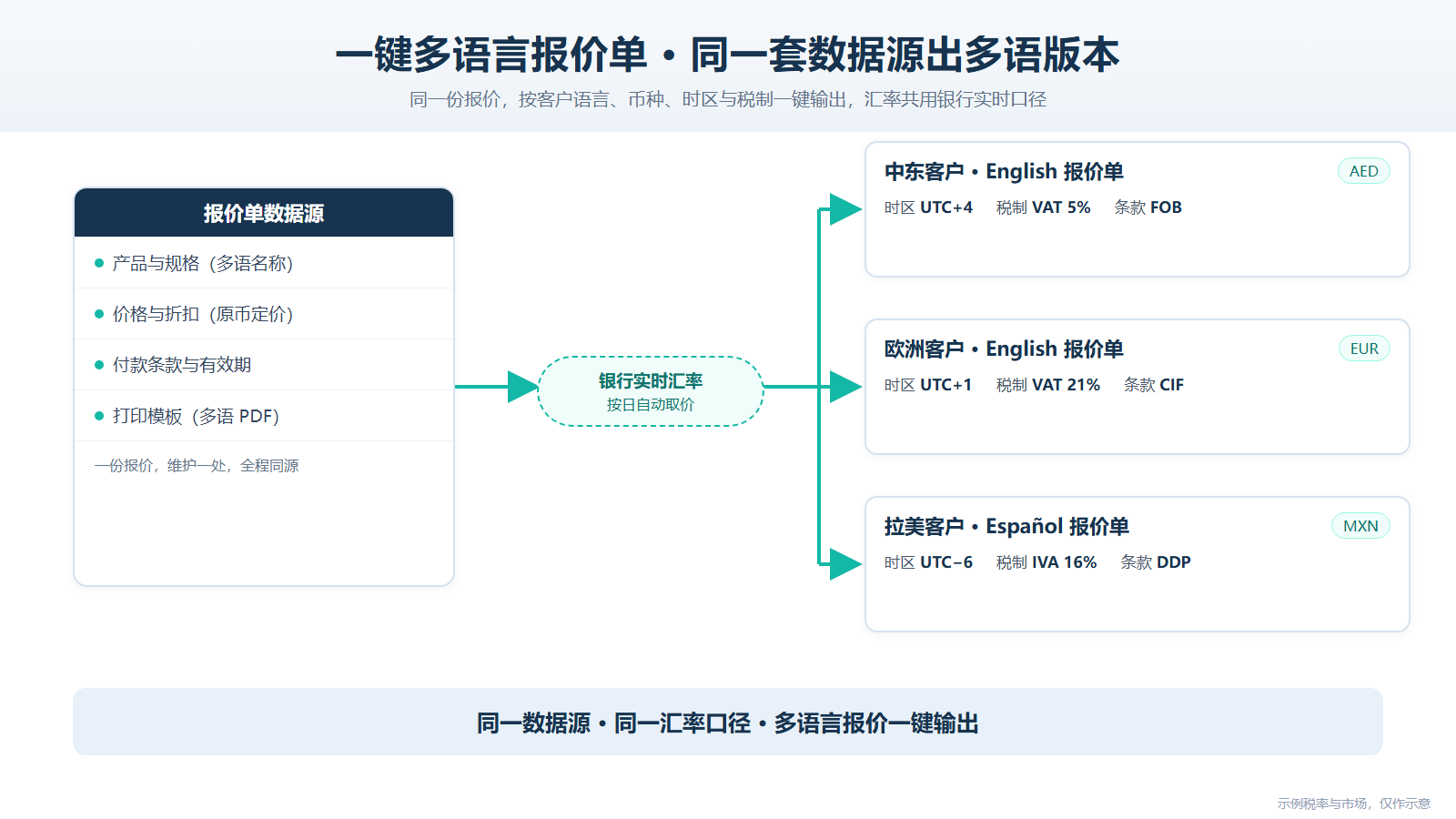
Two easily overlooked details deserve separate mention. First, one-click multilingual quotations: once products, terms, units and print templates are configured per language, the same quotation can be issued in the customer's language without keeping a separate spreadsheet per language. For teams selling into the Middle East, Europe and Latin America at the same time, this saves duplicated work and translation errors. Second, live bank exchange rates: rates cannot be copied by hand every day. The system should pull from a bank or public rate source on a schedule, with quotations, orders, payments and month-end revaluation sharing one rate basis, so sales does not quote at one rate while finance books at another. Both are native in Odoo, not plug-ins.
The test is straightforward
Take the three country markets you actually sell into and ask, line by line, whether the system can quote in the local currency, invoice under local tax rules, and issue documents in the local time zone. If it fails all three, you will replace the system once you go overseas.
Capability 2: Multi-country consolidation and group control
Once a trading company becomes a group, the question shifts from how much a single shipment earns to how much the group earns after consolidating several companies worldwide. Odoo's multi-company architecture lets each legal entity keep its own books and currency, then consolidates through account mapping and rate translation. Guangzhou OdooAi Intelligent Technology Co. builds full financial accounting to your chart of accounts and reporting basis, so AiERP carries both the operational front end and the group back end. This capability is often underestimated but is a hard requirement for large groups. To benchmark Odoo against SAP, Kingdee and Yonyou across six systems, read Odoo 20 vs SAP, Kingdee and Yonyou in one comparison table; for Greater Bay Area experience, why more manufacturers in Hong Kong and the Bay Area choose Odoo is closer to reality.
| Comparison dimension | Odoo AiERP | Kingdee Cloud Galaxy | Kingdee KIS Professional |
|---|---|---|---|
| Multi-entity, multi-ledger | Separate ledgers, currencies and tax settings per company, with intercompany transactions generating elimination entries automatically | Mature multi-entity finance collaboration, intercompany elimination and group ledger control | Mainly single entity; no group consolidation |
| Consolidated statements | Built to your consolidation basis, with multi-standard conversion and translation rates | Out-of-the-box consolidated statements and parallel accounting standards | Not provided |
| Cost and budgeting | Cost accounting, management accounting, budgeting and analytical accounting built to your basis | Budgeting, treasury and cost analysis built in as modules | Basic financial accounting |
| Business-finance integration | Sales, purchase, inventory, production and foreign-trade documents share one source with journal entries; no re-import needed | Mature business-finance integration with strong financial depth | Basic linkage between inventory, sales, purchase and finance |
| Implementation boundary | Full financial accounting is delivered as customisation; agree chart of accounts and reporting basis up front | Standard modules cover full finance; implementation speed is a strength | Covers bookkeeping and reporting only |
| Suitable scale | From integrated manufacturing-trade to large groups, scaling smoothly as entities are added | Mid-size to large groups, especially multi-entity, multi-business | Small business with lower revenue |
One caveat
AiERP's full financial accounting is a customised delivery, not out of the box. Writing the consolidation basis, account mapping and audit requirements into the contract at selection time is far cheaper than adding them after go-live.
Capability 3: Open source, security and control, on-premise deployment
For Greater Bay Area manufacturers with overseas customers, factory audits and data-compliance obligations, control over the system is non-negotiable. Odoo AiERP is built on an open-source architecture; Guangzhou OdooAi Intelligent Technology Co. holds multiple software copyright registration certificates, supports on-premise deployment with auditable source code, and gives clear copyright ownership for custom development, so group data need not be handed to a single cloud vendor. Pricing follows the same logic: a one-time fixed fee with no annual licence, catalogue-priced customisation packages, and annual maintenance bought as needed rather than forced, so there is no risk of being switched off for non-renewal. For the security side, compare Odoo achieving China's Level 2 MLPS security certification and how localised Odoo meets Xinchuang and MLPS requirements。
| Comparison dimension | Odoo AiERP | Kingdee Cloud Galaxy | Kingdee KIS Professional |
|---|---|---|---|
| Deployment model | On-premise, with data on your own servers; hosted deployment optional | Public cloud, private cloud or hybrid | Mainly on-premise; some editions support cloud |
| Source code and copyright | Open-source base plus self-owned copyright; source auditable and extensible | Commercial licence; platform-level customisation delivered by partners | Standardised product with limited customisation room |
| Extension approach | Odoo Studio low-code drag-and-drop for forms, kanban, reports and approval flows; modular development across 20/19/18 | BOS platform development, industry plug-ins and open APIs | Limited custom forms and workflows |
| Data security | Own servers with tiered permissions and operation logs, meeting cross-border data-compliance requirements | Centrally operated cloud; private cloud can meet data-localisation needs | Local data with a simpler permission model |
| Version continuity | Odoo 20/19/18 data structures stay backward compatible with a clear upgrade path | Cloud iterates automatically; version managed by the platform | Legacy product line; upgrading requires migration |
| Vendor lock-in | Source code in hand; you can self-maintain or change provider | Heavily dependent on the platform ecosystem and implementation partners | Upgrade path tied to the Kingdee product line |
Capability 4: Foreign-trade sales, inquiries and quotations
Foreign trade starts with an inquiry, not an order. A usable foreign-trade ERP turns a price request in an email into a traceable opportunity, then generates a quotation with currency, Incoterms and validity period, keeping sample dispatch and follow-up in the same customer record. Odoo AiERP covers inquiry, quotation, samples, contracts, export documents and settlement, with multilingual documents and risk alerts built in. Quotations show the pattern clearly: product names, specification text, units of measure, payment terms and print templates all switch to the customer's language in one action, while the exchange rate is pulled from the connected live bank feed for that day, so sales no longer reconciles numbers across spreadsheets. For the full playbook from inquiry to multi-channel acquisition, read Odoo foreign-trade pain points, multi-channel overseas marketing and the independent-site loop。
| Comparison dimension | Odoo AiERP | Kingdee Cloud Galaxy | Kingdee KIS Professional |
|---|---|---|---|
| Inquiries and leads | CRM lead and opportunity funnel shares one source with quotations, orders and receipts; email and social leads flow back into the same record | CRM covers opportunities and sales funnels, with customer data shared across entities | Mainly customers and receivables; no foreign-trade lead loop |
| Multi-currency quoting | Multi-currency and FX, price lists, quotation validity, multi-format quotation builder; rates can pull from a live bank source so quotations price at the day's rate automatically | Multi-currency documents with company-currency conversion; foreign-trade scenarios mostly configured per project | Mainly company currency; foreign currency needs extra configuration |
| Multilingual quotations | One-click multilingual quotations: product names, units, terms and PDF templates follow the customer's language while pricing stays identical | Multilingual interface available; quotation templates maintained separately per language | Multilingual quotations not supported |
| Incoterms | Incoterms carried from quotation to order, with FOB/CIF/DDP cost allocation flowing into cost | International trade terms supported on the finance side; business documents depend on industry packages | No dedicated Incoterms or export quotation framework |
| Global acquisition | SEO optimisation, GEO optimisation for large language models, social matrix and marketing automation, with leads flowing into CRM | Mature marketing and BI; overseas acquisition depends on integrations | Not covered |
| Cross-border platforms | Amazon, Tmall, JD, Shopee, Lazada and AliExpress connectors with two-way Shopify sync | Open APIs can connect marketplaces, usually requiring implementation or custom development | Largely out of scope for e-commerce integration |
| Sales analysis | Sales funnel, expected-profit analysis and opportunity traceability built in | Mature BI dashboards with sales and profit analysis | Basic sales and profitability reports |
Capability 5: Import/export documents, customs declaration and clearance
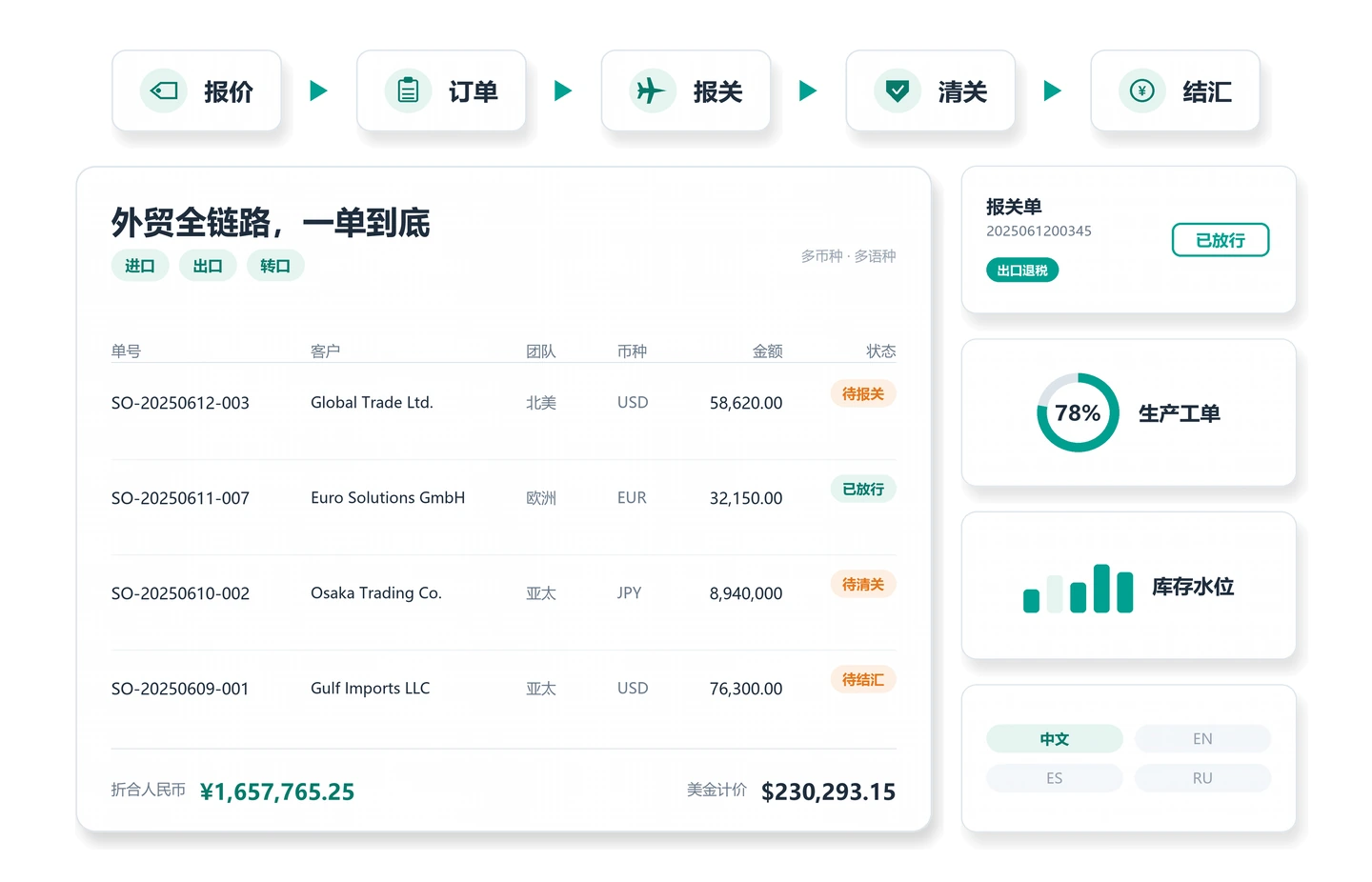
Documents are where an import/export ERP parts ways with a generic one. A single export shipment involves a contract, invoice, packing list, customs authorisation, bill of lading, certificate of origin and settlement write-off; if product name, quantity or currency fails to match anywhere, the tax rebate stalls. Ask at selection time whether these documents are generated by the system or rebuilt by hand in a spreadsheet. For a full blueprint covering cross-border supply chain, customs and rebate documents, see Odoo import/export and foreign-trade AI management platform。
| Comparison dimension | Odoo AiERP | Kingdee Cloud Galaxy | Kingdee KIS Professional |
|---|---|---|---|
| Full export process | Enhanced customs declaration, clearance, settlement and collection across general trade and integrated manufacturing-trade | Standard product leans toward finance-operations integration; foreign-trade flows depend on industry plug-ins or customisation | No standalone import/export module; exports rely on manual documents |
| Cost allocation | FOB/CIF/DDP cost allocation, with freight, insurance and port charges collected into order cost | Import cost collection, duty and landed cost achievable through packages | Purchase costs allocated to inventory; foreign-trade basis limited |
| Single Window | Connects to customs and e-port systems through connectors and local implementation | The app marketplace offers Single Window integration and other foreign-trade plug-ins, billed separately | Outside standard scope |
| Document consistency | Sales orders, invoices and customs data share one source, reducing duplicate entry | Mature business-finance linkage; foreign-trade documents need package work | Finance and business documents share one source; the foreign-trade document chain is missing |
| Trade modes | General trade, integrated manufacturing-trade, cross-border e-commerce, transit trade and goods in transit | Dedicated industry packages for self-operated and agency import/export, processing trade and transit | Mainly domestic purchase and sale |
| China invoicing | Leqi e-invoicing, tax bureau interfaces and export rebate data, with invoices linked to orders and traceable | Mature invoicing and tax management; export rebate needs a plug-in | Meets domestic bookkeeping and filing |
Capability 6: Integrated manufacturing and trade, from order to rebate
The pain point for integrated manufacturing-trade firms is not whether a BOM exists, but whether a sales order can directly drive scheduling, material issue, work reporting, customs declaration and rebate, with the whole flow in one database. The Odoo ecosystem keeps MES and ERP together: operation reporting, piece-rate and hourly wages, batch traceability and kitting all share one database with sales, inventory and purchasing, so production data needs no second import. To assess manufacturing depth, see the 2026 open-source MES selection guide (5 solution types, 12 acceptance metrics) and the full Odoo MRP manufacturing flow。
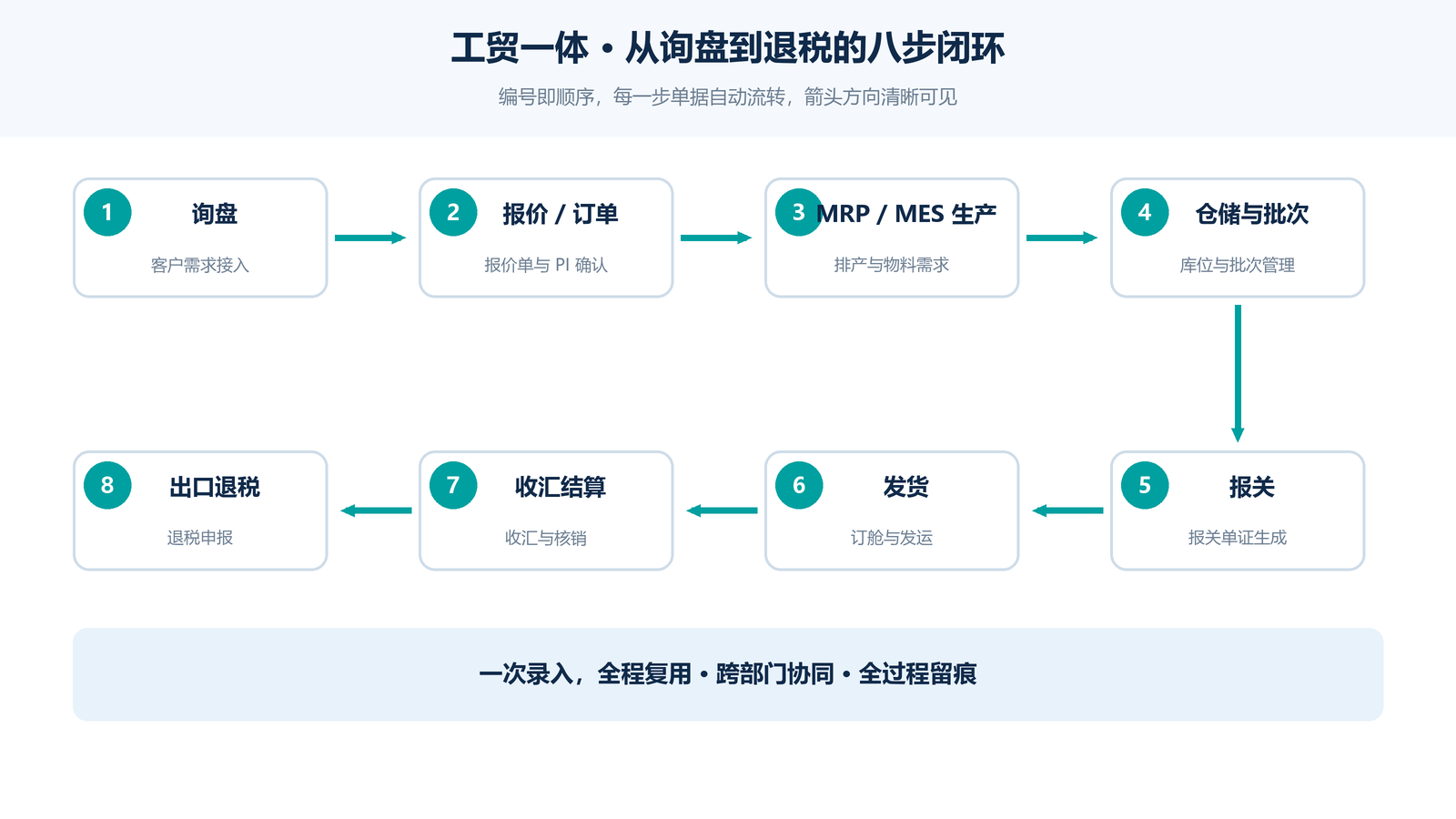
| Comparison dimension | Odoo AiERP | Kingdee Cloud Galaxy | Kingdee KIS Professional |
|---|---|---|---|
| Planning and scheduling | MRP and make-to-order with shop-floor scheduling; flexible manufacturing suits high-mix low-volume | Advanced APS scheduling and multi-plant manufacturing collaboration | Simple make-to-order production planning |
| Shop-floor execution | MES operation reporting, piece-rate and hourly wages, kitting and batch traceability, sharing one database with ERP | Manufacturing execution and quality traceability with a complete smart-manufacturing solution | Simple production and outsourcing; weak shop-floor execution |
| Quality inspection and traceability | Incoming, in-process and outgoing inspection with a non-conformance loop, meeting evidence needs of cross-border orders | Full quality management process with traceability and compliance support | Basic inspection with limited evidence capability |
| Cost accounting | Material, labour and overhead collected by work order, with export costs allocated to orders | Multiple costing entities with refined cost management | Basic costing such as job costing and process costing |
| Flexible customisation | Studio low-code extends BOM, operations and approval flows, maintainable by business users | Platform-level customisation and industry packages | Limited extension capability |
| Domestic and export collaboration | Domestic, export and cross-border e-commerce orders in one database, with inventory and finance on one basis | Mature multi-entity collaboration; foreign trade needs package configuration | Mainly domestic sales |
Capability 7: Transit trade and goods in transit, the Bay Area's differentiator
Qianhai, Nansha, Hengqin and the Hainan Free Trade Port host a dense cluster of transit-trade companies. Transit trade is about controlling title and trade documents: goods move from the producing country through an intermediary in a third country to the consuming country, and the intermediary earns the spread by switching bills of lading, obtaining a new certificate of origin and issuing new invoices to avoid trade barriers. This model involves two international settlements and two document sets, placing extreme demands on data consistency.
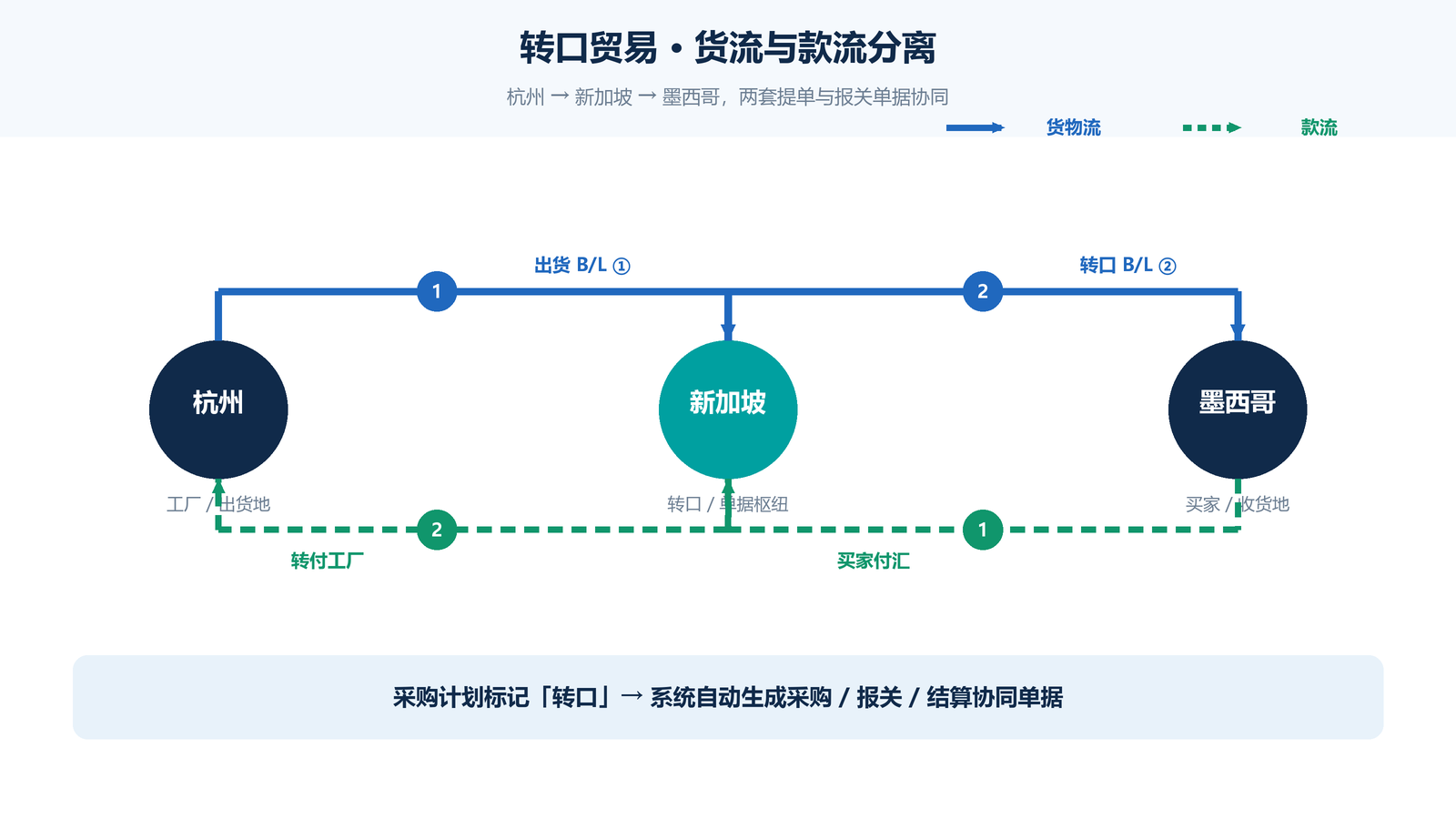
A public case documents a verifiable implementation path. The Mexican company raises a purchase plan marked as transit trade and names Singapore as the transit company. The system generates a sales plan and sales order for the Hangzhou head office, with Singapore as the customer and Mexico as the end customer. After Hangzhou completes the regular export and raises the customs declaration, the Generate Intercompany Purchase Order action automatically creates the Singapore purchase order. Once the Singapore transit purchase order is confirmed, a non-transit sales order is generated automatically, followed by the Mexico purchase order, and Mexico runs a normal import process. Pricing follows each company's margin strategy, with tax referenced to each company's and product's default tax.
| Comparison dimension | Odoo AiERP | Kingdee Cloud Galaxy | Kingdee KIS Professional |
|---|---|---|---|
| Multi-entity collaboration | Purchase plans, sales plans, sales orders and purchase orders flow automatically across three companies | Mature multi-entity collaboration; transit trade needs industry package configuration | No cross-entity business chain support |
| Transit flag | Purchase plans can be flagged as transit with a designated transit company, generating intercompany documents automatically | Requires custom document types and flows | Not covered |
| Title and documents | Two bills of lading, certificate of origin, invoice and packing list, and customs data managed in one system | Document management achievable through foreign-trade plug-ins | Manual documents |
| Pricing and tax | Margin strategy set per company, with independent tax settings per company and product | Complete pricing and tax framework; cross-entity strategy needs configuration | Single-entity pricing |
| FX gain and loss | Two international settlements with automatic multi-currency revaluation and month-end FX closing | Automatic multi-currency FX gain and loss calculation | Manual adjustment required |
| Applicable region | Free trade zones, bonded warehouses, light processing and transit-heavy manufacturing-trade firms | Large transit and commodity trading groups (industry package) | Not applicable |
Case source: Odoo applications in import/export and transit-trade enterprises (odooai.cn, published 3 Nov 2025, updated 25 Nov 2026).
Capability 8: Export tax rebate, multi-currency and settlement
Exchange-rate swings eat straight into trading margin. A workable system must show both transaction and company currency on one document, update rates on policy, compute FX gain and loss automatically at month end, and turn customs declarations and input invoices into rebate filing data. The operative word is automatic: manual exports mean errors and overtime.
| Comparison dimension | Odoo AiERP | Kingdee Cloud Galaxy | Kingdee KIS Professional |
|---|---|---|---|
| Multi-currency accounting | Multi-currency and FX, foreign-currency bank accounts, with business documents and journal entries on one source | Multi-currency ledgers, fixed, floating or custom rates, and live rate integration | Basic foreign currency; limited deep accounting |
| FX gain and loss | Automatic multi-currency revaluation and FX gain and loss, included in month-end closing | Month-end FX gain and loss calculated automatically with standard vouchers | Usually manual adjustment |
| Export tax rebate | Leqi e-invoicing, rebate data linked to invoices and customs declarations, reducing manual exports | Rebate filing via plug-ins and export industry packages, billed separately | Mainly domestic bookkeeping and filing |
| International settlement | Letters of credit, T/T and D/P recorded, with receipts linked to sales orders | LC management and settlement write-off through foreign-trade packages | Not covered |
| Treasury and reconciliation | Receipts, refunds and reconciliation connected to sales orders and POS, with multi-currency bank reconciliation | Mature treasury, bank-direct connectivity and cross-border cash pooling | Cash and bank journals |
Capability 9: Supply chain, inventory and overseas warehouses
Inventory for a trading firm is spread across factories, domestic warehouses, bonded warehouses and overseas warehouses, and must handle batches, serial numbers, shelf life and safety stock. At selection, check whether multi-warehouse transfers follow a system flow, whether available stock deducts incoming quantities, and whether replenishment rules are configurable. For warehousing detail, see Odoo supply chain SCM: sales, purchase and warehousing and Warehouse management WMS: multi-warehouse, multi-location, batch and expiry。
| Comparison dimension | Odoo AiERP | Kingdee Cloud Galaxy | Kingdee KIS Professional |
|---|---|---|---|
| Multi-warehouse and locations | Multiple warehouses, locations and unit conversions, with transfer and count scanning in sync | Multi-entity multi-warehouse collaboration with stock turnover and smart replenishment | Central and branch warehouses accounted separately; limited scale |
| Batch and traceability | Batches, serial numbers, expiry dates and quality traceability in one place | Mature batch and quality management with traceability | Basic batch and shelf-life management |
| Picking and scanning | Mobile scanning and RFID, wave picking, FIFO/FEFO removal strategy | Barcodes and mobile apps, configured per package | Mainly manual order entry |
| Landed cost | Landed cost connected to inventory valuation, with costs allocated down to batch level | Mature import cost collection and landed cost calculation | Automatic purchase cost allocation |
| Replenishment and forecasting | Safety stock rules, make-to-order replenishment and automatic historical replenishment suggestions | Smart replenishment, demand forecasting and supply chain collaboration | Safety stock alerts and basic purchase suggestions |
| Overseas warehouses | Multi-country warehouse stock synced in real time with e-commerce orders, with cross-border orders on the same ledger as ERP | Requires integration with an overseas warehouse system | Not covered |
Capability 10: Human resources and office operations, from attendance and payroll to ESG
People operations at an integrated manufacturer are far more complex than at a pure trading house: shop-floor piece rates, store shifts, overseas-warehouse time zones and cross-province social insurance all belong in the system. Odoo 20 ships human resources as one connected line — employee records, contracts, attendance, time off, payroll, recruitment and appraisals in a single database, wired into finance and operations: an approved expense report generates a vendor bill automatically, and reported hours flow straight into project and production costs. The official handbook covers attendance hardware, work-entry rules and salary configuration, starting from Attendance management and Payroll management.
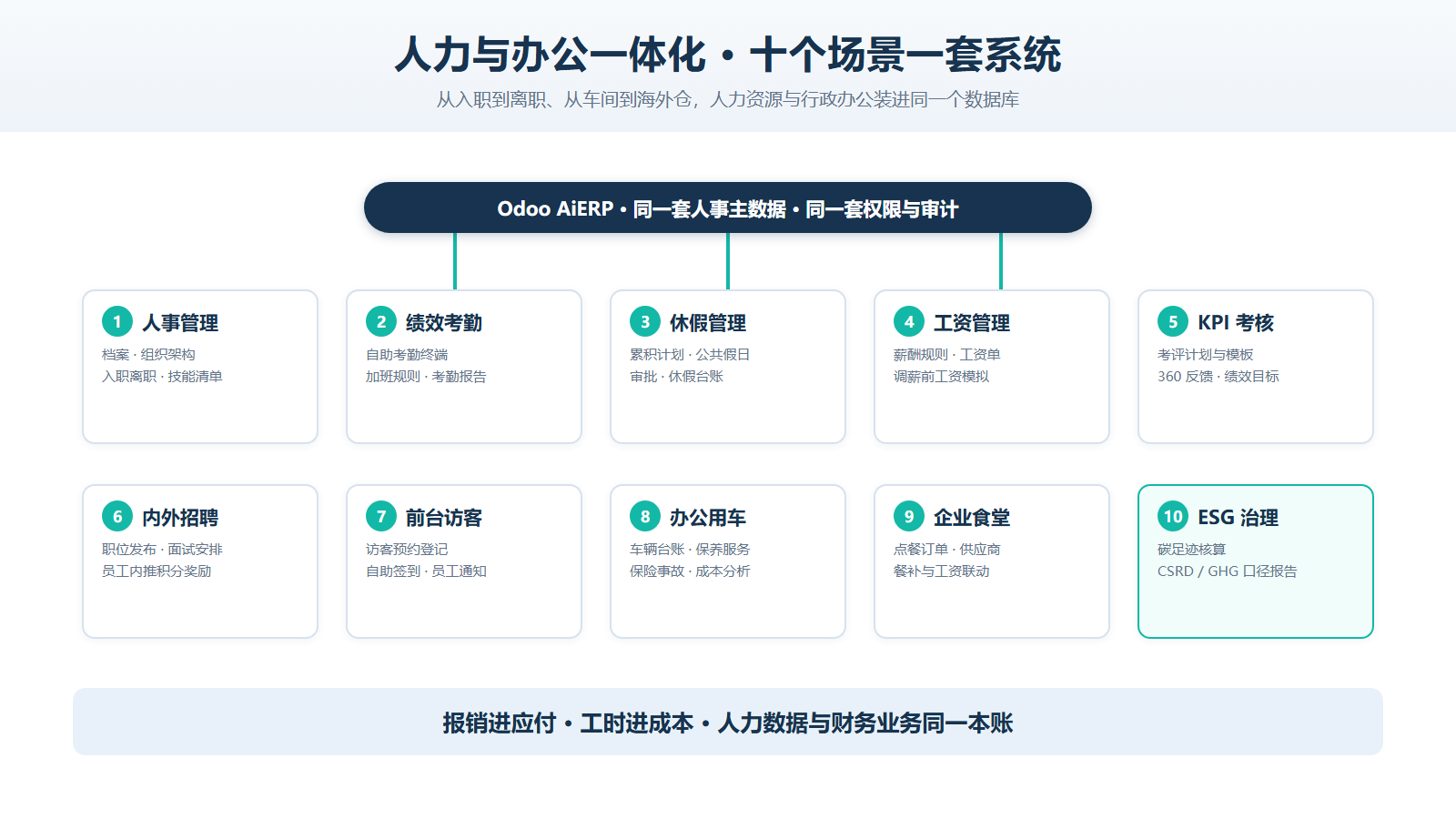
| Comparison dimension | Odoo AiERP | Kingdee Cloud Galaxy | Kingdee KIS Professional |
|---|---|---|---|
| Employees | Employee records, department structure, onboarding and offboarding, skills inventory and equipment ownership in one place; HR data shares the business database | Mature organisation and people module; deep HR scenarios usually move to s-HR | Basic staff records only |
| Attendance | Check-in/check-out, self-service kiosk terminals, overtime and timeout rules, attendance reports; connects to hardware such as BioTime | Attendance and shift scheduling available, implementation-dependent | Not covered |
| Time off | Time-off types, accrual plans, public holidays and mandatory days, approvals and leave ledger, balances feed payroll in real time | Complete leave policy and approval flows, configured per plan | Simple leave records |
| Payroll | Contracts, salary rules, work entries, payslips and batch pay runs; attendance and leave roll up automatically; Odoo 20 adds a salary simulator before raises | Strong payroll configuration, delivered through implementation | Paysheet calculation mainly |
| Appraisals | Appraisal plans and templates, 360 feedback, goals and skills evolution, linked to training and pay | Appraisals support goals and ratings; deeper needs go to s-HR | Not covered |
| Recruitment | Job posting, applicant funnel, interviews and source analysis, plus employee-referral points and rewards | Complete recruitment and talent-pool modules, often selected separately | Not covered |
| Front desk | Visitor invitations, registration, self check-in and staff notifications, in the same database as office workflows | Third-party or industry solutions | Not covered |
| Fleet | Vehicle registry, services, insurance and accidents, odometer and cost analysis; fleet costs land in finance directly | No standard fleet module; third-party or custom work | Not covered |
| Lunch | Vendors, menus, orders and employee accounts; meal allowances link to payroll | Third-party or industry solutions | Not covered |
| ESG | Native ESG app since Odoo 19: automated carbon footprint, gender pay-gap tracking, double-materiality assessment, aligned with CSRD, ESRS and GHG Protocol | ESG mainly disclosure reports and industry solutions, needs dedicated work | Not covered |
Three questions to score an HR suite
Can it connect to our attendance hardware out of the box? Can HR maintain salary and piece-rate rules themselves? Do HR and finance share one ledger? Three answers tell you how many extra systems and interfaces you would have to buy.
Capability 11: Native AI integration and agents (AI features)
AI has moved past the stage of impressive demos and vague deployment. What a trading company actually needs is not another chat window, but an agent that can read its own quotations, customs declarations, inventory and receivables, and it must share the same data, permissions and audit trail as the ERP. Odoo AiERP builds AI directly into the ERP: Guangzhou OdooAi Intelligent Technology Co. provides 17 app_ai series modules, covering multi-model access, AI employees, OCR recognition, document RAG, AI writing and SEO, and AI prompt buttons for inventory, purchasing and accounting, all on the same database as business data. For a complete rollout plan for Chinese LLMs in domestic enterprises, see Odoo 20 AI extension for Chinese enterprises: full deployment of domestic LLMs, and for the integration steps, connecting the Qwen API. Kingdee's counterpart is Lingee, positioned as an enterprise agent operating system: complete in capability, but a separate platform layer used alongside Cloud Galaxy and Cosmic.
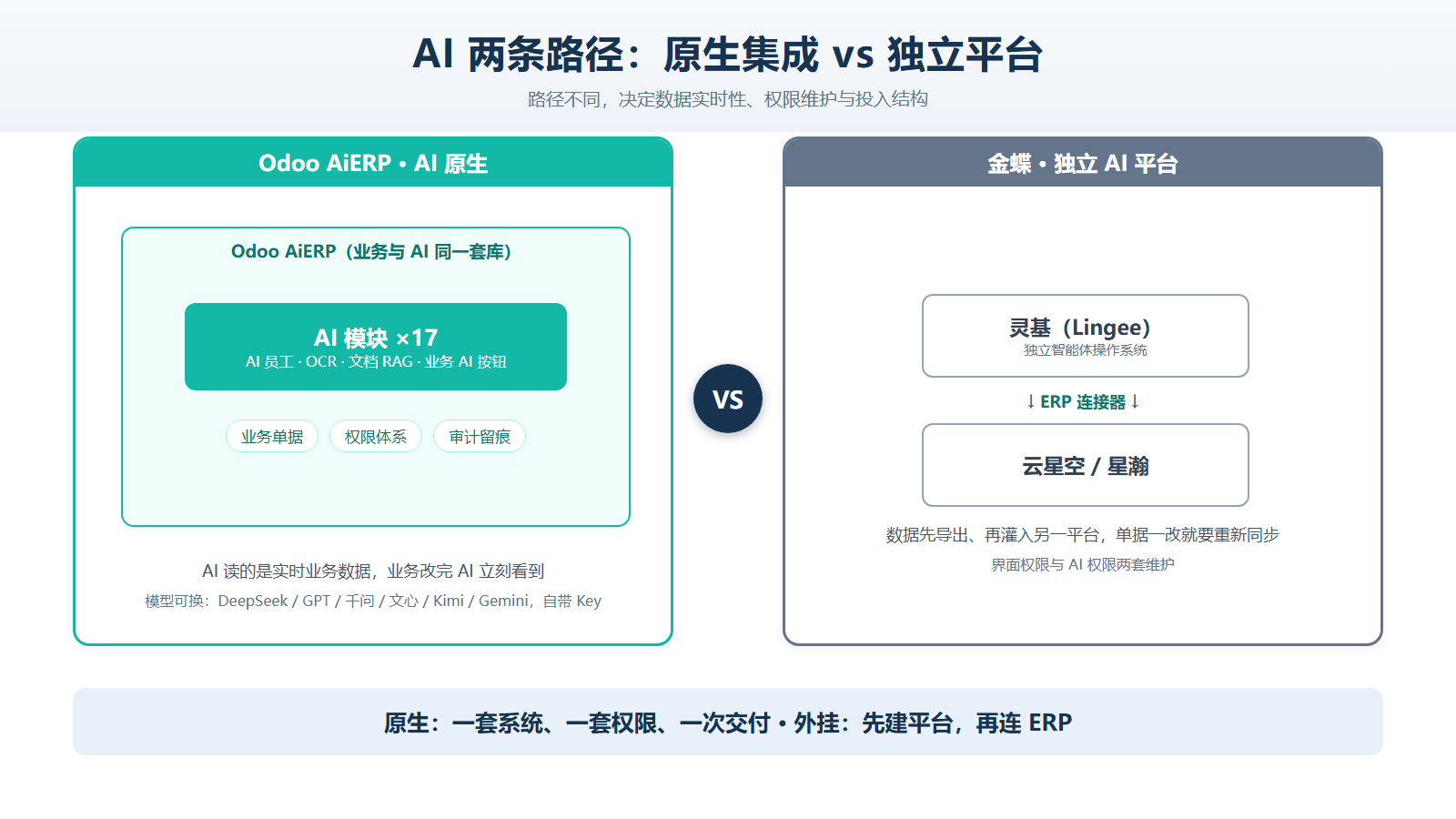
| Comparison dimension | Odoo AiERP | Kingdee Cloud Galaxy | Kingdee KIS Professional |
|---|---|---|---|
| Relationship between AI and ERP | AI modules are installed inside the ERP, sharing one database with business documents, permissions and audit, so AI reads live business data | Lingee is an enterprise agent operating system, a separate platform that connects to Cloud Galaxy and Cosmic through ERP connectors | No native AI; external tools required |
| Model access | Switchable models: DeepSeek, ChatGPT/Azure OpenAI, Alibaba Qwen, Baidu Qianfan ERNIE, Kimi, Google Gemini and Bard, with each company using its own API key and paying the model vendor directly | Lingee supports multiple models, scheduled by the platform | Not covered |
| AI employees and permissions | AI robots bound to users, available in direct and group channels, with allow/deny lists, sensitive-word filtering, demo duration, start/stop and answer-quality scoring, all governed by Odoo's native permissions | Lingee defines agents by role, skill, knowledge and task, with tiered permissions and traceable operation logs | Not covered |
| Document and image recognition | PaddleOCR image recognition converts images and PDFs to text before entering the AI flow; suited to bulk entry of packing lists, invoices, customs declarations and bills of lading | Agents for expense claims and purchase payment review include receipt recognition and three-way matching | None |
| Documents and knowledge base | AI document sorting: folder prompts drive renaming, tagging and filing; documents become RAG sources for AI agents, with PDF text extracted automatically | Lingee accumulates enterprise ontology and knowledge, connecting private knowledge bases and policy documents for retrieval-augmented answers | None |
| Business AI scenarios | AI prompt buttons built into inventory, purchase and accounting documents (AI SCM); AI proactive acquisition, CRM opportunity capture, social media and live-chat agents (AI Marketing); website AI support and product preview cards | Prebuilt first-party agents for finance, supply chain and manufacturing: expense claims, slow-moving stock, expense review, data analysis, PPT generation, purchase payment review, period-end closing and sales fulfilment | Not covered |
| Content and acquisition AI | AI SEO/GEO bulk generation of titles, keywords and descriptions for products, blogs, pages and static HTML, tuned for ChatGPT, Gemini, Doubao and Qwen AI search; AI media bulk localisation with alt/OG optimisation | AI marketing and content capabilities sit mostly in Lingee and the marketing cloud, enabled module by module | None |
| Extensibility | Fully open source with readable, modifiable code; standard open interfaces for MCP, OpenAI, Claude and DeepSeek, so external agents and in-house tools connect directly | Lingee supports MCP and OpenAPI; extension depends on the platform and the Kingdee ecosystem | None |
| Data security and sovereignty | AI inherits the user's existing permissions by default, and AI and interface permissions can also be set independently; authorisation is enforced at the business model layer, so AI cannot bypass the interface to read or write beyond rights; on-premise deployment keeps data inside the network | Lingee supports containerised and offline deployment, clustering and disaster recovery, with permissions shared with the Kingdee AI suite | None |
| Cost structure | AI modules ship with AiERP, and model usage is paid by the company directly to the vendor on consumption, with no per-seat AI subscription stacked on top | Lingee is a separate product line, purchased and implemented separately, priced by platform, user and module | None |
Two pragmatic judgements. First, whether AI is native or bolted on changes the outcome enormously: bolt-on AI must export data first and load it into another platform, re-syncing after every document change and maintaining two permission systems; native AI reads the same ERP tables, so whatever changes in the business is visible to the AI immediately. Second, models should not be locked in: a trading company may use DeepSeek for Chinese documents, GPT for multilingual email and Qwen for image understanding at the same time. Odoo AiERP allows switching models per scenario with each company's own key, which is a hard requirement in overseas markets with strict data compliance.
There is one more point that is often overlooked yet most damaging when it fails: AI must not become a back door around permissions. In many systems AI runs on a separate account or an administrator token, so quotations, cost and payroll that a user cannot see in the interface come out the moment they ask the AI. Odoo AiERP enforces authorisation at the business model layer: the AI holds exactly the permissions of that user, and what cannot be read cannot be read. AI and interface permissions can also be bounded separately, so what a person may do and what the AI may do are governed apart. Combined with full open source and standard MCP, OpenAI, Claude and DeepSeek interfaces, a company can audit the code itself to confirm there is no back door, and connect external agents without being locked to a single vendor.
Odoo 20 ships this road as a factory setting: a native MCP server, read-only by default with permissions fully inherited from the existing system, so external models such as Claude and ChatGPT can connect straight to business data. What used to be an architecture decision made in every project is now a product feature.
Lingee deserves respect: more than 60 agents, over 300 skills, and a first batch of 70 ERP connectors exposing 1,127 tools, with expense, closing and review agents already mature in finance. The difference is the path. Lingee builds an AI platform first and connects the ERP afterwards; Odoo AiERP grows the AI inside the ERP. The former suits groups already deep in Kingdee products that are willing to fund a separate AI platform; the latter suits integrated manufacturing-trade exporters who want one system, one permission model and one delivery to put AI to work.
Capability 12: Pricing structure and total investment
ERP cost is not just the software list price; it includes licensing, implementation, custom development, training, support and future migration. The three products follow completely different logics: Odoo AiERP charges a one-time fixed fee with no annual licence, with catalogue-priced customisation packages and optional rather than bundled annual maintenance; Kingdee Cloud Galaxy stacks annual subscription fees with modules and user counts; Kingdee KIS Professional is bought per module and concurrent user. The figures below come from public channels and are indicative only; the vendor's formal quotation prevails, with public pricing detail at Odoo pricing: community versus enterprise editions, and the delivery rhythm at the five-stage Odoo implementation process。
| Comparison dimension | Odoo AiERP | Kingdee Cloud Galaxy | Kingdee KIS Professional |
|---|---|---|---|
| Pricing logic | one-time fixed fee, with on-premise delivery and auditable source; no annual licence, so users and modules are not billed year after year and cost does not rise with headcount | Public cloud base package billed annually, with modules and users stacking each year; private cloud costs more | One-time purchase per module and concurrent user, relatively affordable |
| Licence model | Perpetual licence: sign once and use long term; on-premise deployments need no annual renewal to keep the right to use | Mainly subscription; stop renewing and the right to use is lost; private deployment by separate agreement | Perpetual licence, but version upgrades and new modules are charged separately |
| Customisation packages | Standard packages divided by business scenario, priced in a published catalogue, with scope, deliverables and acceptance criteria written out item by item, chosen as a package rather than open-ended day rates | Implementation and custom development quoted per project or per person-day, with many stacking items | Limited customisation; anything beyond standard features needs custom development |
| Annual maintenance | optional and unbundled: buy annual support when needed, or carry only internal IT cost otherwise; with source code in hand you can also self-maintain or change provider | The cloud subscription already includes operations, so it is mandatory | Usually an annual service fee or dependence on channel support |
| Public reference | Free trial and selection advice, with packages and implementation process published on odooai.cn, and quotations listing each cost component | In the Kingdee Cloud Cosmic app marketplace, the Foreign Trade Management System buyout edition lists a base price of RMB 90,000 for self-operated export plus RMB 900 per user, and Single Window integration from RMB 20,000 | Channel prices roughly from several thousand to tens of thousands of RMB, implementation billed separately |
| Globalisation cost | Localisation for 160+ countries configured per target market, with no need to buy local software and no extra licence fee for adding a country | Overseas localisation and foreign-trade plug-ins are mostly priced separately | Weak overseas capability; rework cost may exceed the software price |
| Hidden cost | Financial customisation scope and package boundaries must be defined to avoid later change requests, but there is no risk of annual licence increases | Module stacking, upgrade and custom development costs must be locked early, and long-term subscription spend grows with headcount | Scaling usually brings a full migration cost |
| Suitable scale | From integrated manufacturing-trade to large groups, operating in several countries | Growth companies to groups with higher revenue and multiple entities | Small business with lower revenue and headcount |
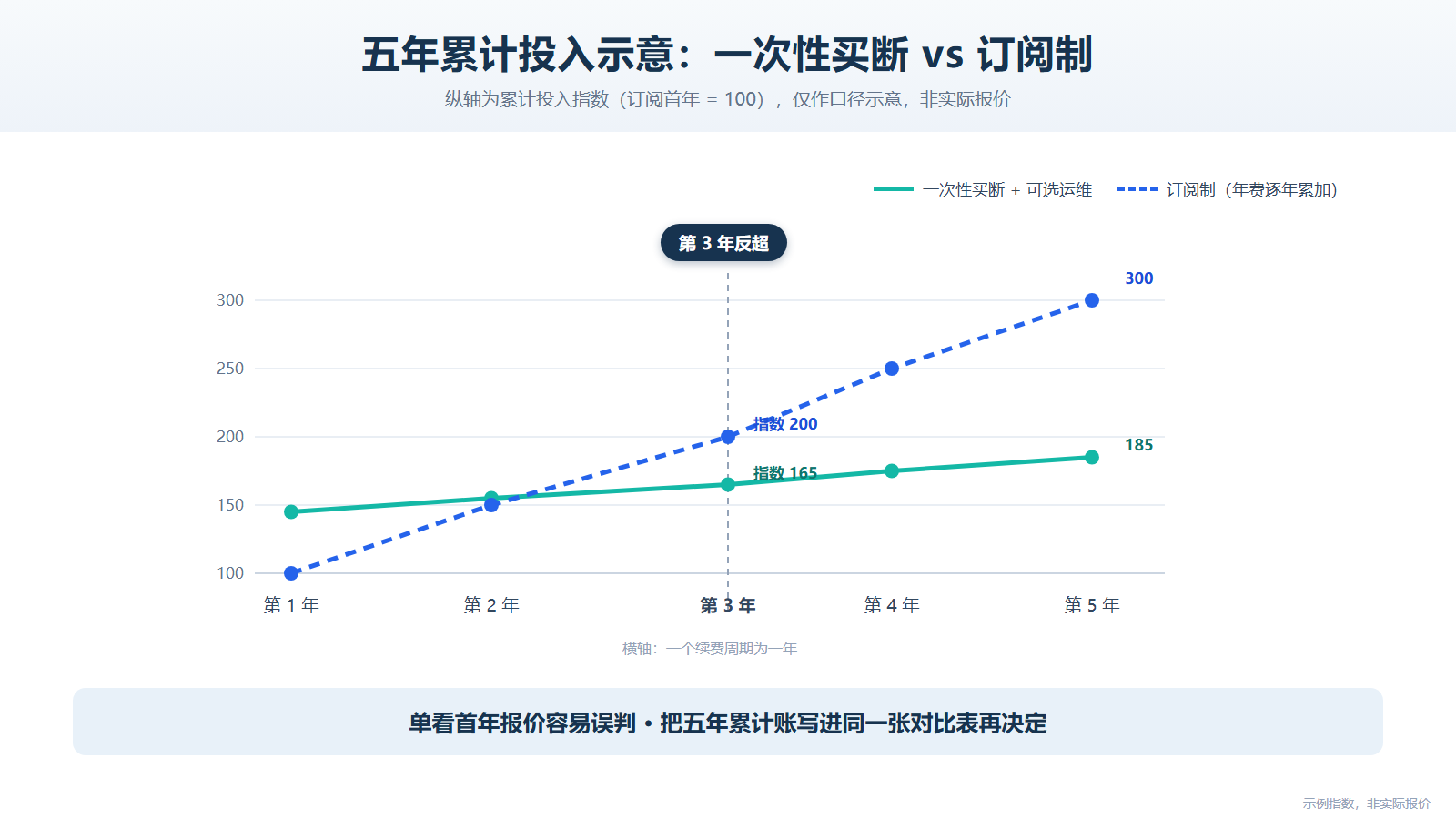
A five-year calculation makes it clearer: subscription spend grows with users and modules each year, and cumulative outlay usually passes a one-time buyout by the third or fourth renewal, while a one-time fixed fee leaves only optional annual maintenance as marginal cost in year five. Once a trading company scales and adds overseas entities, the gap widens further, which is why larger integrated manufacturing-trade firms in the Greater Bay Area lean toward buyout with source-code control.
Recommendation
Put the one-time fee, packages, custom development, migration and five-year cumulative maintenance into a single comparison table before deciding which is cheaper. Judging on the first-year quote alone is easily misleading.
How do you accept the system? Tick 12 items before go-live
Do not judge a system by how smoothly a demo clicks. Run one real export order through the 12 items below. Each item needs a specific document, a named role and a concrete result to pass. The list can go straight into an RFP or acceptance form, so that key flows do not end up back in spreadsheets after go-live.
| # | Acceptance item | How to test | Warning sign |
|---|---|---|---|
| 1 | Multi-currency quotation | Issue real quotations in USD, EUR and one Middle East currency; check currency, discount, validity and print template | Re-entering prices or rebuilding templates for each currency |
| 2 | Multilingual documents | Switch English, Spanish or Arabic and check product names, specifications, units, terms and PDF output | A separate spreadsheet for each language |
| 3 | Live bank rates | On the same day, compare the rate used in quotation, order, payment and month-end revaluation | Three different rates copied by hand |
| 4 | Full export chain | Trace one order from contract, invoice, packing list and customs declaration through bill of lading, settlement and rebate | Any step needs Excel or another system to fill the gap |
| 5 | Rebate documents | Check whether customs declarations, input invoices and rebate filings link automatically | Month-end export and line-by-line manual matching |
| 6 | MRP and MES | Let a sales order drive BOM, material calculation, picking, work reporting and receipt | Production in another system; order status by phone |
| 7 | Batch and serial traceability | Trace a finished good back to raw-material batch, supplier, quality record and customer shipment | Warehouse ledgers or chat history used for recalls |
| 8 | Multi-company consolidation | Post one intercompany transaction across two companies; check elimination, FX translation and consolidated statements | Finance downloads several report sets and combines them |
| 9 | AI permission boundary | With a sales account, ask for payroll, cost and another owner's customers; confirm refusal and an audit record | The AI answers everything because it uses an admin account |
| 10 | Mobile warehouse scanning | Use a phone for receipt, put-away, transfer, picking and cycle count; check live stock | Data entry only on a PC; scanning is decorative |
| 11 | Kingdee or third-party sync | Run a two-way sync of customers, accounts, entries or orders; check field mapping and retry on failure | CSV export only; conflicts cannot be located |
| 12 | Five-year cost | Put licence, implementation, customisation, migration, training and annual maintenance on one sheet and total five years | A first-year price now, with additions negotiated during the project |
Three hard rules for acceptance
Use real data, not demo data; let end users operate, not pre-sales; keep screenshots, document numbers and a named sign-off for every item. Do these three and the selection conclusion will stand.
Frequently asked questions from Greater Bay Area trading companies
Look at globalisation and the business chain first, price later. A trading company must first confirm whether the system can quote in the target market currency, invoice under local tax rules, issue documents in the local time zone, and connect inquiry, customs declaration, settlement and rebate into one chain. Where these are missing, a cheap system still needs spreadsheet workarounds after go-live and costs more in total. Only a price comparison made last is meaningful.
The core difference is global coverage and deployment control. In Odoo AiERP, multi-language, multi-currency and multi-time-zone support are core capabilities, layered with localisation for 160+ countries, open-source on-premise deployment and source-code control, with import/export and transit trade built as enhanced modules. Kingdee Cloud Galaxy is strong in multi-entity finance, group consolidation and a mature supply chain, with foreign-trade flows delivered mostly through industry plug-ins and configuration, which suits large groups whose organisations sit mainly in China.
Yes, but full financial accounting is a customised delivery. Odoo's multi-company architecture lets each legal entity keep its own books and currency, then consolidates through account mapping and rate translation; Guangzhou OdooAi Intelligent Technology Co. builds the general ledger, consolidated statements, budgeting and audit trail to your chart of accounts and consolidation basis. Writing the reporting basis and account mapping down at selection time is far easier than fixing them after go-live.
It means localisation rules preset to each target market's tax regime and filing basis, covering currency, tax rates, invoice formats and report templates, so entering a new market does not require another local system. Deployment still requires confirming compliance against local law and actual business practice, and the exact country list and scope follow the vendor's current documentation.
Two different paths rather than a question of strength. Lingee is Kingdee's in-house enterprise agent operating system, a separate platform that reaches Cloud Galaxy and Cosmic through ERP connectors; per Kingdee it already ships more than 60 agents and over 300 skills, with a first batch of 70 ERP connectors and 1,127 tools, and its expense, closing, expense-review and slow-moving-stock scenarios are genuinely mature. Odoo AiERP takes the AI-native route: 17 app_ai series modules installed directly in the ERP, so the AI reads the same business tables and uses the same permissions and audit trail without exporting data to another platform first. At the model layer it switches freely between DeepSeek, ChatGPT, Qwen, ERNIE, Kimi and Gemini, with each company using its own key and paying vendors directly, so there is no model lock-in. If you are already deep in Kingdee products and willing to fund a separate AI platform, Lingee fits; if you want one system, one permission model and one delivery to put AI to work, native integration is simpler.
Yes. The OCR module is built on PaddleOCR and converts images and PDFs to text with high accuracy in Chinese and English, after which the text enters the AI flow for field extraction and document entry. The document module also renames, tags and files documents from prompts, and serves them as RAG sources for AI agents. For packing lists, invoices, customs declarations and bills of lading arriving in daily batches, this saves manual entry and entry errors.
No annual licence is required. Odoo AiERP uses a one-time fixed fee buyout model with no annual per-user licence: adding users or modules does not trigger an annual increase, and one contract covers long-term use. Beyond that there are only two optional items. The first is customisation packages, divided by business scenario and priced in a published catalogue, with scope and deliverables written into the contract. The second is annual maintenance, bought as needed and never bundled, and if you skip it you can still self-maintain from source or change provider. Compared with a subscription where stopping renewal removes the right to use, this structure is far more predictable for a manufacturing-trade firm planning five years or more ahead.
Both are native. Multilingual quotations rely on Odoo's multilingual data model: product names, specification text, units, terms and PDF templates are stored per language, and the same quotation is issued in the customer's language in one action with identical pricing and discounts. Live bank rates update automatically from a rate source on policy, and quotations, orders, payments and month-end revaluation share one rate basis, so no one copies rates by hand each day and sales and finance never work from two different rates.
Largely not. Kingdee KIS Professional targets small manufacturing-trade firms, covering finance, purchasing, sales, inventory and simple production outsourcing, mainly on-premise and single-entity, without dedicated foreign-trade documents, multi-currency accounting or export rebate capability. If the export share keeps rising, an upgrade or migration is usually needed within a year.
Yes, but field mapping and opening-balance definitions come first. Odoo AiERP provides connectors for Kingdee Cloud Galaxy and Kingdee KIS that carry customers, items, balances and historical documents. Migrate in stages, starting with customers, suppliers, inventory and open orders, and run both systems in parallel for a month to reconcile stock movements and balances before switching over.
Use one real export order. Prepare a sample with a multi-currency quotation, customs documents and a rebate requirement, run the full flow from inquiry to settlement in the trial environment, then have sales, finance and warehouse sign off separately. That shows within days whether the system fits your process, rather than judging a demonstration screen.
Data basis and next steps
This comparison draws on the Odoo Community, Enterprise and AiERP edition notes, the Odoo AiERP product page, the Odoo 20 documentation, the transit-trade application case, and public Kingdee website and app-market materials, with data as of November 2026. Product features, country lists and prices follow each vendor's current formal proposal; currency rates, rebate percentages and cost calculations mentioned here illustrate methodology only and are not a business commitment.
If you are choosing an ERP for import/export in the Greater Bay Area, run one real order first: take inquiry, quotation, customs declaration and settlement through the system, then score it against the comparison tables and the 12-point acceptance checklist in this article. Guangzhou OdooAi Intelligent Technology Co. can turn your business scenario into a one-page selection recommendation, without pitching unrelated modules.
If you forward one paragraph, send these four
To the owner: If you sell in several countries, run manufacturing and trade, and want AI reading live ERP data, benchmark Odoo AiERP first. If China-centred multi-entity consolidation is the core need, Kingdee Cloud Galaxy is the smoother fit.
To finance: Ask three questions: are multi-company eliminations automatic, is FX revaluation automatic at month-end, and are rebate documents assembled from customs declarations and input invoices?
To IT: Ask whether AI inherits the user's permissions, whether it can be read-only, and whether it connects to MCP and external models. Do not let AI become a new admin back door.
To the export lead: Run one real order through inquiry, quotation, customs, clearance, settlement and rebate. Any step that still needs Excel is a post-go-live trap.
Save the card and forward it to the selection group
Run one real order through it before you decide
Prepare a sample covering multi-currency quoting, customs documents and rebate requirements, run the full flow from inquiry to settlement in the trial environment, then have sales, finance and warehouse sign off separately.
Free trial environment One-page selection advice No pitching of unrelated modules